Finding B2B prospects is faster and more accurate with AI. Instead of spending hours on manual research, AI tools can identify, verify, and qualify leads in minutes, boosting sales efficiency and improving conversion rates by up to 25%. Here's how AI transforms B2B contact identification:
Platforms like Leadsforge simplify the process with features like chat-based search, multi-source data enrichment, and verified contact details. By leveraging AI, companies improve lead quality by 30-50%, save time, and increase reply rates by up to 50%.
Want smarter, faster prospecting? AI tools can help you focus on leads that matter most.

5-Step AI-Powered B2B Contact Identification Process
In the past, creating an Ideal Customer Profile (ICP) was a time-consuming task, requiring weeks of manual data collection and analysis. But AI has changed the game. By analyzing patterns within your existing customer base, AI identifies the attributes that matter most - like industry, company size, revenue range, and location.
The biggest benefit here? Speed and accuracy. AI drastically shortens the process, aligning firmographic and technographic data to your best customers in no time. This not only saves you hours of work but also results in a more precise, data-backed profile. Here’s how AI makes refining your ICP faster and more effective.
Thanks to conversational AI, creating an ICP has become almost effortless. Forget about clunky filtering tools - modern AI platforms let you describe your ideal customer in plain language. For instance, with tools like Leadsforge, you can simply type something like, "Marketing managers in tech companies in the USA", into a chat-style interface. The AI instantly converts this description into detailed search criteria. At the same time, the platform pulls data from multiple sources to fill in any gaps, ensuring your ICP is as thorough and accurate as possible.
AI takes a deep dive into two key data sets: firmographic data and technographic data. Firmographic data focuses on company-level details - such as industry, employee count, annual revenue, location, and funding status. Technographic data, on the other hand, reveals a company’s technology stack, from CRM systems and marketing tools to cloud infrastructure and other software.
(function(d,u,ac){var s=d.createElement('script');s.type='text/javascript';s.src='https://a.omappapi.com/app/js/api.min.js';s.async=true;s.dataset.user=u;s.dataset.campaign=ac;d.getElementsByTagName('head')[0].appendChild(s);})(document,372145,'tlb9tturzitublbka5ay');
After defining your ICP, AI steps in to identify companies that fit your criteria by scanning vast databases. It filters prospects based on core attributes like industry classification codes (NAICS or SIC), employee count, annual revenue, and geographic location. The outcome? A refined list of prospects that closely align with your ICP.
But AI doesn’t just stop at basic filtering. It digs deeper, spotting growth indicators such as recent funding rounds or hiring trends. For instance, a SaaS company that recently secured Series B funding and is actively hiring could be a high-priority lead. This next step ensures that AI aligns prospect data with your ICP for targeted outreach.
Using your ICP as a foundation, AI combines multiple data layers to create a comprehensive picture of potential prospects. Firmographic data outlines a company’s profile, while technographic data reveals the technologies they use. Together, these layers allow for precise matching.
Consider the difference between a 10-person startup and a 10,000-person enterprise - their needs and priorities are worlds apart. AI ensures your focus stays on companies that genuinely fit your criteria. It can even highlight opportunities to engage prospects currently using a competitor’s solution, opening doors for competitive displacement.
However, no data source is perfect. B2B data decays at an average rate of 22.5% per year, meaning about 2.1% of firmographic data becomes outdated every month. For example, employee counts from LinkedIn might not match actual payroll numbers, and revenue estimates for private companies often vary across data providers. Relying on a single source can lead to gaps and inaccuracies.
With data decay and inconsistencies being inevitable, enrichment becomes a critical step. Waterfall enrichment improves accuracy by pulling information from multiple data providers in sequence. Platforms like Leadsforge automate this process, verifying details across various sources. If one provider lacks specific information - such as a company’s revenue or tech stack - the system moves to the next source until the profile is complete. This multi-source strategy ensures you’re working with the most current and accurate data available.
The impact of this approach is clear. Companies with well-defined ICPs achieve account win rates that are 50–70% higher than those casting a wider net. Accurate, enriched data not only makes your outreach more relevant but also helps your messaging hit the mark, improving close rates. Plus, high-quality data reduces email bounce rates, protecting your sender reputation and keeping your domain in good standing for future campaigns.
For the best results, combine firmographic data (who they are), technographic data (what they use), and intent signals (what they’re doing). This layered approach provides a complete view of each prospect and helps you time your outreach for maximum impact.
Once you've matched prospects to your Ideal Customer Profile (ICP), the next step is identifying those actively searching for solutions. This is where intent signals and behavioral analysis come into play. By examining digital footprints across websites, social media, and third-party platforms, AI uncovers when prospects are most interested and ready to engage.
The impact of this approach is striking. Companies leveraging AI-driven behavioral insights report 50% higher reply rates in outreach campaigns. Even more impressive, responding to leads within an hour can increase conversions by up to 7x. These aren't just incremental improvements - they're game-changers, helping you connect with decision-makers at the exact moment they're evaluating solutions.
Let’s dive deeper into intent signals and how behavioral data sharpens lead qualification.
Intent signals are digital breadcrumbs that indicate a prospect’s readiness to buy. These can include actions like visiting pricing pages, downloading whitepapers, submitting demo requests, or conducting searches for specific solutions. AI collects and analyzes these signals from various sources, including website analytics, CRM systems, social media interactions, and third-party data, to rank prospects based on their likelihood to convert.
For example, 6sense processes over one trillion signals daily through its Signalverse™ platform to identify accounts showing strong buying intent. Similarly, Cognism combines intent signals with contact data to highlight high-intent leads while adhering to GDPR and CCPA regulations. Platforms like ZoomInfo and Lead411 enhance this data with contact enrichment to enable real-time prospecting.
Not all signals are created equal. For instance, a prospect repeatedly visiting a pricing page signals much stronger intent than someone casually reading a blog post. AI distinguishes between explicit signals, like demo requests, which require immediate action, and implicit signals, such as occasional content views, which may benefit from automated nurturing until stronger interest develops.
Behavioral change alerts add another layer of insight. AI monitors job changes, funding announcements, and hiring trends to identify prospects entering high-intent phases. For example, contacts in new roles are 3x more likely to make a purchase due to their fresh perspective and potential openness to new solutions. Likewise, if a company secures Series B funding and begins hiring aggressively, it’s a clear signal to engage before competitors do.
Once intent signals are assessed, behavioral analysis takes the lead in refining your approach.
Behavioral analysis helps paint a detailed picture of each prospect’s engagement. AI evaluates key patterns, such as:
Using predictive analytics, AI forecasts the likelihood of conversion and continuously refines lead scoring based on historical data to identify behaviors that lead to successful deals. Real-time updates ensure sales teams reach out when interest is at its peak.
For example, Apollo.io uses behavioral analysis to highlight job changes and engagement trends, resulting in 50% higher reply rates. Meanwhile, Persana's Diamond Data combines verified contacts with intent signals, achieving an impressive 87% connection rate. These platforms showcase how blending behavioral data with intent signals creates a system that prioritizes outreach to the most promising leads.
AI also applies negative scoring to weed out low-quality leads. If a prospect unsubscribes from emails, frequently visits competitor websites, or shows no engagement over time, their score is reduced. This ensures sales teams focus their efforts on high-value opportunities instead of wasting time on cold leads.
Platforms like Leadsforge integrate intent signals and behavioral data into their qualification processes. Their chat-like interface highlights prospects actively showing buying signals. By combining firmographic, technographic, and real-time behavioral insights, these tools help you zero in on prospects at the peak of their readiness to convert.
Finding high-intent prospects is a great start, but incomplete or outdated contact details can throw a wrench in your outreach efforts. Imagine reaching out with an invalid email, a disconnected phone number, or an outdated LinkedIn profile - it's wasted time and might even harm your sender reputation. Poor data quality isn't just inconvenient; it costs businesses an average of $15 million each year. This makes real-time data enrichment and verification a must for effective B2B prospecting.
Using AI for data enrichment goes beyond just filling in the blanks. It transforms basic contact info into actionable insights by pulling firmographic data, technographic details, and verified contact information from multiple sources - all at the same time. Unlike static databases that might only update every 30–90 days, real-time systems validate information as you search. This ensures you're working with the most up-to-date and accurate data. With this in place, you can automate and verify every detail in real time, streamlining your prospecting workflow.
AI tools like Leadsforge take a layered approach, using a waterfall process to verify contact details. They sequentially query sources like LinkedIn, email verification services, and phone directories to ensure accuracy.
For example, Cognism's Diamond Data boasts an 87% connection rate, far surpassing the industry average of 30%. Real-time enrichment can significantly boost connection rates by ensuring that every piece of data you work with is fresh and reliable.
But AI doesn’t stop at finding contact details - it adds depth to them. It enriches basic information like a name and email address with context, such as firmographic and technographic insights, helping you tailor outreach and focus on the right accounts.
To maintain data quality over time, ongoing hygiene processes remove duplicates, fix syntax errors, and update records when prospects change jobs. This periodic cleanup - typically every 30–90 days - keeps CRMs free of clutter and prevents your team from wasting time on inactive leads or catch-all email addresses.
Enrichment is only half the battle; verification is equally crucial to ensure your outreach hits the mark. AI-powered systems use multiple layers of validation to confirm data accuracy in real time. For instance, SMTP checks ping mail servers to verify that email addresses are active and deliverable before a single message is sent. LinkedIn profiles are cross-checked against live profiles to confirm the prospect’s current role, while phone numbers are validated for proper formatting and connection status.
Platforms like Skrapp.io excel at spotting fake or disposable emails, achieving over 97% reliability. This reduces bounce rates and protects your sender reputation, ensuring future emails don’t end up in spam folders - even when targeting legitimate prospects.
Some platforms, like Leadsforge, combine enrichment and verification into a seamless process. For example, when you specify your ideal customer using their chat-like interface, the system doesn’t just provide a list of leads. It validates every email address, LinkedIn URL, and phone number in real time by leveraging multiple data sources. This integrated, multi-layer verification ensures that every lead in your system is actionable, keeping your prospecting efforts efficient and effective.
Once your data is verified, the next step is to focus on prioritizing your prospects. After enriching and confirming your contact data, the challenge becomes identifying those leads most likely to convert. Not every prospect is equally ready to take the next step, and that's where AI-powered lead scoring steps in. Instead of relying on instincts or manual effort, machine learning models analyze hundreds of data points to predict which prospects have the highest potential. This data-driven approach can save teams significant time, reducing wasted outreach efforts by up to 25%, according to Forrester research.
AI-based scoring eliminates the need for hours of manual reviews, delivering results in seconds. This allows sales reps to concentrate on leads with the highest likelihood of converting, rather than pursuing unproductive opportunities.
AI models rely on enriched, verified data and observed prospect behaviors to assign precise lead scores. These scores are calculated by analyzing numerous factors simultaneously - something that would be incredibly time-consuming to do manually. The models evaluate firmographic and technographic data, including details like company size, industry, revenue, and technology stack. But it doesn’t stop there. Behavioral signals - such as website visits, content downloads, email engagement, and social media activity - are also factored into the scoring process.
Take Apollo.io as an example. The platform leverages machine learning to analyze more than 200 million contacts, assigning scores based on metrics like email response rates and social interactions. Recent intent signals, such as job postings or technology adoption, are given more weight than static data like company size. The result is a numerical score, often between 0 and 100, with scores above 80 indicating strong conversion potential.
Advanced algorithms like BERT and GPT enhance this process further by aligning a prospect’s business strategies with your value proposition, improving the accuracy of lead scoring. These models continuously learn from past conversion data, refining predictions over time. For instance, if a lead from a mid-sized tech company adopts a new CRM tool and visits your pricing page multiple times, the AI might assign a score of 92 out of 100 - indicating this prospect should be prioritized immediately. This scoring system provides a solid foundation for predictive outreach strategies.
Predictive analytics takes lead scoring a step further by forecasting future conversion potential based on historical trends. Instead of only identifying who is currently engaged, it predicts which leads are most likely to convert in the near future. This is especially crucial in B2B sales, where buying cycles often span months. By detecting patterns like job changes, technology updates, or spikes in content engagement, predictive models help sales teams prioritize their outreach more effectively.
For example, Apollo’s data shows that prospects who have recently changed roles are three times more likely to convert than those who haven’t. Insights like these enable sales teams to dynamically rank leads, adjusting priorities as new behavioral data becomes available. Tools such as Cognism integrate predictive analytics directly into CRM workflows, automatically flagging high-intent leads for immediate follow-up.
Platforms like Seamless.AI report bounce rates below 10% and a 25% boost in productivity when sales teams focus on high-scoring leads. By combining behavioral insights with predictive forecasting, these tools ensure that outreach efforts are perfectly timed to align with a prospect’s readiness to convert.
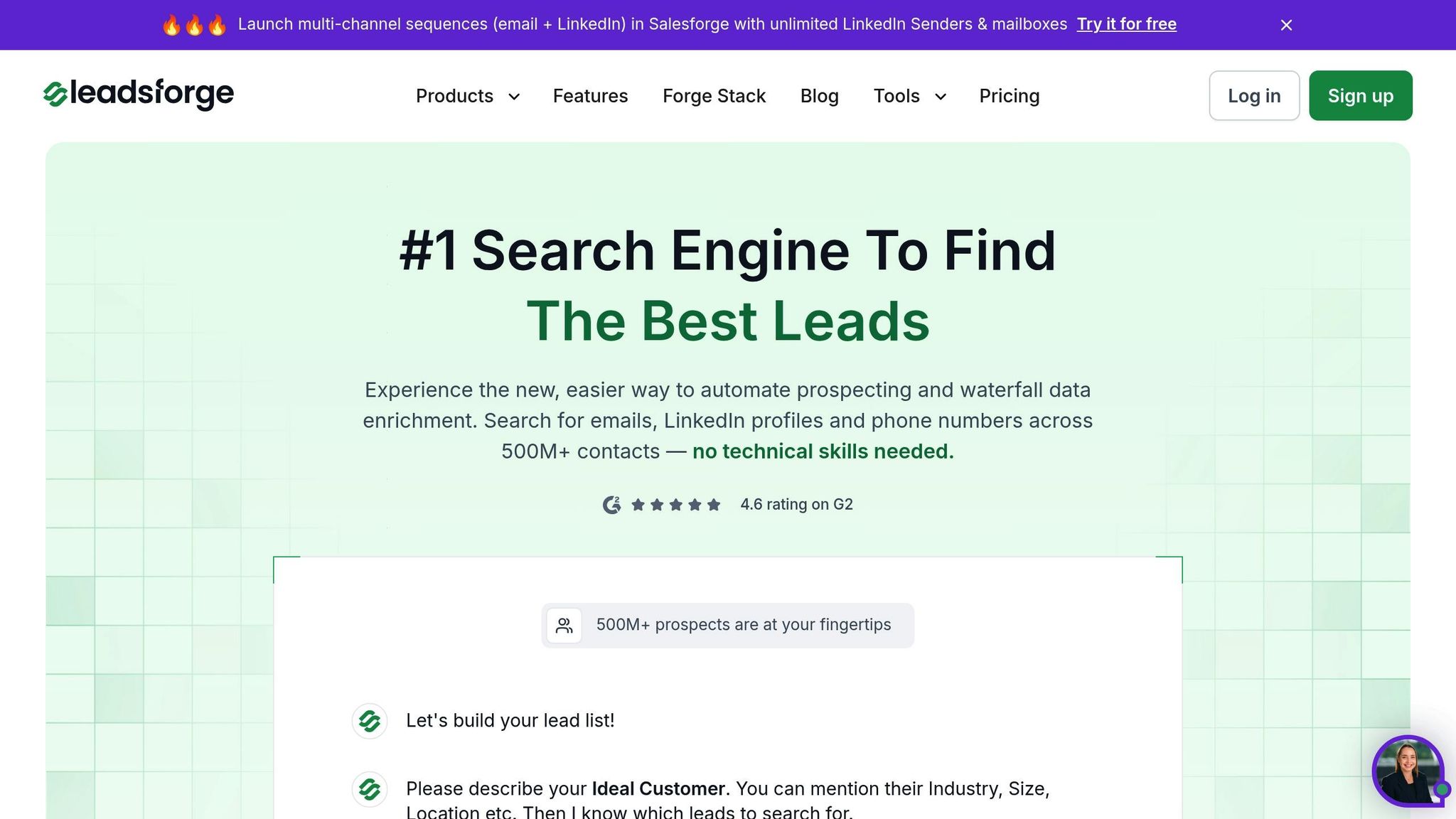
Leadsforge takes the guesswork out of prospect discovery by combining verified data with predictive scoring, all through a chat-based interface. Forget about sifting through endless filters and complicated dashboards - just describe your ideal customer in plain language, and the platform does the rest. By connecting to a vast network of over 500 million global contacts, Leadsforge generates tailored lead lists based on your input. This conversational system simplifies the process, removing the steep learning curve that often bogs down prospecting teams.
The platform’s Waterfall Data Enrichment feature ensures you get accurate and verified contact details by querying multiple data sources. If one source can’t provide an email or phone number, the system automatically tries the next. Emails are validated in real-time, LinkedIn profiles are cross-checked for accuracy, and phone numbers are formatted and verified before being delivered. This layered verification process ensures higher match rates compared to relying on a single data source.
Leadsforge acts like a powerful search engine, bringing together multiple data sources in one user-friendly, chat-like interface. It identifies buying signals and intent indicators - such as website visits, content interactions, and social media activity - to qualify leads before you even reach out. Features like Lookalike Search analyze your existing customer base to find similar high-intent accounts, while the Company Followers tool lets you pull prospects directly from competitors’ LinkedIn pages. These tools turn competitive insights into actionable lead lists.
Leadsforge is rated 4.6/5 on G2 and starts at just $49 per month. This includes 2,000 monthly export credits - where one email costs one credit, and one phone number costs 10 credits. New users also get 100 free credits upon signing up, making it easy to test the platform’s capabilities. With these features and pricing, Leadsforge offers a streamlined way to understand and leverage its core functionalities.
The Company Followers Search feature transforms a company’s LinkedIn followers into a ready-to-use prospect list, complete with verified contact details. Each follower costs just one credit, including their LinkedIn URL.
Lookalike Search digs deeper by analyzing the firmographic and technographic traits of your best customers. Simply input the domains of existing clients, and the AI suggests similar companies that meet the same criteria. What’s unique? The pricing is per company, not per lead. Whether you find five prospects or fifty at a lookalike company, the cost stays the same. This pricing approach encourages more thorough prospecting rather than just scratching the surface.
Leadsforge seamlessly integrates with Salesforge, enabling you to send enriched lead lists directly into email and LinkedIn outreach sequences. This eliminates the usual gap between generating leads and executing campaigns. Once your contacts are identified and verified in Leadsforge, they’re ready for immediate use in Salesforge.
To ensure your emails land in primary inboxes, Warmforge manages email deliverability and warm-up. This is especially useful when scaling outreach to new contacts, as it protects your sender reputation during high-volume campaigns. The Forge Stack also includes Agent Frank, an AI-powered SDR that can autonomously execute outreach strategies using the leads generated in Leadsforge.
These integrations create a smooth, end-to-end workflow - from identifying prospects to launching outreach campaigns. By sharing the same verified data across tools, sales teams can move from "find these contacts" to "start the campaign" in minutes instead of hours. This unified approach streamlines the entire sales process, making it faster and more efficient.
When it comes to AI-powered contact identification, picking the right tool can make all the difference. Each platform - Leadsforge, Apollo.io, Seamless.ai, and Cognism - offers a unique approach to finding and verifying B2B contacts, catering to different needs and markets.
Apollo.io combines a massive database of over 275 million contacts with tools for email sequencing and LinkedIn automation. While it’s a one-stop shop for many, some users have flagged issues with outdated or inconsistent data.
Seamless.ai takes a different route by focusing on real-time validation. Instead of relying on a static database, it searches the web on demand to verify contact information.
Cognism stands out in the European market with its "Diamond Data", which features manually phone-verified mobile numbers. This approach boasts an impressive 87% connection rate, far above the industry average of 30%. With a claimed 98% accuracy in its human-verified data, Cognism is a strong contender for enterprise teams targeting decision-makers in EMEA. However, its pricing is tailored to larger budgets, ranging from $1,500 annually for small teams to over $25,000 for enterprise solutions.
Leadsforge takes a unique approach with its automated multi-source waterfall enrichment. This method queries multiple data providers until verified data is found, improving match rates. It’s also more budget-friendly, starting at $49 per month for 2,000 export credits. Additionally, its chat-based interface simplifies the user experience, eliminating the steep learning curve often associated with prospecting tools.
To better understand how these platforms stack up, here’s a side-by-side feature comparison:
| Feature | Leadsforge | Apollo.io | Seamless.ai | Cognism |
|---|---|---|---|---|
| Primary Strength | Waterfall enrichment & chat-based search | All-in-one database + outreach | Real-time search & verification | Phone-verified EMEA data (Diamond Data) |
| Enrichment Method | Multi-source waterfall enrichment | Database filtering and CSV upload | Real-time web search | CRM, CSV, and API enrichment |
| Database Size | 500M+ contacts | 275M+ contacts | 1B+ contacts (claimed) | 400M business profiles |
| Verification | Real-time waterfall verification | Static database with periodic refreshes | Real-time search engine | Human-verified "Diamond" data |
| Starting Price | $49/month (2,000 credits) | $59/user/month (Basic plan) | $65/user/month (Basic plan) | Custom pricing ($1,500–$25,000+/year) |
| Free Tier | 100 credits on signup | Available | 50 credits/month | Not available |
| G2 Rating | 4.6/5 | Not specified | Not specified | Not specified |
| Best For | Teams needing high match rates without manual filtering | SMBs needing an affordable all-in-one tool | Users wanting to test a generous free plan | Enterprise teams targeting European markets |
This breakdown provides a clearer picture of what each tool brings to the table, helping you decide which one aligns with your prospecting goals and budget.
Incorporating AI into your prospecting workflow is surprisingly straightforward, with most small to mid-sized businesses able to get up and running in just a few days.
The first step is to connect your AI tool to your existing CRM. This integration is critical because 42% of go-to-market teams identify technology gaps and data quality issues as major obstacles to executing their marketing strategies. Before starting, confirm that your AI platform is compatible with your current tech stack. Poor integration is a common reason why 51% of B2B organizations fail to meet their AI investment goals.
For example, Leadsforge simplifies the setup process. Using its chat interface, you can describe your ideal customer profile in plain language, and the platform will automatically generate verified lead lists. Its waterfall enrichment system pulls data from multiple providers until it finds accurate and up-to-date contact information, ensuring your records stay current despite inevitable data decay.
To maintain data freshness, adopt just-in-time verification right before outreach. This approach accounts for the constant decay of contact information, helping you work with verified data that minimizes bounce rates. Non-validated datasets, by contrast, often lead to higher bounce rates.
Once your AI-powered workflow is in place, shift your focus toward tracking the metrics that matter most.
Focus on metrics that directly impact revenue, rather than vanity numbers. One key indicator is your MQL-to-SQL conversion rate - if this rate is low, it may signal that your AI targeting criteria need fine-tuning. Using accurate contact data can increase conversion rates by 66% compared to relying on outdated information.
Other essential metrics to monitor include your email bounce rate (aim for less than 5%), connect rate (the percentage of prospects who respond), and sales cycle velocity (how quickly AI-sourced leads move through your pipeline). AI-powered lead qualification can dramatically improve efficiency, cutting manual scoring time from two hours to just two minutes per prospect. This time savings allows your sales team to focus on engaging with prospects instead of spending hours on research. On average, sales reps lose 500 hours annually - equivalent to about 62 working days - due to poor-quality prospect data.
You should also monitor your find rate, which measures the percentage of contacts successfully enriched with verified data. Multi-source waterfall enrichment systems typically achieve 85-95% find rates, far surpassing the 50-60% match rates of single-source platforms. If your find rate starts to dip, it may be time to reassess your data provider or enrichment strategy.
Thanks to AI-driven platforms, manual prospecting has gone from being a time-consuming chore to a process that can be completed in just minutes. Instead of relying on outdated databases, these tools offer real-time verification and behavioral intent insights that traditional methods often overlook.
Take Leadsforge, for instance. This platform streamlines prospecting with a chat-based interface that transforms customer descriptions into accurate, verified lead lists almost instantly. With access to a database of over 500 million verified B2B contacts and features like company lookalikes and follower searches, scaling your prospecting efforts has never been easier - no extra team members required.
The results speak for themselves. In 2025, UniteSync used The Forge Stack to achieve an impressive 85.26% positive reply rate and a customer acquisition cost of just $2.86. By combining AI-powered contact identification with verified deliverability, their campaigns consistently hit reply rates of 17%. This highlights how the AI-driven strategies discussed in this guide can deliver far better outcomes than traditional manual prospecting or outdated contact lists.
By adopting the techniques outlined here - like real-time verification, regular list updates to counteract data decay, and leveraging AI for buying signals - you can create smarter, more effective lead lists that convert at a higher rate.
Want to see the difference for yourself? Get started with 100 free credits on Leadsforge and experience how an AI-powered contact identification workflow can turn prospecting into an automated, results-driven process that delivers qualified leads in just minutes.
AI takes Ideal Customer Profiles (ICPs) to the next level by sifting through massive datasets - like company size, technology adoption, hiring patterns, and intent signals - to pinpoint trends tied to successful outcomes. What’s more, AI doesn’t just stop there. It continuously learns from closed deals, keeping ICPs current and aligned with shifting market dynamics, while uncovering insights that manual analysis might miss.
Take platforms like Leadsforge, for example. These tools simplify the process by letting users outline their ideal customer. The AI then steps in, enriching this input with verified data, intent signals, and look-alike matches to craft highly accurate, actionable ICPs. This smarter, data-driven approach sharpens lead targeting, cuts down on wasted time, and allows sales teams to zero in on high-value prospects. The result? Higher conversion rates and shorter sales cycles.
Intent signals are actions that hint at a prospect’s interest and buying readiness. These might include visiting pricing pages, downloading white papers, or repeatedly searching for specific solutions. By examining these behaviors, AI tools can identify high-potential leads, allowing sales teams to focus on prospects who are actively researching and more likely to make a purchase.
Leadsforge takes this concept further by continuously tracking and updating lead data with real-time intent signals. It evaluates prospects based on explicit actions - like checking out pricing pages - and implicit behaviors, such as engaging with multiple pieces of content. This approach helps sales teams connect with the right prospects at the right moment, boosting conversion rates and speeding up sales cycles. What sets Leadsforge apart is its focus on real-time, verified intent data, offering a clear edge in pinpointing high-quality leads.
Real-time data enrichment breathes life into outdated contact lists by continuously updating critical details like job titles, phone numbers, and firmographics the moment a prospect's situation changes. Imagine this: a company secures new funding or a prospect interacts with your product by downloading a demo. With data enrichment, your records immediately reflect these changes, allowing sales teams to zero in on leads that show active interest instead of wasting time on stale information.
Tools like Leadsforge elevate this process by sourcing verified data from multiple channels in real time. Simply define your ideal customer, and the platform delivers enriched, qualified lead lists packed with accurate contact details, intent signals, and behavioral insights. The result? Less time spent on manual research, shorter prospecting cycles, and hyper-personalized outreach that accelerates conversions and streamlines your sales pipeline.