Behavioral data is changing how businesses identify high-quality leads. Instead of relying on static details like job titles or company size, it tracks actions like website visits, content downloads, and email interactions. This reveals real buying intent, helping sales teams focus on leads most likely to convert.
Here’s why it works:
To use behavioral data effectively, integrate tools like CRMs, marketing automation platforms, and AI-driven systems. These tools help track actions, sync data, and prioritize high-intent leads. Platforms like Leadsforge simplify this process by combining intent signals, lead scoring, and verified contact data.
To effectively collect and utilize behavioral data, you need a system that captures key signals and consolidates them into a unified lead profile. Here's a breakdown of the tools, integration methods, and privacy practices that can help you achieve this.
To track behavioral data effectively, you’ll need a mix of platforms and tools that work together seamlessly:
The key to success is selecting tools that can communicate with each other. Look for platforms with strong API or native integration capabilities to avoid data silos, which can hinder your ability to create complete behavioral profiles.
Once you have the right tools, the next step is integrating their data streams to gain full visibility into prospect behavior. Combine data from sources like website analytics, email platforms, CRMs, and event tools to create actionable insights. Identify which behaviors each tool tracks and address any gaps in your system.
A data synchronization strategy is essential for ensuring seamless information flow. For example, if a prospect visits your pricing page, downloads a case study, or attends a webinar, those actions should automatically sync with your CRM and update their lead score in real time. This is crucial for B2B sales, where decisions often happen within weeks. Instant alerts for key activities help sales teams act on buying signals at the right moment.
To improve data quality, use a "cascading data enrichment" process. If your primary data source lacks verified contact details, the system queries additional providers to fill in the gaps. This ensures accurate, up-to-date information through real-time checks like email validation, LinkedIn profile confirmation, and phone number verification.
Automated workflows can further streamline your process. For instance, if a prospect visits your pricing page three times in a week, your system could immediately notify your sales team and trigger a personalized email follow-up. This level of automation requires real-time communication between your website analytics, email platform, and CRM - batch updates won’t cut it.
Platforms like Leadsforge simplify these integrations by connecting directly with tools like Salesforge for multi-channel outreach. High-intent leads identified through Leadsforge can be added to email or LinkedIn sequences without manual data exports. This seamless connection ensures that behavioral insights lead to measurable results and makes tracking ROI much easier.
When choosing tools, prioritize those with pre-built integrations for your existing tech stack. This reduces setup complexity and speeds up implementation, helping you create a unified ecosystem where every behavioral signal contributes to a complete lead profile.
Collecting behavioral data comes with legal and ethical responsibilities. It’s essential to implement practices that comply with privacy regulations while maintaining trust with your prospects.
Start by embedding privacy-by-design principles into your system. Ensure you have proper consent mechanisms in place, especially for tracking website activity and email interactions. Prospects should know what data you’re collecting and how it will be used.
Keep your privacy policies clear and straightforward. Avoid legal jargon - use plain language to explain what behavioral signals you track, how long you retain the data, and who has access to it. Offer easy-to-use options for prospects to opt out of tracking if they prefer.
When integrating data from multiple platforms, ensure compliance with privacy frameworks. Vendor agreements should include data protection clauses, particularly if you’re working with third-party providers. Regularly audit your data collection practices to ensure they align with current regulations.
Implement data retention policies to determine how long you store behavioral data. Not every interaction needs to be kept indefinitely - set clear guidelines for archiving or deleting outdated information. This not only supports compliance but also keeps your database manageable and focused on relevant, recent signals.
Your technical infrastructure should support these privacy measures. For example, real-time data processing systems must honor opt-out requests immediately. If a prospect requests their data be deleted, it should be purged from all connected platforms, not just your primary database.
Lastly, validate your compliance regularly. Check that consent mechanisms are functioning correctly and that opt-out requests are processed as expected. Review your data flows to ensure behavioral information isn’t being shared with unauthorized parties or used beyond what prospects agreed to. By prioritizing transparency and compliance, you can build trust while leveraging the full potential of behavioral data.
Once you've gathered behavioral data, the next step is to turn it into actionable lead scores. A solid scoring system ensures your sales team spends their time on prospects who are ready to buy, rather than chasing those who are just browsing.
Many traditional lead scoring methods rely on static details like job titles or company size. Behavioral scoring, on the other hand, focuses on what prospects actually do. It captures real-time signals that reveal when someone is actively exploring a solution.
Here's how to get started: assign scores to specific actions based on how closely they align with buying intent. For example, downloading content might earn 5 points, while requesting a demo could score 10. These scores should reflect where the prospect is in their journey.
High-intent actions - such as visiting a pricing page or requesting a demo - should earn the highest scores (10+ points), as they often signal a prospect is ready to engage with sales. Mid-tier actions, like downloading a whitepaper or comparing features, might be worth 5–7 points since they indicate interest but not necessarily readiness to buy. Lower-value actions, such as reading a blog post or visiting your homepage, might only earn 1–3 points because they typically reflect early-stage awareness.
To refine your scoring, monitor metrics across various touchpoints, including website visits, content interactions, email engagement, and event participation. Incorporating behavioral decay into your model can also help. For instance, a pricing page visit last week is a stronger signal than one from two months ago.
Use your own conversion data to fine-tune point values. For example, if your analytics show that demo attendees convert at 40%, compared to 15% for whitepaper downloads, you should assign demo attendance a higher score to reflect its importance in your sales process.
These scoring methods naturally highlight high-intent actions, which are key to identifying your most promising leads.
Not all behaviors carry the same weight. The difference between a prospect who’s seriously evaluating your solution and someone casually browsing lies in their patterns of engagement, not isolated actions.
High-intent leads often display clustered, sustained activity. For instance, a prospect who visits your pricing page, downloads a case study, and attends a webinar within a single week is signaling strong interest. In contrast, someone who read a blog post months ago and hasn’t interacted since is likely just browsing.
Depth of engagement matters, too. Spending more time on key pages or repeatedly opening emails and clicking links shows genuine interest. On the flip side, a single email open with no further action suggests lower intent.
Another critical factor is conversion velocity - the speed at which leads move through your funnel. Real-time tracking can help you pinpoint prospects who quickly progress from website visits to requesting demos and engaging in sales conversations. This is a strong indicator of buying intent. For leads with mixed signals, like attending a webinar months ago but showing no recent activity, segment them into a "warm" category and target them with re-engagement campaigns.
Understanding how different behavioral patterns relate to deal size can also help your team focus on the leads that are most likely to drive revenue.
Manually reviewing prospect behavior is time-consuming and inefficient. AI tools simplify this process by analyzing massive datasets to uncover which behaviors are most likely to lead to conversions.
Today’s AI systems excel at identifying patterns in buyer behavior. Instead of relying on guesswork or basic rules, these tools learn which actions signal a higher likelihood of conversion. For example, AI might reveal that prospects who visit your pricing page, download technical documents, and open multiple emails within 14 days are more likely to convert than others. These insights allow you to refine your scoring models and uncover trends you might not have noticed otherwise.
Platforms like Leadsforge use AI to streamline lead scoring and qualification. For example, Leadsforge can detect high-intent actions, such as when a prospect starts following your company on LinkedIn, and turn those insights into actionable lead lists. This automation eliminates the need for manual data analysis and ensures your sales team focuses on prospects with real buying potential.
Leadsforge also integrates with multi-channel outreach tools like Salesforge, enabling dynamic, real-time engagement. If a lead visits your pricing page three times in one week, the system can automatically trigger a personalized email or LinkedIn message. By syncing this behavioral data with your CRM and marketing platforms, AI tools provide instant alerts, allowing your sales team to act quickly when a lead shows strong intent. Over time, these systems improve their accuracy, ensuring your resources are allocated where they’ll have the most impact.
Once you've scored your leads based on their behavior, the next step is to group them into specific segments. This allows you to tailor your messaging to match where each prospect is in their buying journey, rather than treating every lead the same.
Leads can generally be divided into three categories based on their behavior: hot, warm, and nurture.
To segment effectively, track behavioral signals across multiple channels, such as website activity, content engagement, email interactions, and event participation. Pay attention to both the recency and frequency of their engagement. For example, a lead who visited your site once a month ago is different from one who’s been active multiple times in the last week.
Tools like Leadsforge make segmentation easier by using built-in intent signals and lead qualification features. For instance, Leadsforge can identify prospects who follow your company on LinkedIn - an important sign of engagement - and integrates seamlessly with multi-channel outreach tools. By focusing on actual behaviors rather than assumptions based on job titles or company size, you can create targeted outreach strategies that align with each lead’s stage in the buying process.
After organizing your leads into segments, the next step is crafting messages that align with their specific stage in the buying journey.
Timing is critical. Hot leads require quick follow-ups - ideally within hours of their high-intent actions. Warm leads need consistent engagement, around two to three touchpoints per week. Nurture leads should receive less frequent outreach, about one to two times per week, to avoid overwhelming them while still staying on their radar.
Segmenting leads by behavior doesn’t just refine your messaging - it also reduces wasted effort. One of the biggest challenges in B2B sales is spending time on prospects unlikely to convert. By identifying cold leads early, you can focus your resources on qualified opportunities.
Cold leads typically show minimal engagement across channels. They rarely open emails, visit your website, or download resources, and they skip events like webinars or demos. For these leads, set clear thresholds for removing them from active sales pipelines. For example, leads inactive for 30 days or those who haven’t opened three consecutive emails can be flagged for nurturing or removed from active outreach.
This approach allows your sales team to concentrate on prospects with genuine buying intent. Instead of chasing a cold lead with little recent activity, they can focus on someone who’s frequently interacting with your content - drastically improving the likelihood of conversion.
Behavioral segmentation also provides valuable insights into your marketing efforts. If leads from a specific source consistently remain cold, it may be a sign to reallocate your budget. On the other hand, if prospects from another channel often move from warm to hot, that’s an area worth investing in further. This data-driven approach ensures resources are allocated where they’ll have the most impact.
The benefits extend beyond sales. Marketing teams can refine their strategies by understanding which segments respond best to specific types of content. Product teams gain insights into which features generate the most interest. Even customer success teams can identify expansion opportunities by tracking behavioral signals from existing clients.
The impact of behavioral segmentation is clear in key metrics. Leads scored using behavioral data convert at higher rates compared to those segmented by traditional demographic methods. Response rates improve significantly for hot and warm leads, and sales cycles shorten because teams engage prospects at the right time based on their actions. Additionally, cost per acquisition decreases as less time and effort are wasted on unqualified leads.
Measuring the impact of behavioral data is key to understanding whether it’s truly enhancing lead quality. Without monitoring the right metrics, it’s impossible to gauge the effectiveness of your system.
When it comes to evaluating success, three metric categories matter most: conversion, efficiency, and quality.
Platforms like Leadsforge can help improve these metrics by using intent signals and multi-channel outreach to pinpoint high-intent prospects.
To measure progress, establish a baseline for these metrics and review your performance monthly. Once you have a solid understanding of your data, you can shift your focus to fine-tuning your system for even better results.
Behavioral data systems aren’t static - they require constant refinement. A good starting point is to review your lead scoring rules every quarter. Look at how well your "high-intent" leads are converting compared to mid-tier leads. If you find that mid-tier leads are converting at higher rates, it’s time to adjust your scoring thresholds.
To get more precise, create a matrix that maps behavioral signals - like website visits, content downloads, email opens, and demo requests - against actual conversion outcomes over a 3-6 month period. This analysis can uncover patterns. For instance, you might find that leads who visit your pricing page and download a case study convert more often than those who only read blog posts. Use these insights to tweak your scoring model: assign higher points to actions like demo requests and fewer points to less predictive behaviors, such as webinar attendance. If leads who engage with technical documentation tend to convert faster, prioritize that behavior in your scoring.
Collaborate with your sales team to refine your scoring rules regularly and document any changes. This feedback loop ensures your system stays aligned with real-world outcomes.
The results speak for themselves. Companies that implement behavioral data systems often see improvements within two to three months. Leads scored with behavioral insights typically convert at higher rates compared to those qualified based solely on demographics. Sales cycles tend to shorten - often by 20-30% - and conversion rates improve at every stage of the funnel.
Behavioral segmentation also makes resource allocation more efficient. By categorizing leads into segments like hot, warm, and nurture, you can cut wasted outreach by 20-40%. This allows you to focus on prospects who are genuinely ready to engage. For example, if your "hot" leads convert at 30% with an average deal size of $50,000, while your "nurture" leads convert at only 5%, prioritizing high-intent prospects can significantly boost ROI.
Platforms like Leadsforge enhance these outcomes with features such as integrated intent signals and automated data enrichment. With a 4.6 rating on G2, Leadsforge pulls data from multiple sources until it finds verified information, resulting in cleaner lists and higher match rates. By consistently tracking these metrics, you can quantify your ROI and make a strong case for continued investment in behavioral data systems.
Finding the right platform for behavioral data analysis is crucial for turning leads into conversions. Each platform offers unique approaches to data collection, enrichment, and lead scoring, so choosing wisely can make all the difference.
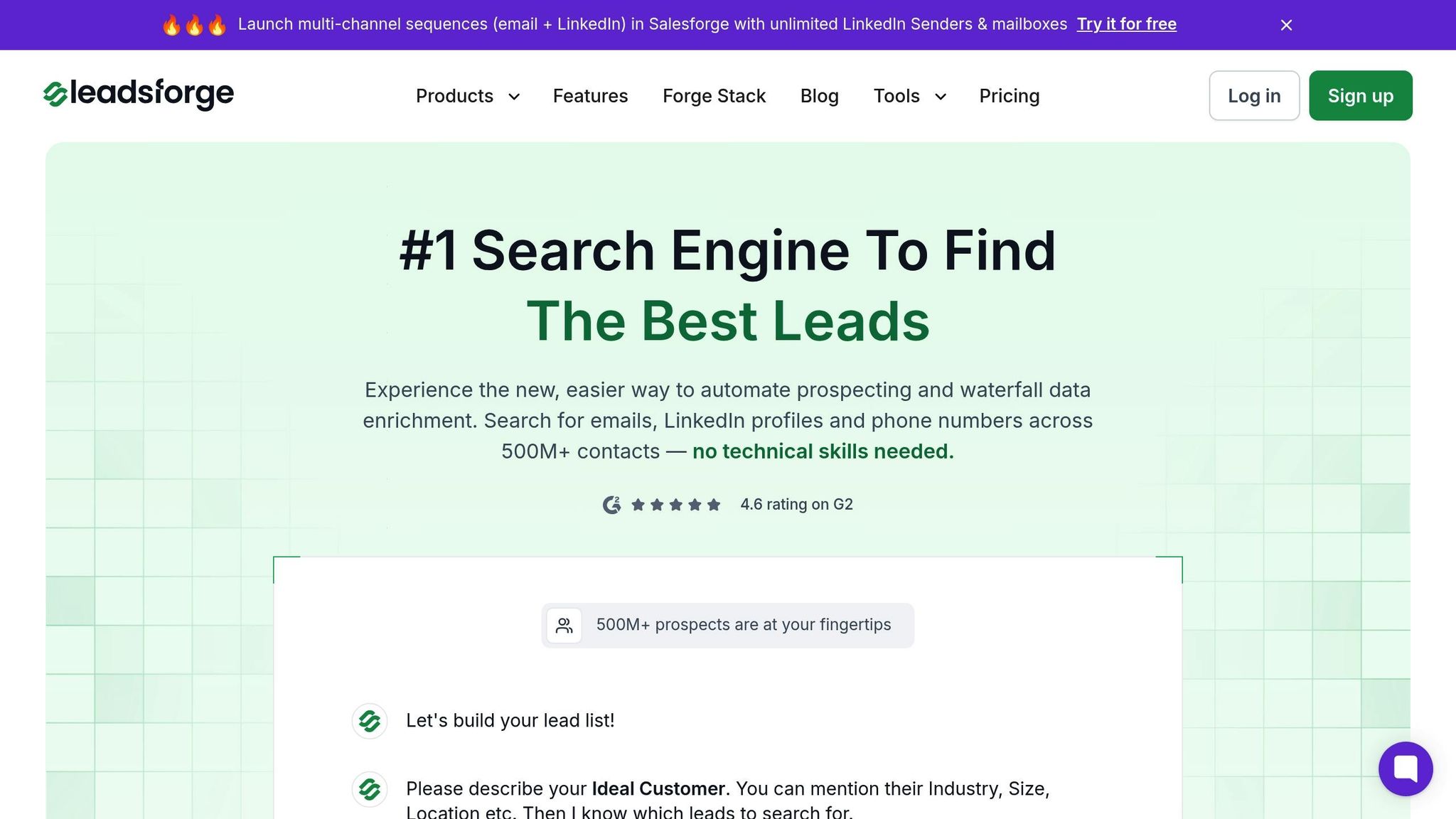
Leadsforge stands out as a powerful tool for lead generation, tapping into a database of over 500 million verified contacts. Its waterfall enrichment process ensures higher match rates by continuously checking multiple sources until verified data is found, unlike platforms that rely on a single source. This results in cleaner, more accurate lead lists.
What makes Leadsforge unique is its user-friendly, chat-like interface. You can simply describe your ideal customer profile in plain language, and it generates highly targeted lead lists with minimal effort. The platform also uses built-in intent signals and lead qualification features to identify prospects who are most likely to convert. For instance, it tracks LinkedIn followers of company pages to gauge interest and uses lookalike searches to find businesses with similar behaviors to your top customers.
With a 4.6 rating on G2, Leadsforge is widely recognized for delivering verified, high-quality leads. If you're using The Forge Stack, Leadsforge integrates seamlessly with Salesforge, enabling multi-channel outreach while carrying over behavioral insights from prospecting to conversion.
To evaluate Leadsforge alongside other platforms, here’s how it compares in key areas:
Leadsforge aggregates data from multiple channels, including website visits, content downloads, email interactions, LinkedIn engagement, and event participation. This creates a unified view of each prospect’s journey, helping teams identify potential drop-offs and refine their strategies.
Selecting the best platform depends on factors like company size, budget, and business goals. Here are some points to consider:
The right platform can be a game-changer, helping you leverage behavioral insights to improve lead quality and drive better results.
Behavioral data is transforming how B2B teams prioritize prospects. Instead of relying solely on static demographics, it focuses on what prospects actually do online - like visiting pricing pages, downloading resources, attending webinars, or interacting with LinkedIn posts. This shift encourages teams to move away from chasing sheer volume and instead zero in on leads with clear buying intent. The result? Better conversion rates and a more efficient sales process.
By leveraging behavioral insights, companies can improve targeting and engage prospects at the right time, which ultimately leads to shorter sales cycles. Combining behavioral data with interaction and attitudinal data creates a complete view of each prospect. This comprehensive perspective helps identify high-intent leads, tailor messaging to their needs, and refine qualification processes.
Getting started with a behavioral data strategy doesn’t have to be complicated. Tools like Leadsforge simplify the process. Using an AI-powered, conversational interface, Leadsforge allows you to describe your ideal customer profile in plain language. The platform then generates targeted and verified lead lists, enriched with behavioral signals like intent data and LinkedIn engagement trends, all backed by ongoing data verification.
One of the standout benefits of behavioral data is its ability to cut down on wasted outreach. By segmenting leads based on their engagement patterns, sales teams can focus their efforts on prospects who are ready to make a purchase, saving time and resources spent on less promising leads. When paired with tools like Salesforge for multi-channel outreach, these insights flow seamlessly from prospecting to deal closure, ensuring a smooth transition from lead generation to conversion.
To make the most of behavioral data, it’s essential to track the right metrics - think funnel conversion rates, website activity, content engagement, email interactions, and event participation. By analyzing how these signals align with actual conversions, teams can continuously tweak and improve their strategies.
At its core, leveraging behavioral data is about acting on meaningful insights to enhance lead quality, streamline sales efforts, and create better customer experiences. Companies that focus on quality over quantity and use AI-driven tools to uncover patterns are reaping the rewards. These practices highlight the potential of behavioral data to drive success throughout the sales cycle.
To stay compliant with data privacy regulations while collecting and using behavioral data, businesses need to adopt a few key practices. First and foremost, they should secure explicit consent from users before gathering any data. It’s equally important to be upfront about how the data will be used - this means offering a clear and thorough explanation, often through a well-detailed privacy policy.
Businesses must also ensure they’re adhering to laws like the GDPR, CCPA, or any other regulations relevant to their location and operational regions. Regular audits of how data is collected, stored, and managed are essential, as is utilizing tools designed to prioritize security and compliance. These steps not only reduce risks but also reinforce trust with users.
Platforms such as Leadsforge can make the compliance process easier. Leadsforge focuses on ethical and secure data handling while enriching and verifying the data. By combining advanced targeting capabilities with privacy-conscious technology, businesses can enhance lead quality without stepping outside the boundaries of compliance.
Integrating tools that analyze behavioral data with existing systems often presents hurdles such as data compatibility, system complexity, and a lack of expertise. For instance, businesses might face difficulties aligning data formats across platforms or ensuring smooth communication between older systems and new software.
To address these obstacles, it’s crucial to choose tools with strong integration capabilities and flexible APIs. Take platforms like Leadsforge, for example - they streamline the process by organizing and enriching lead data into formats that can easily sync with most CRMs and marketing tools. Beyond the tools themselves, investing in proper training and bringing IT teams into the process early can significantly ease the transition and help businesses get the most value out of their behavioral data insights.
Behavioral lead scoring zeroes in on what prospects do - like browsing your website, clicking on emails, or downloading resources - to gauge their interest and how ready they are to make a purchase. In contrast, traditional lead scoring leans on fixed details such as job titles, company size, or industry type.
By tapping into behavioral data, businesses can zero in on leads showing active interest, making it easier to focus on those most likely to convert. Tools like Leadsforge take this a step further by automating the analysis and delivering actionable insights. This means your team can dedicate their time to pursuing high-potential leads, boosting sales efficiency.