Serviceable Addressable Market (SAM) is the portion of your Total Addressable Market (TAM) that your business can realistically target and serve with its current capabilities. While TAM represents the total market potential, SAM focuses on the segments you can reach based on factors like geography, product fit, and operational capacity.
SAM is especially useful for B2B teams to focus on reachable, high-value market opportunities, ensuring resources are allocated effectively. By defining your SAM, you can align sales and marketing efforts, improve forecast accuracy, and target accounts that match your Ideal Customer Profile (ICP). Tools like Leadsforge can help refine your SAM and generate high-quality leads.

TAM vs SAM vs SOM Market Sizing Framework Comparison
Before diving into the numbers for your SAM (Serviceable Addressable Market), it’s crucial to lay the groundwork. You need to define your target customers, understand your product’s boundaries, and gather reliable market data. These steps help ensure your calculation is accurate and actionable.
Your Ideal Customer Profile (ICP) is essentially a blueprint for the companies that would benefit most from your product and are most likely to purchase it. Start by analyzing your current customer base. Identify your most profitable accounts - those with the highest Lifetime Value (LTV). Then, dig deeper by talking to these customers and consulting your sales and support teams. This will help you understand their goals, challenges, and decision-making processes.
Look for patterns among your top-performing customers. Use firmographic criteria such as industry, company location (including headquarters and subsidiaries), annual revenue, employee count, and organizational structure. Add technographic criteria by examining their tech stack - what CRM, sales intelligence, and marketing tools they rely on - and their monthly technology budget. Research shows that companies with a well-defined ICP experience 68% higher account win rates than those without one.
"Accurately defining your ideal client profile (ICP) is the cornerstone of your go-to-market strategy and forms the basis for identifying the right personas at your target accounts." - Ariana Shannon, Author, SalesIntel
Don’t overlook the insights your customer success teams can provide. They often have a clear understanding of which customer types derive the most value from your product. A well-crafted ICP also enables highly personalized outreach, with firmographic segmentation increasing reply rates by as much as 45%.
Once you’ve nailed down your ICP, it’s time to factor in your product’s limitations. Your pricing, features, and packaging can significantly narrow your potential market. For example, if your premium software is priced at $50,000 per year, small businesses with tight budgets may not be a viable audience, even if they meet other criteria. Similarly, if your product requires specific technical integrations, your market is limited to companies with compatible systems.
Operational capacity is another key consideration. If your team can only support 500 customers, that constraint will limit your SAM, no matter how large the demand for your product might be.
"SAM reflects the specific market segments within TAM that align with a company's operational capabilities and geographic reach." - Dr. Loaloa Riad, Globemonitor
Accurate SAM calculations depend on reliable data. To ensure precision, use a mix of data sources for both top-down and bottom-up approaches.
Combining both top-down and bottom-up data ensures a well-rounded understanding of your market.
"When you get all these data points aggregated together at an account-level, and all the accounts add up to your TAM, SAM, SOM, that's fantastic. Now you have a precise solution you can actually use." - Rohini Katsuri, CEO, HG Insights
(function(d,u,ac){var s=d.createElement('script');s.type='text/javascript';s.src='https://a.omappapi.com/app/js/api.min.js';s.async=true;s.dataset.user=u;s.dataset.campaign=ac;d.getElementsByTagName('head')[0].appendChild(s);})(document,372145,'tlb9tturzitublbka5ay');
Once you've defined your ICP and gathered reliable data, it's time to calculate your Serviceable Addressable Market (SAM). There are two main methods to do this: the top-down and bottom-up approaches. For the most accurate results, it's best to use both and cross-check your findings.
The top-down approach begins with your Total Addressable Market (TAM) - essentially, the global demand for your product or service - and then narrows it down using a series of filters. To determine your TAM, you can rely on market reports from firms like Gartner or Forrester. For instance, if you're in the marketing automation software business, you'd start by looking at the global marketing software market.
From there, apply broad filters to focus on the portion of the market you can realistically serve. These filters might include:
For example, if HubSpot focuses on inbound marketing in North America, they would filter the global marketing software TAM down to just that region and niche. In 2022, HubSpot's projected revenue of approximately $1.69 billion reflects their SAM, not the entire TAM.
Next, subtract unreachable market segments - those restricted by factors like regulations, logistics, or product fit. Explicitly calculate the percentage of the market that falls into this category and subtract it. The remaining figure represents your SAM.
"In my experience, these tools are extremely informative when determining how to niche. Take the time, and understand the opportunity or lack thereof with your new target." – Lori Highby, Keystone Click
The bottom-up approach is more detailed and often more precise, especially for B2B companies, as it relies on your own data. Start by identifying the total number of potential customers that fit your ICP within your target segment. Use tools like firmographic databases or your CRM to count companies that match your criteria. For example, you might focus on manufacturers with 50–100 employees in the Midwest.
Next, calculate your Average Annual Revenue per Account (ACV) using historical sales data. Multiply the total number of potential accounts by your ACV to determine your SAM. For instance, if you have 2,000 potential accounts and an ACV of $25,000, your SAM would be $50 million.
"The most accurate approach when calculating your total addressable market (TAM) is the bottom-up market size calculation - using in-house data from your customers." – Dom Wells, CEO and Founder, Onfolio
To refine your results, segment your market by company size (e.g., SMB, Mid-Market, Enterprise). Since ACV often varies by segment, calculate the SAM for each group separately, then combine them for a comprehensive total.
By cross-validating the results from the top-down and bottom-up methods, you can arrive at a more reliable SAM estimate. The top-down approach provides a big-picture check, ensuring your bottom-up calculations aren’t overly optimistic. Meanwhile, the bottom-up approach offers detailed, actionable insights that are invaluable for sales planning and resource allocation.
If your top-down and bottom-up results differ significantly, it's a sign to revisit your assumptions. You might need to refine your ICP, adjust market share expectations, or reevaluate which segments are realistically accessible. Research shows that companies with a well-defined ICP see 68% higher account win rates, so getting this step right is crucial.
| Approach | Starting Point | Data Sources | Best Use Case |
|---|---|---|---|
| Top-Down | Total Market (TAM) | Analyst reports (Gartner, Forrester), Census data | Market entry planning, investor presentations |
| Bottom-Up | Individual Accounts | CRM data, historical sales, ACV | Sales forecasting, resource allocation |
You can also calculate your SAM/TAM ratio to better understand the portion of the total market you can realistically address. A lower ratio often indicates you're operating in a niche market, which isn’t a drawback - it just means your focus needs to be precise.
"Defining the difference between these values [TAM and SAM] can give your team more realistic revenue goals for your marketing and sales strategy." – ZoomInfo
With a clear SAM calculation, you're equipped to develop targeted lead generation strategies, such as those offered by Leadsforge.
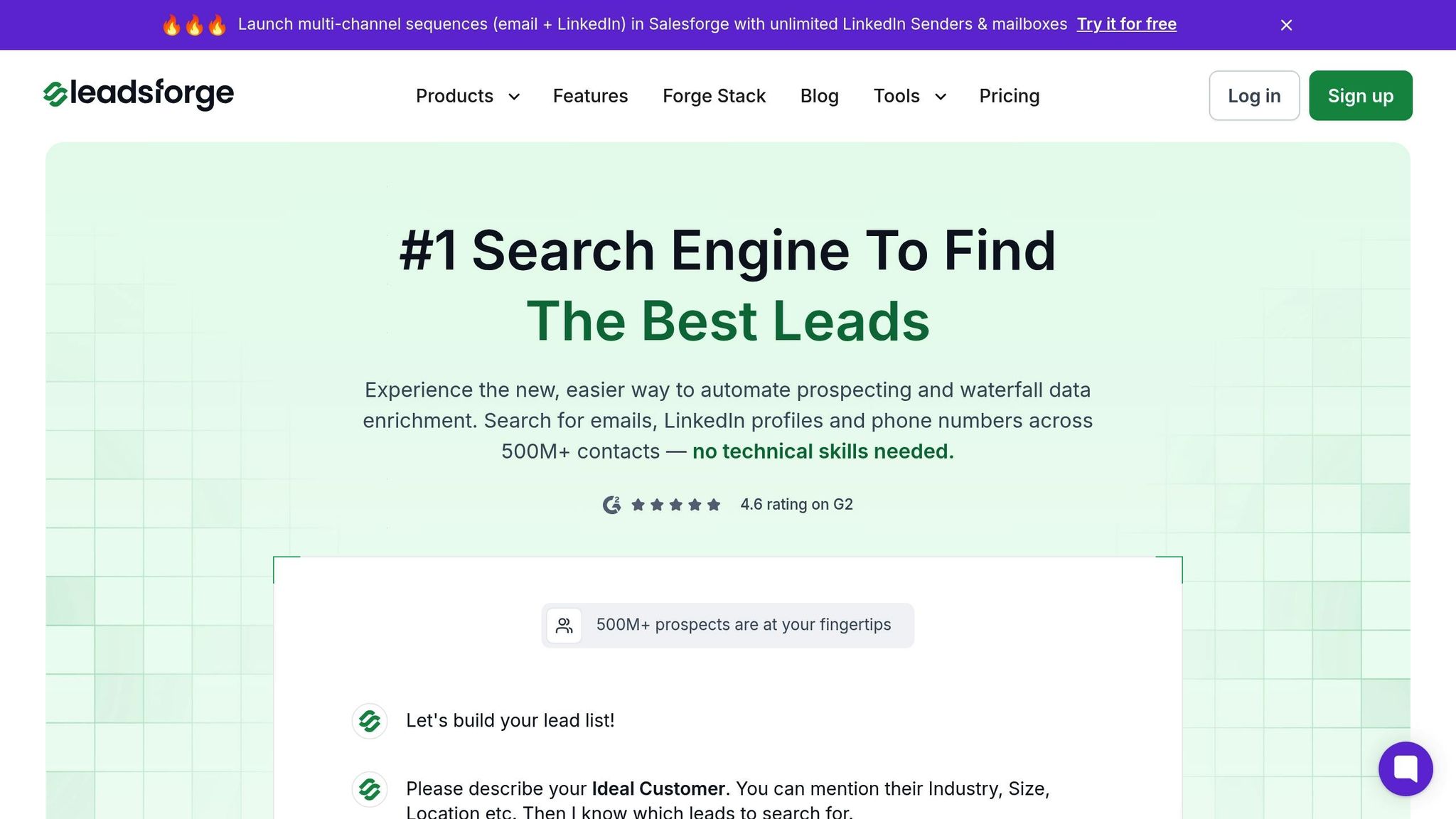
Once you've figured out your SAM (Serviceable Addressable Market), the next step is putting that analysis to work by generating leads. That’s where Leadsforge comes in. This platform makes the process easier by allowing you to describe your ideal customer in plain language - no need to wrestle with complicated filters. For example, you can simply type something like "decision-makers at mid-sized tech companies in New York", and the platform’s AI will create a targeted list that matches your SAM. This natural language approach also opens the door to more refined segmentation and data enrichment, which we’ll cover next.
Leadsforge builds on your SAM analysis by converting your market definition into actionable lead lists. Its conversational interface applies filters for industry, company size, location, and technology stack based on your input, ensuring every lead aligns with your SAM criteria. Additional features like company followers search let you identify prospects already following your competitors on LinkedIn, while the lookalike search finds companies similar to your top customers. New users also get 100 free credits to test how effectively the platform translates your SAM into actual prospects, offering a no-risk way to evaluate its capabilities.
Having accurate data is non-negotiable. Leadsforge enhances basic contact information by adding details like job titles, company revenue, employee count, and location. It also verifies email addresses in real time with over 95% accuracy, ensuring your outreach efforts hit the mark. On top of that, the platform incorporates intent data, so you can focus on leads within your SAM who are actively searching for solutions like yours. This transforms cold outreach into warm, meaningful conversations. Studies show that using data-enrichment strategies can boost conversion rates by 15–20%, making this step a game-changer.
Once your data is enriched and verified, the next step is seamless integration. Leadsforge connects directly to HubSpot and Salesforce, syncing leads to your CRM without the hassle of manual data entry. You can also organize your SAM into tiers - such as strategic, core, and long-tail accounts - and adjust your outreach strategy accordingly. High-value accounts might get personalized attention, while lower-tier prospects can be reached through automated touchpoints. By combining automated segmentation with your SAM, Leadsforge ensures every lead fits your target market. Companies that use AI-driven lead scoring and automated segmentation report up to a 52% increase in conversion rates. Plus, the platform is GDPR and CCPA compliant, which is crucial if your SAM includes prospects in Europe or California.
A well-defined SAM (Serviceable Addressable Market) can significantly enhance the quality of your lead lists. Instead of reaching out to a broad audience, SAM narrows your focus to a specific group of accounts that align with your ideal customer profile (ICP). This ensures that every lead entering your sales development pipeline is a strong match. Consider this: 68% of B2B companies cite lead quality as their biggest sales hurdle, and poor data quality costs organizations an average of $12.9 million annually. Shifting your prospecting efforts to align with SAM transforms the focus from sheer quantity to meaningful quality.
"A clearly defined SAM ensures list-building efforts focus only on companies and contacts that match your ICP, industry, and deal-size sweet spot. This dramatically reduces bad data and low-fit leads entering your sales funnel." - SalesHive
To maximize the impact, apply disqualifiers with the same precision you use for qualifiers. For instance, if specific industries, revenue ranges, or tech stacks rarely convert, bake those exclusions into your list-building rules. This eliminates the need for your sales development reps (SDRs) to manually weed out unfit leads, allowing them to concentrate on prospects that genuinely meet your criteria. This disciplined approach lays the foundation for segmenting and tiering your SAM.
Not every account within your SAM requires the same level of attention. Breaking your SAM into tiers - such as Strategic (A), Core (B), and Long-tail (C) - helps align your resources with the potential value of each account. For example, Tier A accounts might merit personalized, multi-threaded outreach strategies, including direct phone calls and tailored messaging. Meanwhile, Tier C accounts could be handled through automated email campaigns, allowing you to conserve resources for higher-value opportunities.
Start by piloting one or two high-confidence segments, like U.S.-based SaaS companies with 200–1,000 employees. Track metrics like reply rates and meetings booked to fine-tune your strategy. This data-driven approach highlights which industries, company sizes, or other factors yield the best results, ensuring your efforts stay focused and efficient.
To bring your SAM strategy to life, integrate it into your CRM using account tags, custom fields, and dynamic views. This ensures your team has instant access to pre-approved, high-fit account lists, eliminating guesswork and streamlining workflows.
Platforms like Leadsforge make this process even easier. Once your SAM criteria are set, the platform can generate targeted account lists, enrich them with verified contact details, and sync everything seamlessly with your CRM. Its intent data feature takes things a step further by identifying leads within your SAM who are actively searching for solutions, turning cold outreach into warmer, more productive conversations.
Additionally, creating a feedback loop is crucial. Encourage your sales team to flag accounts that seem like good fits on paper but fail to convert. This input allows you to continuously refine your SAM filters and improve lead quality over time. By combining these steps, you can build a dynamic lead generation system that evolves and improves with every interaction.
To keep your lead generation strategy sharp, it’s crucial to revisit and update your Serviceable Addressable Market (SAM) as circumstances shift. Market conditions, product features, geographic reach, and pricing models are all factors that evolve over time, requiring regular adjustments to your SAM. For instance, launching new features, introducing different delivery models, or expanding product lines are clear signals that it’s time for a SAM update.
Shifts in customer behavior, regulatory changes, inflation, and fluctuations in purchasing power can also reshape your SAM. These external factors can either expand or contract your potential market. A great example is Facebook’s journey: in 2004, the platform targeted college students exclusively. As the company introduced new features and broadened its vision, its SAM grew to include a much larger audience, spanning Gen-X and Boomers, transforming Facebook into a global phenomenon.
Recognizing these triggers is just the starting point. To stay ahead, you also need a structured process for periodic reviews.
Set up a quarterly or semiannual schedule to review essential metrics like Average Revenue Per Customer (ARPC) and Customer Lifetime Value (CLV). Use both top-down and bottom-up data to refine your insights. Over time, as you gather more customer data, your calculations will become more accurate.
Consider breaking your SAM into smaller, focused segments - think "micro-SAMs" organized by industry or company size. This approach makes it easier to pinpoint high-performing areas. If certain segments underperform, tweak your Ideal Customer Profile (ICP) filters and disqualifiers. Keep in mind that contact information degrades quickly - about 22.5% of email addresses become outdated each year.
Leadsforge simplifies the process of keeping your SAM up to date. When market conditions or product constraints shift, you can describe your updated ICP in plain language, and the platform will automatically adjust your targeting criteria. Its data enrichment tools ensures your contact lists stay fresh by running regular verification cycles to weed out outdated information.
What sets Leadsforge apart is its dynamic approach to SAM management. Its intent data identifies prospects actively searching for solutions, turning your static lists into actionable opportunities. The competitor monitoring tool is another game-changer - it tracks LinkedIn followers of rival companies, helping you spot potential new entrants into your market that align with your ICP. By syncing with your CRM and outreach tools, Leadsforge creates a feedback loop, analyzing which SAM segments convert best and using that data to fine-tune your filters for future campaigns.
This ongoing refinement ensures your lead generation strategy stays aligned with the ever-changing market landscape, helping you maintain the high-quality leads that drive success.
Pinpointing your Serviceable Addressable Market (SAM) is a critical step toward achieving sustainable growth and making the most of your resources. Without a well-defined SAM, B2B teams risk wasting time and effort chasing opportunities that simply aren't feasible.
"A SAM calculation takes the pressure off aiming at wildly unrealistic targets - like capturing 100% of a $1 billion market in 3 years".
This approach is backed by real-world examples. Take HubSpot, for instance. By narrowing its focus to a specific SAM - small and medium-sized businesses interested in inbound marketing - the company hit impressive milestones, including a projected $1.69 billion in 2022 revenue and a $13.5 billion market cap.
However, SAM isn't something you define once and forget. Markets evolve, products change, and customer needs shift. Tools like Leadsforge can be game-changers in this context. By automating tasks like data enrichment, contact validation, and identifying active prospects through intent signals, Leadsforge helps transform static SAM estimates into dynamic, actionable strategies. This shift allows companies to move seamlessly from planning to execution.
A clear SAM helps your team focus on attainable goals, and the right tools ensure a steady flow of high-quality leads. Start by defining your SAM, back it up with solid data, and let automation keep it sharp and effective. This combination paves the way for consistent, long-term growth in the B2B space.
TAM, SAM, and SOM are essential concepts in market analysis that help businesses size up their opportunities and focus their efforts effectively.
Think of it this way: TAM gives you the big-picture potential, SAM shows what’s within your scope, and SOM pinpoints the market share you can realistically achieve. This framework is a practical tool for prioritizing resources and setting realistic growth targets.
Defining your Ideal Customer Profile (ICP) means building a clear framework to pinpoint the customers who will gain the most from your product or service. Start by identifying the specific problem your product solves and the measurable benefits it provides - like boosting revenue or streamlining operations. This keeps your ICP grounded in actual business needs.
From there, collect detailed data about potential customers, focusing on factors like company size, industry, revenue, location, and even their tech stack. Platforms such as Leadsforge can help enrich this data, giving you a clearer picture of your target audience. To narrow things down further, evaluate prospects based on their readiness, willingness, budget, decision-making authority, and how well they align with your solution. Assigning scores to these factors can help you zero in on high-priority accounts.
Don’t stop there - test your ICP with small outreach campaigns to see how it performs and tweak it as needed. Make it a habit to revisit and update your profile regularly to keep up with shifts in the market or customer behavior. A strong, up-to-date ICP ensures your lead-generation efforts hit the mark, delivering better outcomes for your business.
To keep your SAM (Serviceable Addressable Market) accurate and in sync with market shifts, it’s essential to reassess critical factors like customer demand, product capabilities, and distribution reach on a regular basis. Start by revisiting your Total Addressable Market (TAM) with the latest industry data, then use the SAM formula: SAM = TAM × Market-Fit Factor × Accessibility Factor. Be sure to adjust these factors whenever there are significant changes, like launching a new pricing model or navigating supply chain disruptions.
Make updating your SAM a quarterly habit. Begin by collecting fresh TAM data from reliable industry sources. Then, analyze your product’s market fit and accessibility using internal performance metrics and insights into your competitors. Once recalculated, integrate the updated SAM figure into tools like your CRM or sales platforms, such as Leadsforge. This ensures your prospecting and lead-scoring strategies align with current opportunities. By staying proactive, you can allocate resources effectively and aim for the best possible ROI.