If you work in GTM, RevOps, or growth, you’ve probably come across Waterfall.io.
It claims to give you one API that can find prospects, verify emails, get phone numbers, and enrich company data, all by aggregating 30+ global data vendors into a single source.
But does it actually perform as well as it sounds?
To find out, we explored Waterfall.io’s API documentation, analyzed its accuracy and scalability, and reviewed how it performs for B2B data enrichment.
Here’s everything we discovered about Waterfall.io, its features, pros, cons, and whether it truly stands out as an ideal enrichment tool.
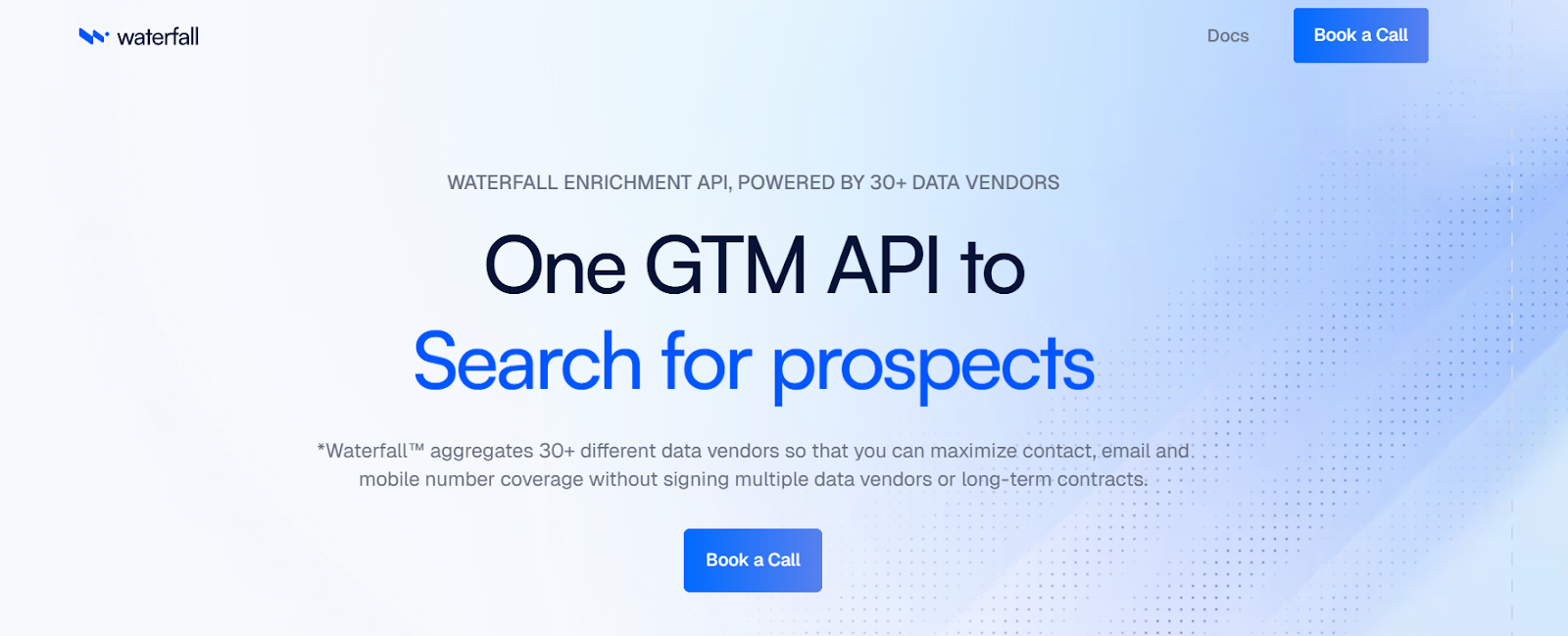
Waterfall.io is a B2B data enrichment API that connects to 30+ verified data vendors to help teams find accurate emails, phone numbers, and company details in real time.
It’s built for GTM, RevOps, and data teams that want to automate enrichment at scale.
It ensures enterprise-grade security with SOC 2 Type II certification, full GDPR and CCPA compliance, and continuous monitoring by Drata.
Every record is verified, private, and safe to use, making Waterfall.io a trusted choice for companies that rely on clean, compliant B2B data.
Waterfall.io works through a simple API process that connects to over 30 data vendors to return verified B2B contact and company information.
It’s designed for developers and data teams who want accurate enrichment with minimal setup.
Here’s how it works step by step:
Every user gets an API key after signing up.
You add this key to your API header (x-api-key), it authenticates your requests and lets you access all Waterfall endpoints securely.
Waterfall has different endpoints for specific needs:
You send a request to the relevant endpoint.
Each endpoint accepts specific input, like a domain, LinkedIn URL, or email, and optional filters such as:
Waterfall automatically routes your query to the best data sources among its 30+ vendors.
When you send a request:
Using the job_id, you fetch enriched or verified data, such as:
All results follow a consistent format, making it easy to plug into your CRM, database, or automation tool.
If something goes wrong, Waterfall returns standard HTTP error codes:
Rate limits apply, usually 50 requests per minute for enrichment and prospector calls.
You can monitor API usage and balance with /v2/account.
This gives detailed metrics on requests, enriched contacts, verified emails, and remaining credits.
Waterfall.io lets you send one API request and get verified, enriched B2B contact data from 30+ sources, all in one place, with enterprise-grade accuracy, security, and compliance.
Here’s a breakdown of Waterfall.io’s features that are actually useful:
Waterfall.io is developer-first but sales-friendly, giving GTM and RevOps teams instant access to global B2B contact data, verified emails, and direct dials, all from one secure, automated API stack.
Waterfall.io uses a usage-based pricing model, you only pay for what you use.
There are no monthly contracts, credit expirations, or hidden fees, and you can scale usage up or down anytime.
If you enable phone enrichment, extra charges apply only when valid numbers are returned.
Large teams can request custom pricing and higher rate limits (up to 1,000 requests/minute).
All billing is handled in one contract and invoice, replacing multiple vendor subscriptions.
To get exact rates, users must book a call with the Waterfall team.
If your workflow revolves around data enrichment and integration, and you just need verified contact or company data inside your CRM or product, Waterfall.io is a great fit.
If you like Waterfall.io for combining multiple data providers into one enrichment pipeline but don’t want to deal with API setup, coding, or complex integrations.
Leadsforge gives you the same multi-source “waterfall enrichment” in a chat-based interface.
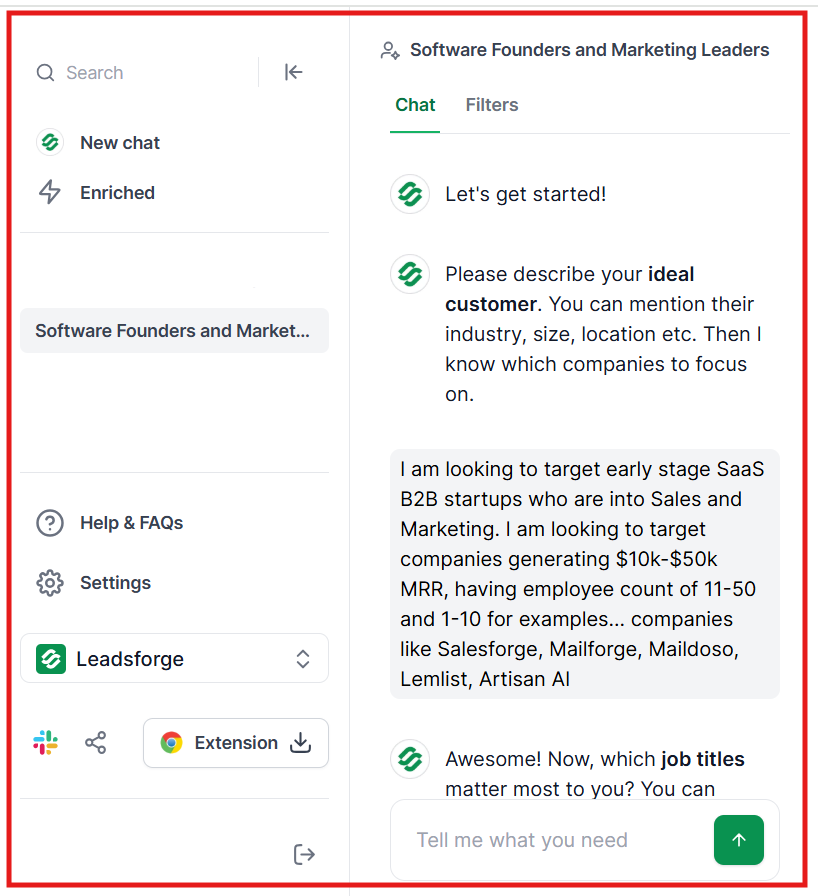
You can simply type prompts and instantly get verified emails, phone numbers, and LinkedIn profiles from a global database of 500M+ contacts.
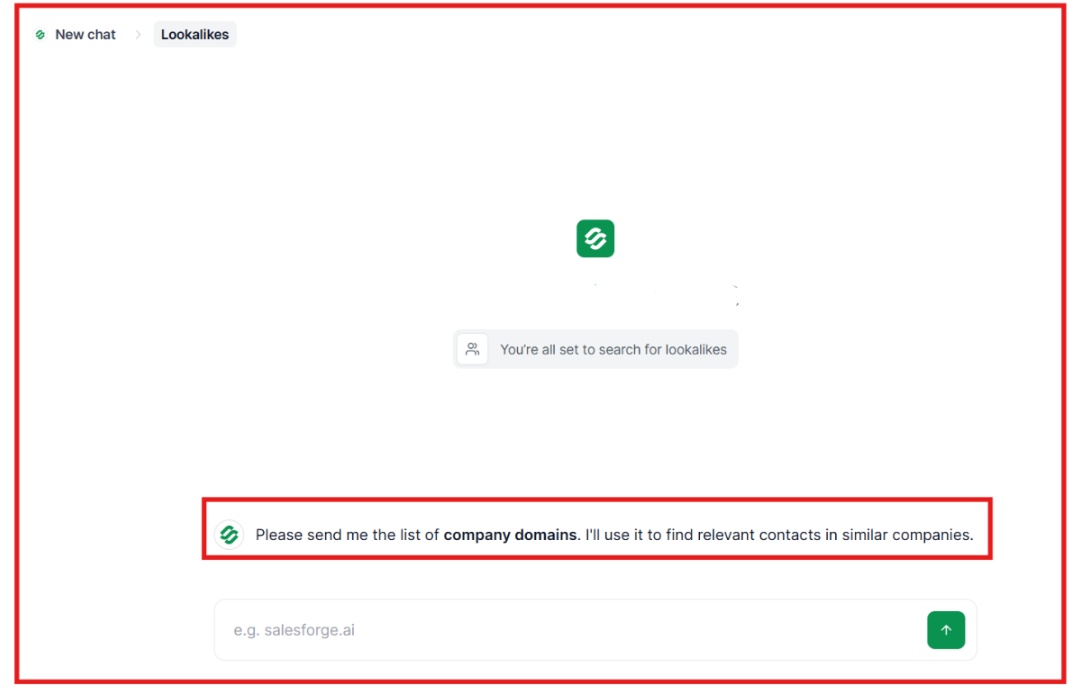
It also includes lookalike search, competitor followers, and intent signals (like hiring or product launches), all inside one simple chat interface.
Leadsforge offers 2,000 credits for $49/month, with credits that never expire.
By contrast, Waterfall.io runs on usage-based API pricing that can be unpredictable and requires manual setup before you start enriching data.
This means that even though both tools perform waterfall enrichment, Waterfall.io demands technical effort, while Leadsforge gives you the same capability in a no-code, chat-style interface designed for instant lead generation.
If your team has engineers and wants to build custom enrichment pipelines, Waterfall.io gets the job done.
But if you want to search, enrich, and export verified leads globally in one click, without writing a single line of code, Leadsforge gives you more speed, flexibility, and value.
Waterfall.io is a strong platform if your team has developers and wants full control over enrichment through APIs.
It gives you access to 30+ global data sources, solid data accuracy, and detailed company insights. But it’s not made for everyone.
If you don’t have technical skills or time to set up APIs, using Waterfall.io can feel complex.
You’ll need to manage formatting rules, API keys, and usage costs, which can add up quickly.
It’s great for data engineers, but not the most practical tool for sales or marketing teams that just want quick, verified leads.
So yes, Waterfall.io is worth it, but only if you have a developer team and want to build a custom enrichment pipeline.
If you want the same data coverage without the setup, Leadsforge is a simpler choice.
It provides real-time waterfall enrichment, verified emails, phone numbers, and LinkedIn profiles, all through a simple, chat-based interface.
Try Leadsforge now with 100 free credits!