B2B lead generation thrives on trust. Decision-makers rely on credible insights to guide their choices, with 73% trusting thought leadership content over traditional marketing. Yet, most B2B campaigns target only the 5% actively searching for solutions, leaving the 95% untapped.
Thought leadership solves this by offering expertise, not just products. It builds trust, engages early-stage buyers, and improves lead quality. 90% of executives are more open to outreach from companies producing high-quality insights, and thought leadership delivers a 156% ROI - far outperforming standard marketing efforts.
This approach not only nurtures long-term relationships but also ensures your brand is top-of-mind when buyers are ready to act.
Before diving into solutions, it's important to understand the hurdles that B2B lead generation faces today - challenges that traditional tactics often fail to address. By identifying these pain points, we can better see how thought leadership can step in to make a real difference.
The way decision-makers approach buying has changed dramatically. Today, 70% of the B2B buying process happens before a prospect even speaks with a sales representative. Buyers are doing their own research, forming opinions, and narrowing down their options long before vendors have a chance to make their pitch.
This shift has created a trust gap. Decision-makers are bombarded with generic outreach, leading to what’s often called "noise fatigue." They’ve grown skeptical of traditional marketing tactics. In fact, 87% of IT decision-makers actively seek insights from external, trusted sources before they’ll even consider engaging with a vendor. They’re not interested in flashy product brochures - they want evidence that you truly understand their challenges.
On top of that, organizational complexities make trust-building even harder. Cross-functional buying committees and misaligned sales and marketing efforts often lead to confusion and missed opportunities. Promising leads can slip through the cracks when these teams fail to coordinate effectively.
Many B2B marketers focus almost entirely on the small group of buyers who are actively in the market. While this may seem logical, it creates a hyper-competitive environment. The result? A mad scramble for the same intent signals.
Consider this: buyers report receiving 36+ vendor outreaches within just two weeks of showing interest online. This aggressive approach often backfires, with 56% of B2B buyers saying they feel overwhelmed by vendor outreach once they start their research. Many prospects respond by going silent, ignoring communication altogether, or making decisions based solely on price.
Even worse, this narrow focus means companies often overlook a much larger audience - those who are in the early stages of research. 78% of buyers ultimately choose vendors they were already aware of before starting their active search. If you’re not building relationships with this broader audience, you’re unlikely to make their shortlist when they’re ready to buy.
Traditional lead generation methods often come with hefty price tags and disappointing results. On average, companies spend $123 per lead, but only 0.2% of those leads turn into closed deals.
The root of the problem lies in a lack of trust. Promotional content and product-centric messaging fail to resonate with skeptical buyers. Nearly half of B2B buyers make decisions defensively, prioritizing options that minimize personal risk. This means they’re unlikely to engage with vendors who haven’t already demonstrated expertise. Worse, 45% of decision-makers say poor-quality thought leadership actually causes them to lose respect for a company, taking it off their radar completely.
Adding to the inefficiency is an overemphasis on vanity metrics - clicks, downloads, and form fills. While these numbers may look impressive in reports, they rarely translate into meaningful revenue. Companies end up pouring money into channels that generate high volumes of low-quality leads, while failing to connect with potential buyers who are still in the research phase. This cycle highlights the need for thought leadership to build trust, credibility, and ultimately, reduce acquisition costs.
(function(d,u,ac){var s=d.createElement('script');s.type='text/javascript';s.src='https://a.omappapi.com/app/js/api.min.js';s.async=true;s.dataset.user=u;s.dataset.campaign=ac;d.getElementsByTagName('head')[0].appendChild(s);})(document,372145,'tlb9tturzitublbka5ay');
Thought leadership isn't just another marketing term - it’s a specialized type of content that showcases real expertise and a distinct perspective. While it falls under the broader umbrella of content marketing, not all content marketing can be considered thought leadership. The difference lies in its depth, credibility, and purpose.
Standard content marketing often focuses on educating audiences about products or services and is frequently created by marketing teams or generalist writers. Thought leadership, on the other hand, demands insights from subject matter experts (SMEs) who have firsthand experience. This type of content dives deeper, predicting industry trends and addressing questions that haven’t even been asked yet.
Trust is a cornerstone of thought leadership. This is especially important in the B2B space, where buyers are often skeptical of generic marketing pitches. Thought leadership doesn't just aim to capture immediate leads - it helps you connect with the 95% of potential buyers who aren’t actively looking to purchase at the moment. By consistently sharing meaningful insights, you build recognition and ensure that when these prospects are ready, your brand is the first one they think of. Let’s take a closer look at what sets thought leadership apart.
What makes thought leadership stand out from typical content? Here are its defining traits:
Grounded in data and research.
Strong thought leadership relies on verified data, original studies, or first-hand insights. In fact, 55% of decision-makers say that high-quality thought leadership is defined by solid research and data.
Forward-thinking and challenging the status quo.
Thought leadership doesn’t just describe what’s happening now - it offers a vision of what’s next. It often challenges conventional thinking, with 81% of buyers saying they value bold insights that make them rethink their assumptions.
Focused on solving problems, not selling products.
Audiences, especially in technical B2B industries, can easily spot a sales pitch. Effective thought leadership tackles genuine challenges - even those unrelated to your offerings. As Daniel Van Otterdijk, Group Chief Communications Officer at DP World, puts it:
"If you know your customers' challenges, you can shape content that sharply identifies those problems and brings our unique solutions into focus".
Authored by experts with a name and face.
People trust people. 67% of decision-makers prefer content written by identifiable experts rather than faceless brands. Additionally, 77% of buyers value insights from subject matter experts over general commentary from executives.
The numbers speak for themselves: thought leadership can deliver an ROI of 156%, which is 16 times higher than the average marketing campaign. Yet, only 15% of buyers consider the thought leadership they currently consume to be of high quality. This gap presents a huge opportunity for brands willing to create content that truly resonates.
Once you understand what makes thought leadership effective, the next step is choosing the right formats to deliver your message. Your format should align with your audience’s preferences and your organization’s strengths. Here are some popular options:
"Thought leadership is about establishing a unique perspective on conversations that are playing out in society, so that you can try and inspire new thought and new action in others."
– Aneesh Raman, Founding Director, LinkedIn Opportunity Institute
Repurposing is key.
Creating top-tier thought leadership content takes time and resources, so make it count. For instance, you can turn a research report into a webinar series, pull key findings for social media posts, or create podcast episodes around the main insights.
Ultimately, the format is secondary to the substance. Whether it’s a whitepaper, webinar, or podcast, your content must demonstrate expertise, be backed by data, and deliver value that goes beyond the usual marketing fluff. The goal is to go deep on a few critical topics where your organization can offer meaningful, relevant insights.
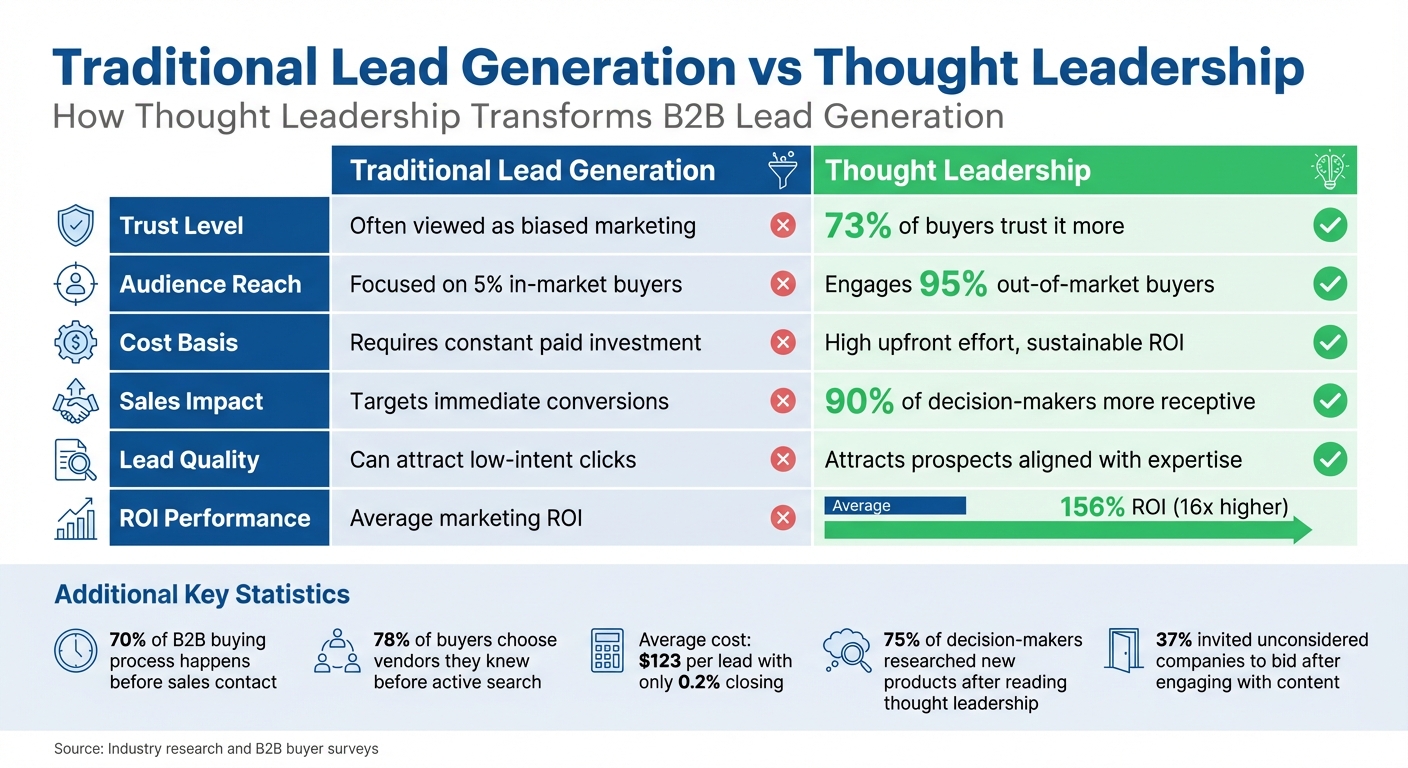
Traditional Lead Generation vs Thought Leadership: Key Metrics Comparison
Now that we’ve explored what thought leadership is and how to structure it effectively, let’s dive into how it tackles some of the toughest challenges in B2B lead generation. Here’s a compelling fact: 73% of decision-makers trust thought leadership more than traditional marketing materials, and it delivers an impressive ROI of 156%.
In B2B sales, trust isn’t just a nice-to-have - it’s critical. Nearly half of B2B buyers make cautious, risk-averse purchasing decisions over 70% of the time. Thought leadership helps break through this hesitation by positioning your business as a trusted advisor rather than just another vendor.
The numbers back this up. Ninety percent of C-suite executives are more open to outreach from companies that consistently deliver high-quality thought leadership. Even more striking, 70% of executives have reconsidered relationships with existing suppliers after reading a compelling thought leadership piece. Your content doesn’t just attract fresh leads - it also strengthens client retention and helps you stand out from competitors.
What makes thought leadership so powerful in building trust is its ability to demonstrate expertise in ways that standard marketing simply can’t. By sharing original research, data-driven insights, and expert opinions on industry challenges, you showcase a deep understanding of your audience’s pain points. As Ophelie Janus, Global Head of Thought Leadership at Siemens, explains:
"Every business decision ultimately boils down to ROI and trust. In this context, thought leadership plays a crucial role. Consistently and repeatedly delivering credible yet actionable insights to customers... offers a unique opportunity to strengthen trust."
Beyond trust, thought leadership also boosts your authority by earning valuable backlinks, which further solidify your standing in the industry. This enhanced credibility naturally opens the door to reaching a wider audience.
Not every buyer is actively searching for solutions, but thought leadership allows you to engage the 95% who aren’t currently in the market. By consistently delivering valuable insights, you build “mental availability,” ensuring your brand is top-of-mind when these prospects eventually enter the buying cycle. In fact, 75% of decision-makers say that a specific piece of thought leadership prompted them to research a product or service they hadn’t previously considered.
Real-world campaigns highlight this strategy in action. For example, in 2025, Mastercard’s APAC Communications team used LinkedIn Thought Leadership Ads to share authentic content from business leaders. By targeting audiences based on specific skills and job functions, their “always-on” campaign achieved a 130% increase in Company Page followers, a 175% rise in click-through rates, and a 169% boost in engagement. Similarly, Lenovo’s “Professionals Redefined” initiative positioned the brand as a leader among entrepreneurs, gaining over 7,000 Showcase Page followers, 14,000 unique visitors to its microsite, and over 1 million impressions in just two months.
By creating early familiarity, thought leadership ensures your brand becomes the obvious choice when buyers move from research to decision-making. The key is producing “utility content” - resources that help out-of-market buyers navigate challenges or improve their work today, rather than simply showcasing products. Alexandra Rynne, Content Strategy Lead at LinkedIn Ads, sums it up well:
"B2B marketers need thought leadership to build brand awareness and recognition among the 95% of potential buyers who aren't in the market."
Thought leadership doesn’t just build trust and drive engagement - it’s also a more cost-effective way to generate high-quality leads. Unlike traditional methods like paid ads or cold outreach, which require continuous spending and often yield inconsistent results, thought leadership relies on upfront effort to deliver long-term, organic ROI that compounds over time.
By building trust and extending your reach, thought leadership attracts high-intent leads without the need for constant paid investment. Traditional lead generation focuses on the 5% of buyers actively in the market and demands ongoing spending to maintain visibility. In contrast, thought leadership creates a foundation of trust and authority that draws premium leads organically. Plus, high-quality content generates backlinks, which improve SEO and reduce reliance on costly paid channels.
Here’s a comparison to illustrate the difference:
| Feature | Traditional Lead Gen | Thought Leadership |
|---|---|---|
| Trust Level | Often viewed as biased marketing | 73% of buyers trust it more |
| Audience Reach | Focused on the 5% in-market buyers | Engages the 95% out-of-market buyers |
| Cost Basis | Requires constant paid investment | High upfront effort, sustainable ROI |
| Sales Impact | Targets immediate conversions | 90% of decision-makers are more receptive |
| Lead Quality | Can attract low-intent clicks | Brings in prospects aligned with expertise |
What’s even more compelling is that thought leadership naturally attracts buyers who resonate with your brand’s vision and expertise. These leads often see the value in working with recognized industry leaders and are willing to pay a premium. In fact, 37% of decision-makers have invited a previously unconsidered company to bid on a project after engaging with its thought leadership content.
Take HubSpot as an example. Their annual “Social Media Trends Report,” based on surveys of over 1,000 global marketers, is a masterclass in thought leadership. By repurposing this data into blog posts and social media content featuring insights from internal experts like Amy Marino, Head of Brand Marketing, HubSpot strengthens its authority and consistently generates high-quality leads.
Transform trust into tangible leads by combining gated content, targeted distribution, and AI-powered tools. Thought leadership builds authority, and with the right strategies, you can turn that engagement into qualified B2B leads. Here’s how to make it happen.
Save your most valuable insights for gated premium content. Assets like research reports, whitepapers, and industry benchmarks should sit behind a lead capture form. Why? Because gated content signals that what you’re offering is worth exchanging contact information for.
When you gate high-value content, you're not just gathering email addresses - you’re identifying prospects actively looking for solutions to specific challenges. In fact, 63% of buyers say thought leadership helps prove an organization understands or can solve their business problems. These high-intent leads are gold.
Focus on gating content that required significant effort to create - proprietary research, in-depth case studies, and comprehensive guides. Meanwhile, use ungated content, like blog posts and social media updates, to build awareness and showcase expertise. This approach ensures you’re capturing leads who are genuinely interested, not just casual readers.
Creating exceptional thought leadership is only half the battle - you need to get it in front of the right audience. Effective distribution is critical, and LinkedIn stands out as a top platform. In fact, 40% of marketers rank it as their go-to for lead generation. What makes LinkedIn especially powerful is its Thought Leader Ads, which promote content directly from an executive’s personal profile rather than the company page.
This strategy works. For example, Salesforce used LinkedIn’s Live Event Ads and Campaign Manager to target decision-makers for its Dreamforce event. The result? A 30% reduction in costs for driving qualified viewership and a 52% increase in InMail acceptance rates. The takeaway? People trust people more than brands, so tailor your distribution strategy accordingly.
After capturing leads with gated assets, guide them through channels where they’re already engaged. Beyond LinkedIn, a multi-channel approach is key. Email marketing remains a strong performer, with an average 2.4% conversion rate for nurturing leads. Niche forums like Reddit, Quora, and Slack communities provide access to highly targeted decision-makers in a non-promotional setting. And don’t forget SEO - optimized thought leadership accounts for about 34% of B2B leads.
Once your thought leadership gains traction, the next step is pinpointing which engaged prospects are worth pursuing. This is where AI tools like Leadsforge come into play, making lead qualification more efficient.
Leadsforge enriches basic contact details with valuable insights, such as job titles, company size, and technographic data, ensuring your leads align with your Ideal Customer Profile. Its real-time intent analysis monitors behavioral signals to identify when companies are actively searching for solutions. For instance, if someone downloads your whitepaper on supply chain optimization, the platform cross-references that action with other intent signals - like website visits or LinkedIn activity - to determine if they’re sales-ready.
What sets Leadsforge apart is its seamless integration with multi-channel outreach tools through The Forge Stack. It automates personalized follow-ups, whether through email sequences, LinkedIn messages, or sales rep notifications, as soon as a high-value prospect shows strong buying signals. Considering that 61% of B2B marketers cite lead quality as their biggest challenge, this level of automation ensures your thought leadership efforts directly contribute to pipeline growth.
To truly understand the return on investment (ROI) of your thought leadership content, you need to track metrics that tie directly to revenue - not just surface-level numbers like page views.
Once your strategies are in motion, measuring their effectiveness becomes essential for refining your B2B lead generation efforts. Thought leadership builds trust, but the real question is: how does that trust translate into qualified leads?
The first step is linking your content to tangible pipeline activity. Use UTM parameters on every piece of thought leadership you share. This allows you to track which assets are driving traffic and conversions. Pair these insights with attribution software integrated into your CRM - tools like HubSpot or Salesforce can help you follow leads from their first interaction with your content all the way to a closed deal.
Don’t just focus on immediate actions like clicks; track delayed responses too, such as users who return days later to engage. Multi-touch attribution is particularly important here - it ensures every interaction along the customer journey gets the credit it deserves.
Another critical metric is your visitor-to-lead conversion rate. For instance, using LinkedIn Lead Gen Forms, which pre-fill user information, can boost conversion rates by 2-3x compared to traditional forms. This is especially effective on mobile, where a seamless experience makes a noticeable impact.
Dig deeper into engagement metrics to understand how your audience interacts with your content. Instead of celebrating 10,000 page views, focus on scroll depth, average time on page, and click-through rates (CTR). These metrics reveal whether decision-makers are genuinely engaging with your content or abandoning it after a quick glance. Keep in mind that 52% of decision-makers and 54% of C-suite executives spend over an hour each week consuming thought leadership. If your average time on page is just 30 seconds, it’s a sign something needs adjustment.
Also, track how your content builds authority. Metrics like backlink growth and referring domains are key indicators. High-quality thought leadership naturally attracts backlinks, which can improve your Domain Authority and boost organic search rankings. Keep an eye on branded search volume over time - this reflects whether your thought leadership is making your company a go-to name when prospects begin their research.
SEO metrics are vital too, considering that roughly 34% of B2B leads originate from organic search. If your thought leadership ranks for industry-specific terms, you’re capturing demand exactly when it matters most.
But engagement metrics alone aren’t enough. Lead quality should also be a top priority.
It’s not about the sheer number of leads - it’s about their quality. Focus on metrics like Cost per SQL (Sales Qualified Lead) and Lead-to-Close Rate to gauge how well your content attracts the right audience. Feedback from your sales team can also be invaluable. If prospects are referencing your thought leadership during discovery calls, that’s a strong indicator of its impact.
Evaluate your content’s contribution to the pipeline. Thought leadership often prompts decision-makers to explore solutions, which can accelerate deal cycles. Use your CRM to tag deals where thought leadership played a role - whether it helped shorten the sales process or contributed to landing a larger contract.
"Every business decision ultimately boils down to ROI and trust. In this context, thought leadership plays a crucial role." - Ophelie Janus, Global Head of Thought Leadership, Siemens
Tools like Leadsforge can further enhance your ability to qualify leads. Metrics such as high conversion rates, improved close rates, and extended customer lifespans all validate the ROI of thought leadership.
Thought leadership isn’t just a trendy term - it’s a proven method to tackle some of the toughest challenges in B2B lead generation. When 73% of decision-makers trust your expertise over your product brochures, and 9 out of 10 become more open to your sales efforts, you’re not just building credibility - you’re setting yourself apart from the competition. And with a 156% ROI - 16 times higher than the average marketing campaign - the numbers speak for themselves.
Keep in mind that 95% of potential buyers aren’t ready to make a purchase right away. Thought leadership helps you connect with these prospects during this crucial period, building trust and awareness so that when they’re ready to buy, you’re the first name they think of. It doesn’t just fill your sales pipeline - it improves the quality of your leads, shortens the sales cycle, and strengthens your relationships with existing customers, making it harder for competitors to step in.
But great content alone isn’t enough. To turn those engaged readers into qualified leads, you need the best tools to identify and act on high-intent prospects. That’s where Leadsforge comes in. By automating prospecting and data enrichment, Leadsforge helps you zero in on the prospects engaging with your insights. Features like intent signals and automated lead qualification ensure you’re focusing on the right opportunities - those who are ready for a sales conversation.
The most successful companies prioritize deep insights and original perspectives, creating content that not only attracts buyers but also cements their influence in the market. As Ophelie Janus from Siemens puts it:
"Every business decision ultimately boils down to ROI and trust. In this context, thought leadership plays a crucial role".
To turn engagement into revenue, focus on these key steps: define your unique perspective, use premium content to capture high-intent leads, and leverage tools like Leadsforge to streamline the process. Thought leadership is about more than just content - it’s about building trust, driving quality leads, and creating lasting value. The businesses that educate, challenge assumptions, and offer real insights are the ones that win.
Thought leadership plays a key role in helping B2B companies build trust and establish credibility. By sharing expertise and offering research-backed insights, businesses can demonstrate a deep understanding of industry challenges. This not only showcases their knowledge but also positions them as reliable partners that decision-makers can count on.
In fact, research reveals that 90% of B2B executives are more receptive to sales outreach from companies that consistently publish high-quality thought leadership content. By addressing critical pain points and providing actionable solutions, brands can break through buyer skepticism and build stronger connections with potential clients.
Platforms like Leadsforge amplify the power of thought leadership by ensuring your content reaches the right audience. With AI-driven prospecting, Leadsforge creates highly targeted lead lists, connecting your expertise with decision-makers who truly value it. Plus, its integrated tools for outreach and data enrichment simplify the process, turning your credibility into tangible business growth.
To share your thought leadership content effectively, begin by publishing it directly on your website. Make sure it’s optimized for search engines using strong keywords, meta tags, and backlinks. This step ensures your content is easy to find for decision-makers actively searching for solutions. From there, repurpose the material into various formats - such as LinkedIn posts, short videos, or infographics - to engage your audience on platforms where they’re already spending time. LinkedIn, in particular, is highly effective, as it’s widely trusted by B2B decision-makers.
To expand your reach, consider leveraging an AI-powered platform like Leadsforge. This tool helps generate highly targeted lead lists and enables you to deliver personalized content through LinkedIn messages or email campaigns. Plus, Leadsforge integrates seamlessly with tools like Salesforge, allowing for smooth multi-channel outreach. This streamlined process not only saves time but also ensures your thought leadership content gets in front of the right audience when they need it most.
To understand how thought leadership drives B2B lead generation, it's essential to focus on measurable, actionable metrics. Start by monitoring engagement metrics like page views, time spent on the page, and social shares. Then, track conversion rates - think form submissions, webinar registrations, or eBook downloads. Finally, evaluate the pipeline impact by looking at metrics such as marketing-qualified leads (MQLs), sales-qualified leads (SQLs), and revenue generated. Together, these indicators link your content’s credibility to real business outcomes.
Tools like Leadsforge can simplify this process. With its AI-powered platform, Leadsforge tags leads originating from specific thought leadership content and integrates these insights directly into its CRM. This enables marketers to calculate key metrics like conversion rates, cost per lead, and revenue contribution in real time. Plus, its advanced data enrichment and intent signal tracking help prove ROI while fine-tuning strategies for generating higher-quality leads.