If you're in B2B sales or marketing, you've likely heard of TAM (Total Addressable Market) and SAM (Serviceable Addressable Market). Here's the difference:
Why it matters:
Key takeaway: Use TAM to understand overall market size and SAM to plan achievable growth. Both are crucial for effective decision-making in B2B businesses.
TAM, or Total Addressable Market, represents the absolute revenue potential a business could achieve by capturing 100% of its market. Essentially, it’s the theoretical ceiling for revenue in a perfect scenario of complete market dominance. For B2B companies, TAM answers the critical question: "How big is the opportunity?" For instance, if your company sells project management software to healthcare providers across the U.S., your TAM would represent the revenue you'd generate if every healthcare organization became your customer. While achieving full market capture is unrealistic, understanding TAM is crucial for determining if a market is worth pursuing.
TAM plays a key role in business strategy and investor relations. Anna Talerico from the Corporate Finance Institute describes it as a "sanity check" for financial modeling and valuation. It helps businesses assess whether a market is large enough to support their goals before committing significant resources. For startups seeking venture capital, TAM analysis is especially important - research shows that startups with robust TAM calculations raise, on average, 40% more funding. Beyond fundraising, TAM helps businesses prioritize product development, allocate marketing budgets, and set achievable sales targets. Without a clear TAM, companies risk entering markets too small to sustain growth, contributing to the fact that around 70% of startups fail due to poor market sizing.
TAM isn’t a static figure. High-growth companies are 67% more likely to update their TAM calculations quarterly to account for market changes, new competitors, or regulatory shifts. This ongoing adjustment highlights TAM's importance in shaping dynamic business strategies.
There are three main methods for calculating TAM. Each approach suits different scenarios, and combining them often provides the most reliable results.
| Method | Data Source | Best Use Case |
|---|---|---|
| Top-Down | Industry reports (e.g., Gartner, IDC) | Early-stage startups, investor pitches |
| Bottom-Up | Internal sales data, CRM analytics | Strategic planning, accurate forecasting |
| Value Theory | Customer surveys, willingness-to-pay | New products, emerging market categories |
For example, a niche software company serving 30,000 clients with an average account value of $5,000 per year would calculate a TAM of $150 million.
Understanding these methods is essential for accurately assessing market opportunities and shaping business strategies.
For B2B companies in the U.S., TAM is more than just a theoretical figure - it’s a practical tool for making informed decisions about resource allocation and strategy. By understanding TAM, businesses can assess whether the potential revenue from a new product or market segment justifies the required investment.
A large TAM is particularly attractive to investors. It signals significant revenue growth potential, which is why venture capitalists and private equity firms pay close attention to TAM during funding rounds. For example, Morgan Stanley estimated that Apple’s foray into the automotive industry in 2015 could expand its TAM to $3.4 trillion.
Internally, TAM helps sales teams design territories, set quotas, and prioritize customer segments. David Louie, Product Management Director at Salesforce, emphasizes its importance:
"Finding [TAM] can guide your strategic plans, help you prioritize opportunities, and keep all your teams on the same page."
For product teams, TAM provides a framework for evaluating the return on investment (ROI) of new features. Features that help capture a larger portion of the market may justify additional investment, while those appealing to only a small segment might not. Companies with accurate TAM data are also three times more likely to achieve product–market fit within 18 months.
(function(d,u,ac){var s=d.createElement('script');s.type='text/javascript';s.src='https://a.omappapi.com/app/js/api.min.js';s.async=true;s.dataset.user=u;s.dataset.campaign=ac;d.getElementsByTagName('head')[0].appendChild(s);})(document,372145,'tlb9tturzitublbka5ay');
The Serviceable Addressable Market (SAM) is the portion of your Total Addressable Market (TAM) that you can realistically serve. This depends on factors like geography, distribution networks, product specialization, and regulatory limitations. While TAM represents the total market opportunity, SAM focuses on the segment that is actually within your reach.
Take WeWork as an example: In 2025, the company’s TAM for desk-based service sector workers across OECD nations was valued at $1.35 trillion. However, when narrowed to the "Creative Class" in urban areas at companies with fewer than 250 employees, their SAM dropped significantly to $168 billion - just 12.4% of the TAM. Similarly, a baseball bat manufacturer might identify a U.S. TAM of 20 million potential customers worth $1.2 billion in revenue. But if its distribution network only covers 5 million people, the SAM is limited to $300 million.
Calculating SAM involves multiplying the number of potential customers in your target segment by the average annual revenue per customer. David Louie, Product Management Director at Salesforce, highlights its importance:
"SAM represents only the portions you could serve now... Knowing your SAM and TAM helps you plan realistic growth targets, so you can confidently expand your distribution and increase production."
Unlike TAM, which tends to remain stable, SAM can grow as your business expands. Entering new regions, improving distribution channels, or enhancing product offerings can all increase your SAM, bringing you closer to capturing a larger share of your TAM.
The main distinction between TAM and SAM lies in the constraints. TAM assumes no limitations - it’s the theoretical maximum market size if you had unlimited resources, no competition, and could serve every potential customer. SAM, on the other hand, applies practical filters like geographical reach, product fit, distribution capacity, and regulatory hurdles.
TAM is often used to validate a business idea for investors by showcasing the total market potential. SAM, however, is more tactical, helping businesses focus their sales and marketing efforts. Lori Highby from Keystone Click emphasizes the importance of understanding these tools:
"In my experience, these tools are extremely informative when determining how to niche. Take the time, and understand the opportunity or lack thereof with your new target."
| Metric | Scope | Primary Use Case | Key Constraints |
|---|---|---|---|
| TAM | Total market demand | Investor pitches, long-term potential | None (assumes 100% share) |
| SAM | Targetable segment | GTM strategy, sales territory planning | Geography, regulations, product fit |
This table highlights how TAM and SAM serve different strategic purposes: TAM is about market validation, while SAM focuses on operational execution. One often-overlooked factor that can narrow TAM to SAM is product cannibalization. For instance, a luxury brand may not target lower-priced segments without risking its brand’s value, which effectively reduces its SAM.
Understanding these differences is crucial for B2B sales teams to build effective strategies.
For B2B sales teams, SAM provides a practical framework to turn market potential into actionable strategies. It helps set realistic revenue goals and design effective territory plans by focusing on high-potential accounts that align with the Ideal Customer Profile (ICP). This profile often includes firmographics (like company size and industry), technographics (such as current tech stack), and behavioral data (such as growth stage). Companies that integrate ICPs into their SAM analysis see 68% higher account win rates, and 71% of businesses that consistently exceed revenue and lead targets rely on ICPs as a core part of their processes.
SAM also enhances forecast accuracy and territory planning. Many companies struggle with forecasting, with fewer than 25% achieving over 75% accuracy. This is often because they rely solely on historical data rather than incorporating external market factors like SAM. By benchmarking against SAM, sales leaders can divide markets based on realistic reach, ensuring better allocation of resources and more accurate projections. Rohini Katsuri, CEO of HG Insights, explains:
"When you get all these data points aggregated together at an account-level, and all the accounts add up to your TAM, SAM, SOM, that's fantastic. Now you have a precise solution you can actually use."
Basing quotas on SAM, rather than TAM, helps prevent unrealistic targets and reduces employee burnout. Businesses that review and update their SAM regularly - annually or even quarterly for high-growth companies - can adapt their strategies as market conditions, geographical reach, and internal capabilities evolve.

TAM vs SAM: Key Differences for B2B Market Sizing
Let’s break down the differences between TAM (Total Addressable Market) and SAM (Serviceable Addressable Market) to better understand their roles in strategic planning and execution. Think of TAM as the "total pie" - the entire revenue opportunity available if your business could capture 100% of the market. This is a valuable metric for validating ideas and catching the attention of investors. On the other hand, SAM is a more realistic slice of that pie, representing the portion of the market you could actually reach based on your current resources, geographic focus, and business model. While TAM represents the full market demand, SAM narrows it down to what’s achievable right now. This distinction is crucial for setting both long-term goals and short-term operational plans.
TAM often grabs the attention of founders and investors because it highlights growth potential. Meanwhile, sales and marketing teams zero in on SAM to create actionable strategies. As Bill Aulet, author of Disciplined Entrepreneurship, puts it:
"It is important to estimate TAM objectively instead of exaggerating or underestimating this value with subjective attitudes, as it is vital to allocate a suitable market with potential growing capacity."
The key difference lies in the filters applied. TAM calculations are broad, focusing on the overall market demand, while SAM involves more specific constraints. For instance, a B2B software company might calculate a global TAM of 400 million businesses. However, when narrowing it down to U.S.-based companies that use a particular CRM software, the SAM becomes a much smaller, more actionable figure.
| Feature | Total Addressable Market (TAM) | Serviceable Addressable Market (SAM) |
|---|---|---|
| Definition | Total revenue opportunity with 100% market share | Portion of TAM realistically reachable with current distribution and model |
| Size | Represents maximum potential demand | A smaller, focused subset defined by practical constraints |
| Filters | Broad, industry-level estimation | Narrowed by geography, regulations, and product specifics |
| Use Cases | Long-term vision, market validation, attracting investors | Guides sales strategies, targeted marketing, and resource allocation |
| Stakeholders | Focused on by founders, executives, and investors | Prioritized by sales teams, marketing, and RevOps professionals |
Understanding the differences between TAM and SAM can help you avoid common missteps in market sizing. One frequent mistake is treating TAM as if it were SAM. For example, setting sales quotas based on TAM instead of the more realistic SAM can lead to overambitious targets, employee burnout, and missed forecasts. It can also inflate Customer Acquisition Costs (CAC) by spreading marketing efforts too thin across an audience that isn’t serviceable.
Another common error is overestimating market size. Consider an accounting app targeting small businesses. Research might show that 90% of businesses not using premium software already employ a full-time in-house accountant, significantly reducing the actual addressable market. Similarly, studies reveal that 46% of beauty shoppers prefer in-person purchases, which limits the SAM for physical retail compared to the broader market.
Static market analysis is another challenge. Failing to update TAM and SAM estimates can result in outdated strategies. For example, in 2015, analysts predicted Apple’s expansion into the automotive market could increase its TAM from $800 billion to $3.4 trillion by 2020. However, markets evolve due to new competitors, changing regulations, and technological advancements. Revisiting these figures regularly - quarterly or annually - is essential to stay aligned with market dynamics.
Lastly, relying solely on top-down data can lead to inflated projections that lack actionable detail. A bottom-up approach, using internal data like current customer counts and average revenue per user, often produces more accurate and practical estimates. Balancing industry-wide forecasts with granular, real-world data ensures your models are both realistic and actionable.
Now that we’ve covered the basics of TAM and SAM, let’s look at how modern AI tools take these concepts and turn them into actionable lead lists. AI-powered platforms simplify the process by transforming market definitions into precise filters, making it easier for sales teams to focus on prospects that fall within their target market.
And the results speak for themselves. Companies that rely on data are 23 times more likely to acquire customers, while having a clearly defined Ideal Customer Profile (ICP) can boost acquisition rates by 50%. These numbers are even more critical when you factor in that Customer Acquisition Cost (CAC) has climbed 22% between 2013 and 2022. Precision targeting isn’t just helpful - it’s necessary for staying profitable.
What used to take days or even weeks can now be automated. Advanced AI platforms can pinpoint niche segments within your broader market where your product performs best. This allows sales teams to focus on accounts with the highest likelihood of conversion, improving the return on investment (ROI) for outreach efforts.
As Rohini Katsuri, CEO of HG Insights, puts it:
"When you get all these data points aggregated together at an account-level, and all the accounts add up to your TAM, SAM, SOM, that's fantastic. Now you have a precise solution you can actually use."
The move from static market analysis to dynamic, AI-driven targeting ensures that your lead lists stay updated as market conditions evolve. Companies that actively plan and measure performance against their market-sizing goals grow 30% faster than those that don’t. With these automated insights, businesses can seamlessly connect strategic planning with practical lead generation.
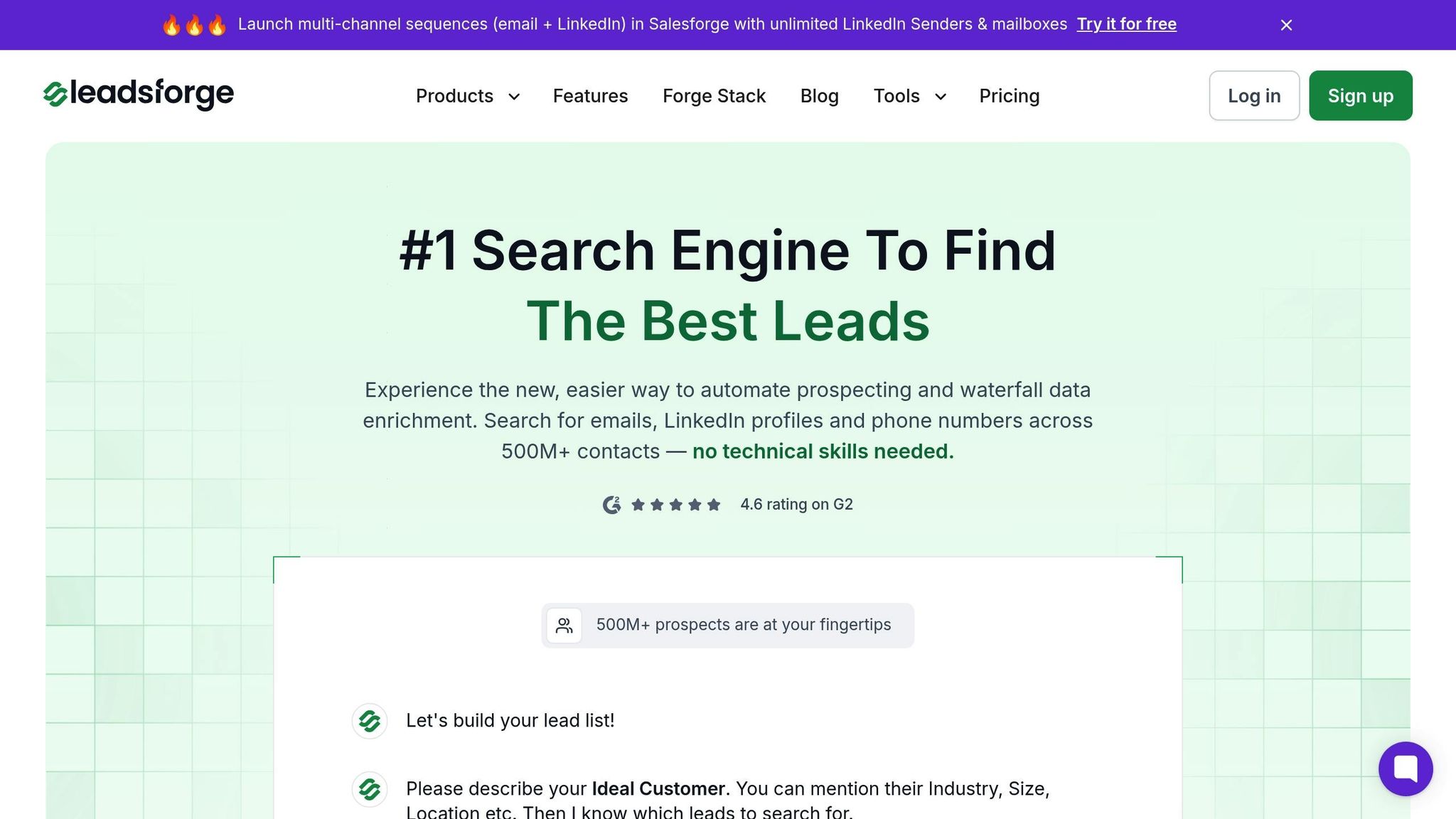
Leadsforge takes these AI-driven capabilities a step further, turning strategic market insights into ready-to-use leads. Its chat-like interface lets users input plain-language descriptions - like “B2B software companies in the U.S. with 50-200 employees using Salesforce” - and instantly generates precise ICP filters. This eliminates the technical hurdles that often slow down market segmentation.
The platform also handles data enrichment and verification in real time. Once you define your SAM, Leadsforge creates targeted lead lists complete with verified email addresses, LinkedIn profiles, and phone numbers through its waterfall enrichment process. This saves teams from the tedious work of manually matching and cleaning data, which many other platforms still require.
Leadsforge’s pricing model is simple and flexible, starting at $49/month for 2,000 credits. New users even get 100 free credits to test the platform. Unlike enterprise-level tools that lock you into annual contracts and seat-based licenses, Leadsforge offers a pay-as-you-go model that’s perfect for small- to mid-sized B2B teams.
The platform also helps identify niche segments through features like company lookalikes and followers search. For example, if you’ve already landed deals with specific companies, Leadsforge can find similar organizations within your SAM. This bottom-up approach uses your actual sales data, rather than broad industry estimates, to create more accurate and actionable lead lists.
Platforms like ZoomInfo and Apollo are well-known for their extensive databases and advanced features, including buying signals, hiring trends, and revenue intelligence. These tools are great for large enterprises with dedicated RevOps teams and big budgets. But for smaller teams, their complexity can be overwhelming when quick, actionable results are needed.
Leadsforge, on the other hand, caters to small- to mid-sized U.S.-based B2B teams looking for speed and simplicity without compromising accuracy. While ZoomInfo requires users to manually select NAICS codes and layer multiple filters, Leadsforge’s conversational interface does the heavy lifting. You can go from defining your TAM to downloading a verified lead list in just minutes.
| Feature | Leadsforge | ZoomInfo / Apollo |
|---|---|---|
| Interface | Chat-like, conversational AI | Complex dashboards |
| Pricing Model | Credit-based (pay-as-you-go) | Subscription/Enterprise plans |
| Target Audience | Small to mid-sized US B2B teams | Mid-market to large enterprises |
| Data Enrichment | Automated waterfall process | Manual data handling needed |
| Market Definition | Auto-converts TAM/SAM to ICP filters | Requires manual firmographic selection |
The difference becomes clear in terms of time-to-value. Leadsforge users can refine their SAM, generate leads, and export verified contact data all in one session. While enterprise platforms offer a broader range of features - like AI Copilots and buying group identification - they come with steep learning curves and hefty price tags, which may not make sense for teams with straightforward lead generation needs.
Lori Highby, Founder and CEO of Keystone Click, highlights the importance of selecting the right tool:
"In my experience, these tools are extremely informative when determining how to niche. Take the time, and understand the opportunity or lack thereof with your new target."
For teams that need to move quickly and operate efficiently, Leadsforge’s focused approach to TAM and SAM-based lead generation delivers results without the complexity of enterprise-grade tools.
Grasping the distinction between TAM (Total Addressable Market) and SAM (Serviceable Addressable Market) is key to crafting a smarter B2B strategy. While TAM offers a big-picture view of long-term potential, SAM narrows the focus to the market you can realistically serve, factoring in elements like regional distribution, North American regulations, and local demographics.
It’s a good practice to revisit your TAM and SAM figures regularly - at least once a year, or even quarterly if you’re in a fast-paced industry. Markets, competitors, and internal capabilities are always shifting, and staying updated ensures you’re making informed decisions. Whether you’re launching a new product, expanding your sales team, or entering fresh markets, these moments call for reevaluating your market metrics. Research even shows that companies actively tracking market data grow 30% faster than those that don’t.
As Clifford Chi from HubSpot explains:
"TAM, SAM, and SOM are simply overlapping metrics that make it easier to fine-tune your business plan, identify achievable goals, and understand the potential revenue and operational impacts of certain business decisions".
This kind of clarity helps you avoid wasting resources on markets you can’t effectively serve and instead focus on segments with the highest conversion potential. It also lays the groundwork for integrating AI-driven tools into your strategy.
For example, modern AI-powered solutions like Leadsforge can transform your market-sizing data into actionable lead lists. Instead of manually combing through databases or dealing with complicated dashboards, you can define your SAM in straightforward terms and quickly access targeted, verified contacts. Aligning your market data with focused outreach not only improves lead quality but also saves time - perfect for small- to mid-sized US B2B teams looking for speed and precision without the hassle of enterprise-level tools.
When it comes to B2B companies, TAM and SAM are key metrics that significantly influence investment decisions. TAM, or Total Addressable Market, represents the total revenue opportunity available if a product were to capture 100% of its market. Essentially, it gives investors a glimpse of the maximum growth potential for a business. Meanwhile, SAM, or Serviceable Addressable Market, narrows the focus to the portion of the market a company can realistically target. Factors like geography, product compatibility, and distribution channels help define this more achievable segment.
Investors rely on these metrics to balance growth potential against risk. A large TAM can support higher funding rounds and aggressive expansion plans, while a clearly defined SAM provides insight into short-term opportunities and practical go-to-market strategies. For example, platforms like Leadsforge can stand out by presenting a robust TAM, such as the entire U.S. B2B SaaS market, alongside a focused SAM, like mid-market firms accessible through AI-powered prospecting. This dual clarity not only highlights potential growth but also differentiates Leadsforge from competitors like HubSpot or Salesforce. By offering this level of transparency, companies can boost investor confidence, shaping decisions around funding, valuation, and resource allocation.
Refining your market strategy from Total Addressable Market (TAM) to Serviceable Addressable Market (SAM) means zeroing in on the part of the market you can realistically target and serve. It starts with defining your product or service’s ideal customer profile and calculating TAM. This is usually done by multiplying the total number of potential customers by the average revenue per customer.
From there, break your TAM into smaller, more manageable segments. Consider factors like industry, company size, or geography, and account for practical limitations such as your service areas, regulatory restrictions, or how well your product fits specific needs. For each segment, estimate the number of reachable accounts and their potential revenue. Adding up these qualified segments will give you your SAM.
To ensure your SAM is accurate, validate it with primary research - think surveys, interviews, or small-scale sales tests. Adjust your findings based on any new insights. By narrowing your focus this way, you can allocate resources more effectively, set realistic goals, and make the most of your market opportunities using tools like Leadsforge.
AI-powered tools have revolutionized the way businesses calculate Total Addressable Market (TAM) and Serviceable Addressable Market (SAM), turning what used to be a labor-intensive task into a streamlined, data-driven process. By tapping into real-time data like firmographics, technographics, and intent signals from millions of companies, AI helps businesses zero in on the most relevant market segments and prioritize prospects with the highest intent to buy.
Take platforms like Leadsforge, for example. Their AI capabilities not only keep TAM estimates current but also refine SAM using filters such as geography or industry. On top of that, Leadsforge ranks potential leads based on factors like purchase intent, company size, and overall fit. Unlike competitors such as ZoomInfo or Cognism, Leadsforge takes things a step further by blending predictive scoring with automated outreach. This combination speeds up lead qualification and ensures sales teams are better aligned with market opportunities. The result? Higher conversion rates and smarter use of resources.