Predictive lead scoring is changing how sales teams prioritize leads. By using machine learning to analyze historical and real-time data, businesses can rank prospects based on their likelihood to convert. This approach outperforms older methods, offering 70%–85% accuracy versus 45%–60% for manual scoring.
Key Benefits:
How It Works:
Top Tools in 2026:
To succeed, businesses must integrate predictive scoring into their CRM, train teams to interpret scores, and retrain models quarterly. Start small, test ROI, and scale based on results.
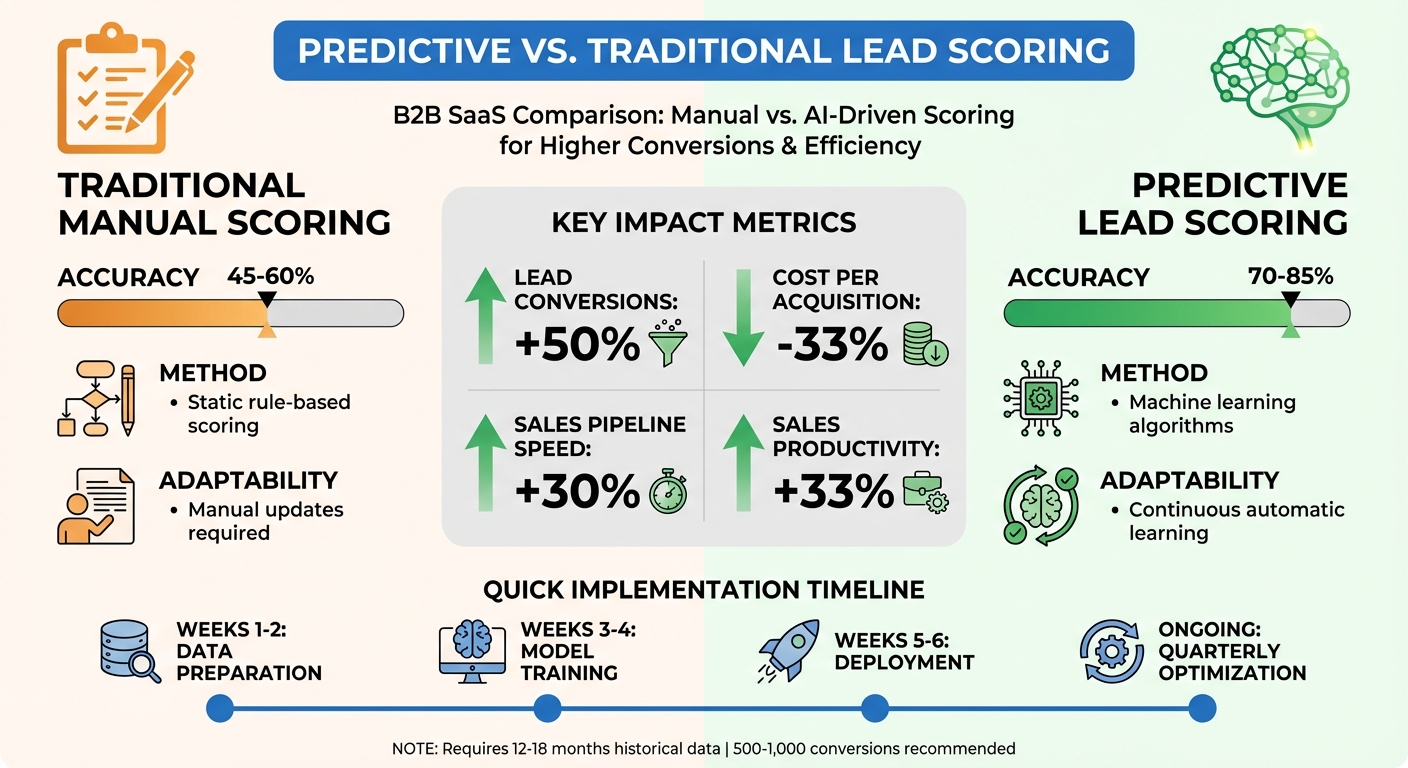
Predictive vs Traditional Lead Scoring: Performance Comparison 2026
Predictive lead scoring takes data from various sources, organizes it into a usable format, and applies feature engineering by assigning weights to different attributes. For example, in some businesses, the size of a company might be a stronger indicator of potential than its geographic location.
The system then trains its model to refine predictions. Unlike older rule-based methods that rely on static scoring, these AI-driven models adapt over time. They learn from every closed deal, continuously improving their understanding of what defines a "good lead" for your business. To create an effective model, you’ll generally need at least 40 qualified leads and 40 disqualified ones from a historical period of three months to two years.
The quality of your predictive model depends heavily on the data it uses. It gathers information from sources like your CRM (contact details, deal history, communication logs), website activity (page views, downloads, time spent), and external enrichment tools. Tools such as Leadsforge streamline this process by supplying verified company data, intent signals, and contact details, saving you from manually collecting firmographic information. However, smooth data integration is crucial. For instance, syncing newly closed leads in enterprise systems like Dynamics 365 can take up to four hours, which may delay retraining the model.
These algorithms continuously improve through automatic retraining cycles. Many systems update every 15 days to adapt to changing market trends and buyer behaviors. To ensure reliability, the models use an "Area Under Curve" (AUC) score to evaluate their performance. This score measures how well the model differentiates between leads likely to convert and those that aren’t. Thanks to this ongoing learning process, the scoring system becomes smarter over time without needing manual tweaks.
Predictive scores adjust in real-time as new data comes in, meaning a lead’s ranking can change based on recent actions - like attending a webinar or visiting your pricing page. Most platforms also display the "top influencing factors" for each score, giving sales reps insight into why a lead received its ranking. This transparency helps teams decide whether to pursue a lead immediately or focus on nurturing them further, leading to more strategic and timely follow-ups.
(function(d,u,ac){var s=d.createElement('script');s.type='text/javascript';s.src='https://a.omappapi.com/app/js/api.min.js';s.async=true;s.dataset.user=u;s.dataset.campaign=ac;d.getElementsByTagName('head')[0].appendChild(s);})(document,372145,'tlb9tturzitublbka5ay');
The evolution of predictive lead scoring has shifted focus from static firmographics to real-time engagement data. Today, platforms like ActiveCampaign's "AI win probability" tool analyze how leads interact with content to estimate their likelihood of conversion. This shift highlights the industry's move away from rigid scoring systems toward more dynamic models that factor in context and intent.
For enterprises already using Salesforce CRM, Salesforce Einstein remains a top choice, offering seamless integration and advanced AI-driven features. Meanwhile, Apollo.io provides a robust database paired with scoring tools, and ZoomInfo excels in delivering accurate and comprehensive data. However, these traditional platforms often require more technical resources compared to emerging solutions. Among these options, one platform stands out for combining lead generation and scoring in a unique way.
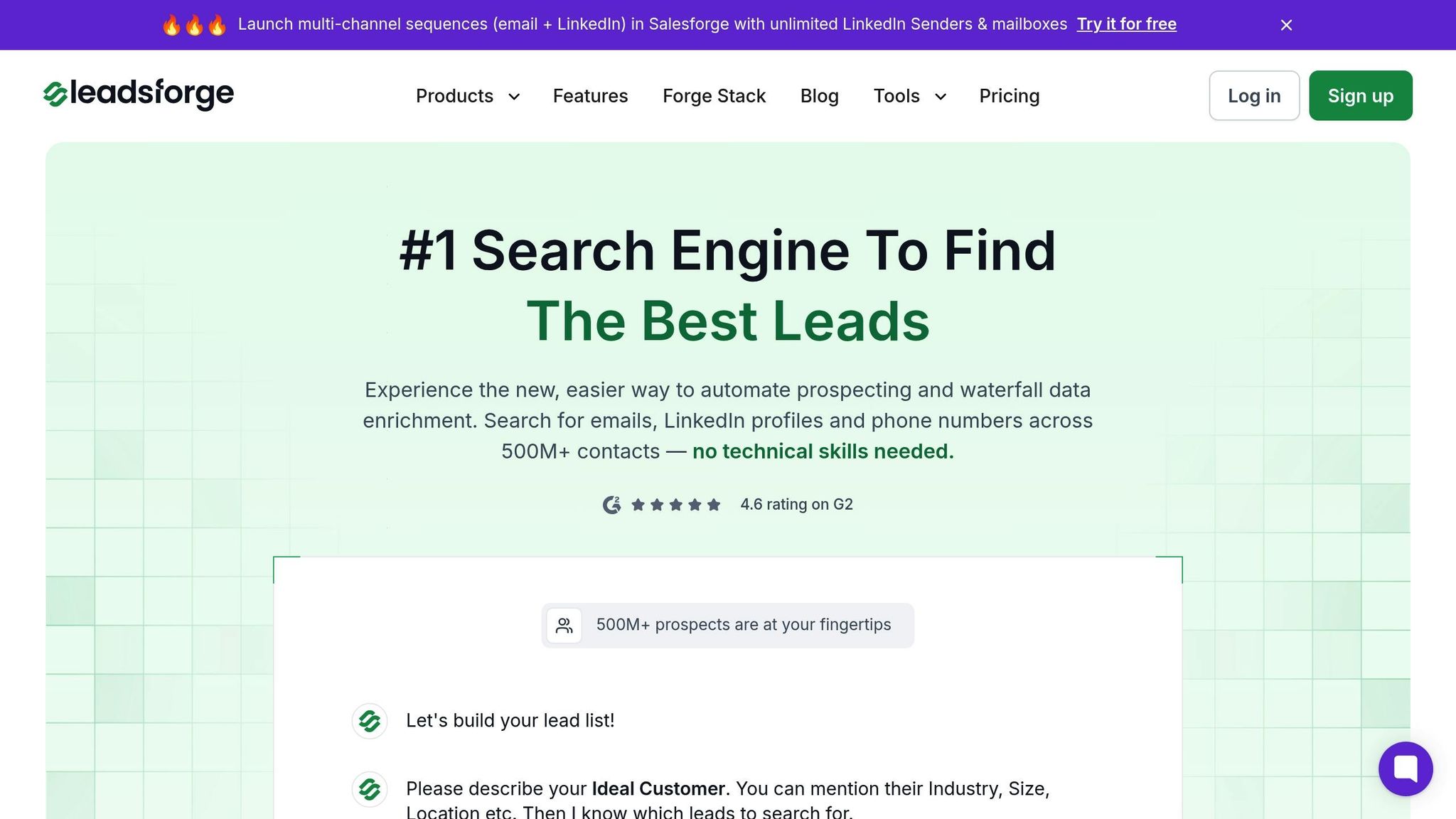
Leadsforge takes a different approach by blending AI-driven lead generation with predictive scoring, ensuring you start with the right prospects. Instead of just scoring leads, it creates targeted, verified lists of potential customers based on your input through an intuitive chat interface. These lists come enriched with LinkedIn profiles, email addresses, and phone numbers, streamlining the process and eliminating the delays commonly associated with manual data collection.
What truly sets Leadsforge apart is its integration with The Forge Stack, particularly Salesforge for multi-channel outreach. High-scoring leads can seamlessly flow into personalized email campaigns without the hassle of manual data transfers. Additionally, the platform leverages intent signals and lookalike search features to identify prospects that align closely with your top-performing customers. At $49 per month (or $588 annually), Leadsforge offers an affordable solution for growing B2B teams that need both lead generation and predictive scoring without the complexity of enterprise-level tools.
| Feature | Leadsforge | ActiveCampaign | Salesforce Einstein | Apollo.io | ZoomInfo |
|---|---|---|---|---|---|
| Primary Focus | AI lead generation + scoring | Marketing automation + scoring | Enterprise CRM + AI scoring | Database + engagement | Data intelligence and accuracy |
| Data Enrichment | Built-in (LinkedIn, email, phone) | Limited | Requires additional tools | Built-in database access | Extensive, focused on accuracy |
| Real-Time Scoring | Yes | Yes (AI win probability) | Yes | Yes | No |
| Native Outreach Integration | Yes (Salesforge) | Yes (email campaigns) | Yes (Sales Cloud) | Yes (sequences) | Yes (CRM integration) |
| Setup Complexity | Low (intuitive chat interface) | Medium | High | Medium | Medium |
| Best For | B2B teams needing leads + scoring | Small businesses with a marketing focus | Large enterprises on Salesforce | Sales teams with existing databases | Teams prioritizing data accuracy |
When selecting a platform, don’t forget to validate your choice with real sales feedback. If your team finds that high-scoring leads aren’t converting, it’s a sign that the model’s weighting factors might need tweaking. Also, make sure your CRM data is clean - standardized job titles and removing duplicates are essential for reliable predictions.
Implementing predictive lead scoring involves four key phases:
Before launching, audit your data to eliminate inaccuracies. To prove the value of predictive scoring, run a 90-day A/B test comparing it to traditional rule-based scoring. Predictive systems often achieve 70–85% accuracy, outperforming the 45–60% accuracy of manual methods. Once deployed, keep refining your system to ensure consistent performance.
Predictive lead scoring requires regular attention. Retrain your model every quarter or after significant changes to your product. Hold monthly meetings with your sales team to adjust the model's weighting factors based on their feedback. Companies that follow these practices often see a 50% increase in sales-ready leads and a 33% boost in sales productivity.
If high-scoring leads aren't converting, it’s a sign that your model’s weighting factors need adjustment. Balance automation with human oversight by having senior reps review borderline scores before making routing decisions. Track metrics like Precision, Recall, and F1-score to detect model drift early. Also, ensure your scoring thresholds (typically on a 0–100 scale) align with actual conversion trends.
While implementing predictive lead scoring, steer clear of common missteps:
Lastly, define what success looks like before you start. Whether it’s achieving a specific lead-to-opportunity conversion rate within 60 days or tracking closed-won deals within a set timeframe, having clear goals ensures your model delivers meaningful results.
Predictive lead scoring is transforming how B2B companies approach prospecting. By leveraging machine learning, these models analyze thousands of data points to predict conversion probabilities with an accuracy of 70–85%, far exceeding the 45–60% accuracy of older methods. This leap in precision isn't just theoretical - it directly impacts the bottom line. Predictive analytics can boost conversion rates by 50% while slashing acquisition costs by 33%.
Getting started requires a structured approach. Begin by auditing your CRM to ensure it includes at least 12 months of historical conversion data. Train your model using a mix of behavioral, demographic, and firmographic signals, then integrate it into your workflow with automated lead routing and proper sales team training. To keep your system sharp, retrain your model quarterly to avoid performance dips caused by model drift.
Collaboration between sales and marketing is non-negotiable for success. When both teams rely on the same scoring framework, sales productivity can jump by 33%. This happens because reps spend less time on manual research and more time engaging with qualified prospects. A continuous feedback loop, where real-world outcomes refine the AI's predictions, ensures the system keeps improving over time.
These strategies lay the groundwork for your next steps.
To put these insights into action, start small. Pilot predictive lead scoring on one product line to test its ROI before rolling it out more broadly. Track key metrics like MQL-to-SQL and SQL-to-close rates to measure the impact post-deployment. If you're exploring platforms to simplify this process, Leadsforge (https://leadsforge.ai) is worth considering. It combines predictive scoring with AI-driven lead generation, offering intent signals and qualification tools that integrate smoothly with your existing systems.
For even better results, pair third-party B2B data with your internal signals to identify potential buyers earlier in their journey. The companies reaping the most rewards treat predictive lead scoring as an ongoing initiative - one that evolves through regular optimization and tight collaboration across teams.
Predictive lead scoring uses AI-powered analysis to evaluate data like customer behavior, firmographics, and intent signals, pinpointing high-quality leads with impressive precision. Unlike older rule-based systems, this approach adjusts to evolving patterns and trends, often reaching accuracy levels nearing 90%.
This method can drive a 25% to 50% boost in conversion rates by prioritizing the most promising leads and aligning sales efforts where they matter most. With data-driven insights at the core, businesses can refine their lead generation strategies and make smarter, more effective decisions.
Creating a predictive lead scoring model that works effectively involves combining several types of data: demographic, firmographic, behavioral, and intent information. Demographic details, such as job title, department, and seniority level, paired with firmographic insights like company size, industry, and revenue, help paint a clear picture of the prospect and their organization.
Behavioral data, like website visits, content downloads, email interactions, and call activity, offers valuable clues about how prospects engage with your brand. These behaviors often signal their likelihood of converting. Adding intent signals - such as keyword searches, technology usage, or lookalike activity - along with historical CRM data (like past wins, lost deals, and deal sizes), allows the model to identify patterns that drive successful outcomes.
Leadsforge streamlines this entire process by combining and enriching all these data points in one platform. It delivers verified contact information, lookalike matches, company followers, and real-time intent signals, making it easier for B2B teams to create accurate and actionable predictive scoring models.
To get predictive lead scoring right, start by setting clear business objectives. Whether your aim is to boost the number of qualified leads or cut down on acquisition costs, defining your goals upfront will guide the entire process. Then, focus on gathering and cleaning your data. This includes information like demographic details, firmographic data, and behavioral signals such as website activity or email engagement. The quality of your data matters - a lot - since accurate predictions depend on it.
Once your data is ready, take it a step further by enriching it with additional insights. This could mean adding details like company size, industry, or verified contact information. Tools like Leadsforge can handle this automatically, making your dataset more robust. After that, move on to training a machine-learning model using historical data. Adjust and fine-tune the model to ensure it delivers reliable results. The last step? Integrate your scoring system with your CRM and outreach tools. This ensures real-time updates and makes lead prioritization seamless. Platforms like Leadsforge can even sync with your CRM and automate lead routing based on scores.
By following these steps - goal setting, data preparation, enrichment, model training, and integration - you can focus on the most promising prospects, streamline your pipeline, and leave outdated scoring methods in the dust.