In B2B sales, personalization is no longer optional - buyers demand tailored experiences that address their specific needs. The challenge? Traditional methods can't keep up with complex sales cycles and massive data sets. Here's where AI steps in, offering scalable solutions to improve lead quality, shorten sales cycles, and increase conversions.
This article explores four AI-powered tools that help businesses achieve personalization at scale:
Each tool excels in specific areas like scalability, integration, and data accuracy, making them critical for modern B2B strategies. Below, you'll find a detailed breakdown of how they work, their costs, and their impact on sales performance.

Leadsforge addresses a major hurdle in B2B marketing: personalizing outreach at scale. It helps you identify the right prospects and retrieve their contact details without the hassle of manual searches or outdated lists. All you need to do is describe your ideal customer - something like, "VPs of Operations at manufacturing companies with 200–2,000 employees in the Midwest using SAP" - and the AI takes it from there. It converts your input into structured criteria, generating verified leads in no time.
With access to a global database of over 500 million contacts, Leadsforge employs a multi-layered data enrichment process. This method cross-references multiple verified B2B data sources to find accurate emails, LinkedIn profiles, and phone numbers for each prospect. By leveraging multiple sources, the platform ensures higher match rates and up-to-date contact details. Additional features, like lookalike searches (uploading your top customers to find similar prospects) and company followers search (identifying individuals linked to your target accounts on social platforms), make it easier to keep your prospect list fresh as you grow.
Leadsforge is built to handle high-volume prospecting across different segments and regions in the U.S. With its capabilities, a single sales rep can generate and update thousands of targeted contacts each month - work that would otherwise require an entire team of researchers. For mid-market sales (deal sizes between $10,000 and $50,000), teams can juggle hundreds of accounts while keeping lists up to date. For enterprise-level sales, where buying committees are more complex, the platform quickly identifies key stakeholders based on role, seniority, and department. Studies show that AI-powered workflows can reduce prospecting time by 50–70%, while integrated AI tools can boost productivity by up to 70% and cut costs by as much as 60%.
When scaling personalized outreach, having accurate and enriched data is non-negotiable. Leadsforge focuses on real-time verification of emails and LinkedIn profiles while incorporating essential firmographic details like revenue, headcount, geographic region, and tech stack. It also uses intent signals to prioritize accounts more likely to convert. To maintain data quality, the platform verifies information before campaigns, standardizes firmographic data before CRM integration, and uses engagement feedback to refine its accuracy over time.
Leadsforge works seamlessly with other tools in The Forge Stack, such as Salesforge (for multichannel outreach), Mailforge (email infrastructure), Warmforge (email warmup), Primeforge (Google Workspace and Microsoft 365 mailboxes), and Infraforge (private email infrastructure). This integration ensures a smooth transition from lead generation to outreach and deliverability management - no complicated setups or heavy IT involvement needed. For teams using external CRMs like Salesforce or HubSpot, Leadsforge supports simple exports and easy field mapping, ensuring data quality and consistent reporting. Its performance is reflected in a 4.6 G2 rating.
Leadsforge uses a credit-based subscription model. The Essential Plan starts at $49 per month or $588 annually, offering 2,000 monthly credits (28,000 annually). Credits don’t expire, and new users get 100 free credits upon signup, with opportunities to earn more through referrals. To evaluate ROI, compare the cost per verified contact with the expense of hiring researchers or SDRs for manual prospecting. Key metrics like meetings booked per 1,000 contacts, reply rates, and opportunity-to-win ratios can help you measure the platform’s direct impact on your sales pipeline.
Next, we’ll take a closer look at how Salesforce Einstein uses predictive analytics to push B2B personalization even further.
Salesforce Einstein brings predictive insights directly into the Salesforce platform, offering tools like lead and opportunity scoring, next-best action suggestions, and AI-generated emails. For teams already working within Salesforce, Einstein integrates effortlessly into existing workflows, making it a natural fit for B2B organizations.
Einstein taps into Salesforce's cloud infrastructure to handle massive amounts of data, processing millions of records and generating billions of predictions every day. Whether you're a mid-market SaaS company evaluating every new lead or an enterprise manufacturer segmenting accounts by engagement, Einstein scales to meet your needs. However, the scalability depends more on your specific Salesforce edition and data storage capacity than on Einstein itself.
Einstein uses your historical Salesforce data - like opportunity outcomes, activity logs, and account details - to build its predictive models. If you have 6–12 months of consistent data with clear win/loss outcomes and well-maintained fields, Einstein's scoring tools become far more reliable. Salesforce users have reported up to a 26% increase in win rates and a 28% boost in sales productivity when using Einstein. However, poor data quality can undermine its performance. To get the most out of Einstein, it's critical to standardize required fields, ensure thorough activity logging, and regularly update key predictors to align with real-world buying signals.
Since Einstein is a native part of Salesforce, getting started is straightforward. Most Sales Cloud editions allow you to activate Einstein features directly from Salesforce Setup using guided wizards. These wizards help configure lead scoring, opportunity scoring, and activity capture without the need for custom API development. Einstein also plays well with external platforms, enabling enriched Salesforce data for better prospect ranking and prioritization. Tools like Outreach.io can further leverage these insights to drive personalized outreach campaigns.
Einstein's pricing depends on your Salesforce edition. Basic features like lead and opportunity scoring are often included in higher-tier Sales Cloud editions. However, advanced functionalities - such as Einstein 1 Sales, Data Cloud, and Einstein Copilot - come with additional per-user fees and potential usage-based costs. If you're not already using Salesforce or are on a lower-tier edition, it's worth weighing the costs against the potential return on investment to determine if Einstein fits your needs.
Up next, we’ll dive into how 6sense uses external intent data to enable personalized account-based marketing at scale.

6sense is an account-based AI platform designed to help businesses uncover hidden buyer activity. It digs into what it calls the "Dark Funnel" - anonymous research done by potential buyers on third-party sites, review platforms, and industry publications. This means B2B teams can identify which accounts are actively exploring solutions, even before prospects officially engage by filling out a form.
6sense handles massive amounts of data in real time, tracking thousands of accounts simultaneously. It automatically updates dynamic segments based on buyer signals, making it easier for sales and marketing teams to scale their efforts. Whether you're targeting a few hundred accounts or tens of thousands, 6sense eliminates the need for manual list updates. The results? Many customers report a 2–3x increase in opportunity volumes by using its predictive models to focus on accounts that are most likely to convert. For large enterprise teams running multi-regional or product-specific ABM campaigns, this level of automation is a game-changer. It enables personalized workflows - across email, ads, and sales plays - for hundreds of high-value accounts at once, all while maintaining accuracy in predicting buyer behavior.
The platform's AI models are built on billions of data points, including website visits, ad interactions, technographic changes, CRM history, and third-party intent signals. This extensive data allows 6sense to pinpoint which accounts are in specific buying stages with impressive precision. Users have reported a 10–40% improvement in win rates and 10–20% shorter sales cycles by aligning their outreach with these predictions. However, the accuracy of these insights depends heavily on clean and consistent data. If your CRM is riddled with incomplete records, inconsistent domain mappings, or sparse activity logs, the platform's performance will suffer. Teams that take the time to standardize fields and clean up their data before implementing 6sense see the best results, making data hygiene a critical step for success.
6sense integrates seamlessly into existing CRM and marketing platforms, making it easy to activate its intent data across your tech stack. Pre-built connectors are available for tools like Salesforce, HubSpot, Marketo, Eloqua, and major ad platforms. For example, 6sense embeds predictive scores and buying stage insights directly into Salesforce, allowing sales development reps (SDRs) to prioritize accounts without needing to toggle between tools. That said, the initial setup can be complex. Onboarding often takes several months and requires dedicated RevOps support to handle data mapping, identity resolution, and model tuning. Many G2 reviewers (where the platform scores 4.4–4.6 out of 5) mention this extended implementation timeframe. A phased rollout - starting with CRM and marketing automation platform (MAP) integration, then adding sales and ad platforms - can help reduce operational strain during deployment.
6sense uses contract-based annual pricing, which factors in account volume, selected modules, and data packages. While exact pricing isn’t published, it typically starts in the tens of thousands of dollars per year for enterprise clients. User reviews consistently place 6sense in the premium/enterprise pricing category, with costs rising significantly for global organizations. For smaller teams or those just beginning their account-based marketing (ABM) journey, the price may be a hurdle. However, businesses that fully leverage its predictive insights and automation capabilities often find the investment worthwhile, thanks to measurable gains in pipeline growth and improved win rates.
Next, we’ll look at how Outreach.io leverages AI to scale sales engagement through automated sequencing and conversation intelligence.

Outreach.io simplifies the sales process from start to finish - covering everything from prospecting to closing deals and beyond. Impressively, the platform helps sellers close over 2 million opportunities every month.
Outreach.io is built to handle growth seamlessly, thanks to its AI-powered tools that boost productivity by 60%. These tools identify top prospects, automate research, and suggest next steps, making it easier to personalize interactions throughout the sales journey - whether it’s prospecting, closing, renewals, or expansion. Large teams can manage thousands of accounts efficiently, as demonstrated by Amplitude, which reduced its tech stack from five platforms to just Outreach, saving over $600,000 annually. Unlike platforms focused solely on lead generation, Outreach.io takes an all-in-one approach, streamlining the entire sales workflow.
The platform uses AI-driven insights to provide detailed account information, ensuring sales teams engage all relevant stakeholders. This alignment around buyer priorities reduces friction and increases success rates. Personalized messaging is supported at every stage of the process, which aligns perfectly with the need for personalization at scale. Additionally, Outreach.io delivers highly accurate sales forecasts through its AI insights, helping teams focus their efforts where it matters most. As JP Cheung of Rootly puts it:
"I sleep better with Outreach, knowing that I have the support I need for our team to succeed. It's a true partnership with Outreach..."
Outreach.io integrates seamlessly with existing CRMs and sales tools, consolidating multiple functions into a single platform. Amplitude’s move from five tools to just Outreach highlights how it can simplify complex tech stacks. However, transitioning to this unified system requires adjustments to workflows and team training. Mallory Davidson, Senior Sales Enablement Lead at Verkada, shares:
"We want them to work smarter, not harder, and Outreach really allows them to do that"
Outreach.io offers custom pricing tailored to each organization’s needs. While the investment may seem steep for smaller teams or those just beginning to scale personalization, the potential return can be substantial for those fully utilizing its end-to-end capabilities. Amplitude’s $600,000+ annual savings is a case in point. For smaller operations, however, more specialized, pay-as-you-go solutions might be a better fit.
Outreach.io stands out with its unified platform and AI-driven insights, setting it apart in a crowded field of sales tools. Up next, we’ll compare all four platforms side-by-side to help you decide which AI solution best matches your B2B personalization goals.
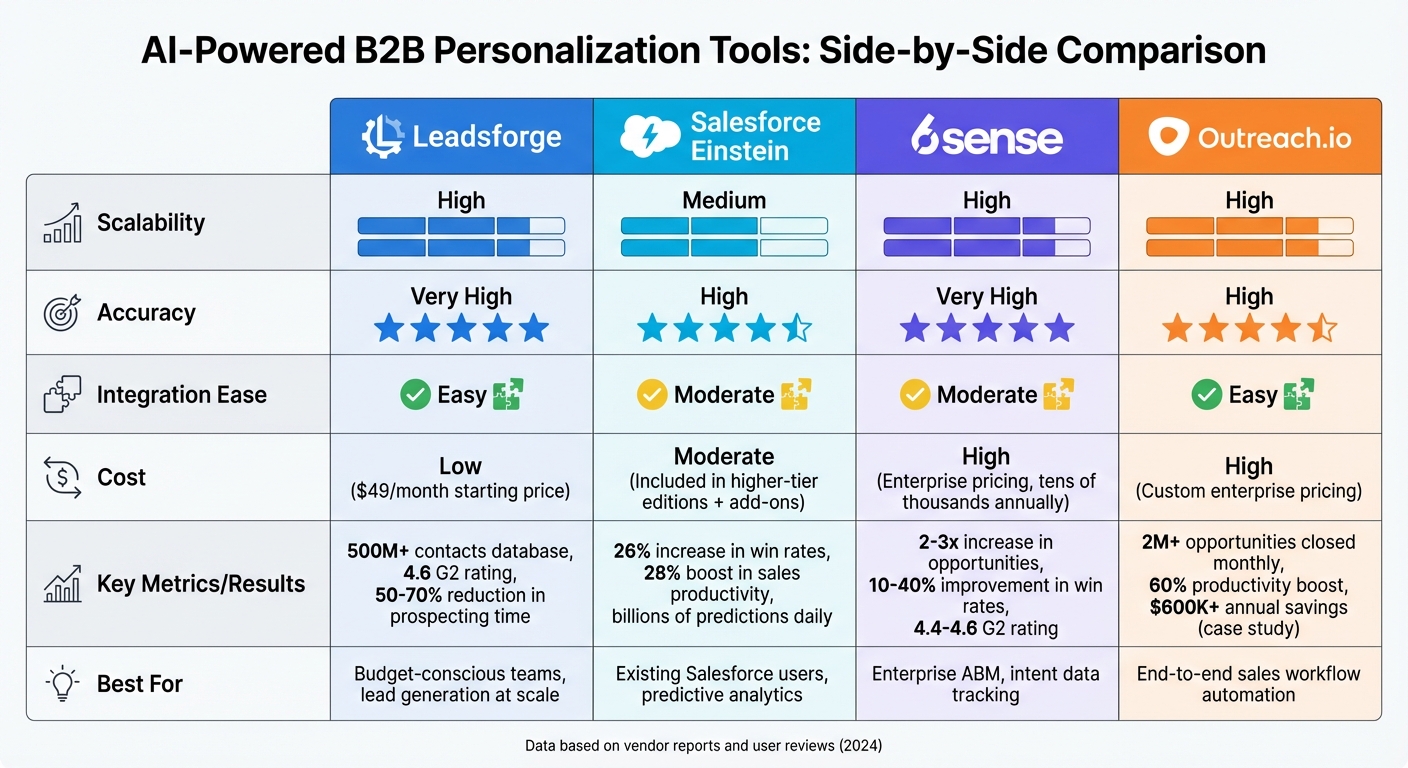
AI Sales Tools Comparison: Leadsforge vs Salesforce Einstein vs 6sense vs Outreach.io
Here's a quick overview of how the platforms compare across four key areas:
| Tool/Strategy | Scalability | Accuracy | Integration Ease | Cost |
|---|---|---|---|---|
| Leadsforge | High | Very High | Easy | Low |
| Salesforce Einstein | Medium | High | Moderate | Moderate |
| 6sense | High | Very High | Moderate | High |
| Outreach.io | High | High | Easy | High |
This table provides a straightforward way to evaluate each tool's strengths before diving into their unique benefits.
Leadsforge shines as a budget-conscious option for teams aiming to scale without overspending. Its credit-based pricing model makes it cost-effective, while its database of over 500 million contacts ensures precise lead generation through a waterfall enrichment process that taps into multiple verified data sources. Plus, exporting leads via CSV or integrating directly with Salesforge is simple, ensuring minimal disruption to workflows.
Salesforce Einstein integrates seamlessly within the Salesforce ecosystem, offering strong accuracy and a comprehensive feature set. It's a great fit for businesses already using Salesforce, though its scalability may depend on the overall system requirements.
6sense leverages predictive analytics and intent data to pinpoint in-market accounts effectively. Its scalability across extensive account data makes it ideal for organizations with dedicated revenue operations teams seeking deeper insights and targeted strategies.
Outreach.io goes beyond lead generation, serving as a complete sales execution platform. It helps sales teams close over 2 million opportunities monthly and boosts productivity. With its easy integration capabilities, it can replace multiple tools, as shown by Amplitude's reported savings of over $600,000 annually. This makes it a powerful choice for managing the entire sales workflow.
These comparisons lay the groundwork for a deeper look at how AI is reshaping scalable B2B personalization.
When choosing an AI personalization tool, it’s essential to consider your specific needs, budget, and current setup. For smaller teams or startups aiming to generate leads without breaking the bank, Leadsforge offers a practical solution. With pricing starting at $49 per month and 100 free credits to kick things off, it provides an affordable entry point. Its waterfall enrichment process ensures you’re not wasting time or money on outdated or inaccurate data, while its chat-based interface keeps prospecting simple and user-friendly.
On the other hand, Outreach.io is a strong choice for businesses managing complex sales workflows. If you need AI-driven support across every stage of the revenue cycle - from prospecting to renewals - this platform can deliver measurable results. For example, many users report significant annual savings by consolidating their tech stacks. Whether you’re just starting out or managing intricate sales operations, there’s a tool out there to help you streamline and succeed.
AI tools such as Leadsforge refine lead generation by tapping into multiple verified data sources and conducting real-time data enrichment. This includes validating email addresses, verifying LinkedIn profiles, and assessing the reliability of phone numbers to create precise, highly targeted lead lists.
By automating these tasks, Leadsforge allows businesses to achieve better match rates and concentrate on prospects with higher conversion potential. This not only saves time but also enhances overall efficiency.
Integrating Salesforce Einstein with your CRM system can significantly elevate how you manage customer relationships and sales processes. For starters, it brings advanced predictive analytics into the mix, giving you the ability to anticipate customer behaviors and needs with greater accuracy. This means you can stay one step ahead in addressing what your customers want.
Another major advantage is the access to personalized customer insights. With these insights, you can tailor your interactions to be more relevant and meaningful, strengthening your connection with customers.
On top of that, Salesforce Einstein takes care of repetitive tasks, such as data entry, freeing up your team to focus on more strategic efforts. It also sharpens lead scoring, helping you prioritize the most promising opportunities, and enhances sales forecasting, offering a clearer picture of future revenue potential. Together, these features streamline your processes, boost productivity, and deepen customer engagement, making your CRM system a much more effective tool.
6sense leverages intent data to decode behavioral signals that indicate a prospect's interest in purchasing. This information allows businesses to focus on the most promising accounts, tailor their outreach to individual needs, and connect with prospects at the perfect moment. By syncing marketing strategies with buyer intent, companies can enhance engagement and achieve better conversion rates.