B2B buyers now rely heavily on digital channels to research solutions, making multi-channel content marketing essential for generating leads. This strategy ensures consistent messaging across platforms like email, LinkedIn, webinars, and paid media, creating multiple touchpoints for decision-makers. Here’s a quick breakdown of the five strategies discussed:
Key Takeaway: Multi-channel marketing drives better results when your data, messaging, and targeting are aligned across platforms. Tools like Leadsforge simplify lead generation and personalization, making every interaction more relevant and impactful.
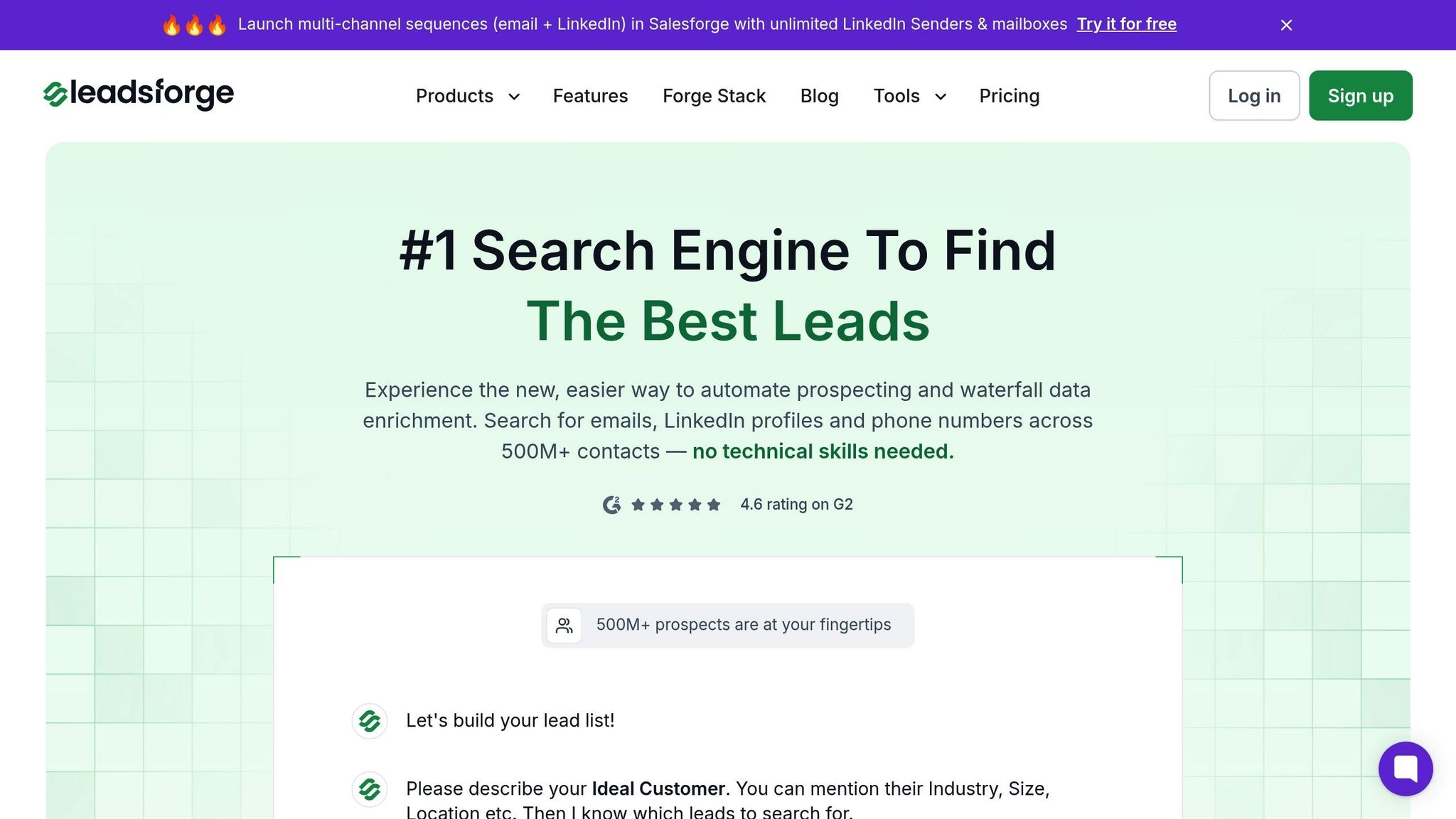
Before launching impactful email campaigns, LinkedIn outreach, or webinars, you need a solid database of the right people. For many B2B teams, this means hours spent manually searching LinkedIn, sorting through outdated spreadsheets, or working with overly broad databases. Leadsforge simplifies this process by serving as an AI-powered prospecting tool, turning a straightforward customer profile into a verified, enriched list of leads. This precise approach sets the stage for tailored strategies across email, LinkedIn, and paid channels.
Leadsforge provides channel-ready data designed to fit seamlessly into your core B2B channels. For email campaigns, it delivers verified business email addresses along with details like role, seniority, industry, and tech stack. This ensures your nurture emails land in the right inboxes and allows for segmentation by roles within the buying committee. For example, executives can receive ROI-focused content, while technical leads get information about integrations and features.
On LinkedIn, the platform’s enrichment capabilities make account-based targeting a breeze. You can create specific audiences like "Directors of IT in Tier 1 accounts" or use the company followers search to find prospects already engaging with your brand or competitors. These enriched profiles integrate seamlessly with LinkedIn Ads, Salesforge connection sequences, and InMail campaigns, ensuring your thought leadership content reaches decision-makers who align with your ICP (ideal customer profile).
For paid media, Leadsforge’s enriched data - such as company size, geography, industry, and job title - helps you build custom and lookalike audiences on platforms like LinkedIn Ads and programmatic channels. This targeted approach minimizes wasted ad spend by serving ads to contacts who closely match your top customers, effectively lowering your cost per qualified lead.
Using this enriched data, you can align your outreach with every stage of the buyer journey. During the awareness stage, broad ICP-based searches help you build audiences for educational campaigns like newsletters, top-of-funnel webinars, and LinkedIn posts. This introduces your brand to contacts who fit your ideal industries and roles but may not yet be familiar with your offerings.
As prospects transition to the consideration stage, Leadsforge’s filters for pain points, tech stack, and intent signals allow for more precise segmentation. These groups can receive mid-funnel content such as case studies, ROI calculators, and webinars across email and social channels. You’re no longer guessing who’s interested - data shows which accounts are warming up.
At the decision stage, enriched data on seniority, buying committee roles, and company size enables targeted outreach. C-suite executives can receive strategic proof points and compliance details, while technical buyers get integration guides and feature demos. These high-intent segments can also be synced into retargeting campaigns and personalized ABM strategies, keeping your brand top of mind as deals move closer to closing.
Leadsforge enriches your leads with firmographics (industry, company size, revenue), role and seniority (job title, function, decision-making authority), technographics (tools and platforms in use), and behavioral or intent signals when available. This data unlocks powerful personalization opportunities across all your channels.
In email campaigns, you can include industry-specific case studies and statistics. For instance, a cybersecurity company targeting healthcare might highlight HIPAA compliance examples, while financial services contacts could receive content about PCI-DSS and fraud prevention. On LinkedIn and in social ads, messaging can shift based on roles - executives see content focused on ROI and differentiation, while technical leads get feature comparisons and integration details. Even ad creatives can be tailored to reflect industry-specific challenges, with CTAs adjusted based on engagement levels like webinar attendance or product content interaction.
By combining Leadsforge enrichment with engagement signals from your marketing channels, you can create compound segments. For example, “Manufacturing companies with 500–2,000 employees, Director-level titles or higher, who clicked on the last two product emails” becomes a priority audience for mid-funnel demos and live Q&A webinars. Prospects from key industries who visit pricing pages or register for webinars can flow into high-touch Salesforge email and LinkedIn sequences, as well as more focused retargeting campaigns. This ensures every interaction feels timely and relevant.
Leadsforge streamlines your multi-channel marketing efforts by automating three time-consuming tasks: list building, enrichment, and qualification. In just minutes, you can generate segmented, enriched lists ready for A/B testing and frequent campaigns - without the need for additional team members.
On the ROI front, more accurate targeting with better-fit leads reduces wasted ad spend and improves conversion rates across channels. Faster iteration on lists allows you to quickly double down on high-performing segments. When paired with the full Forge Stack - Salesforge for outreach, Mailforge and Warmforge for email deliverability - teams in the U.S. often see lower costs per marketing qualified lead (MQL) and shorter sales cycles. This is especially impactful for companies with higher annual contract values (ACVs), where precise ICP matching significantly boosts revenue.
To measure the ROI impact of Leadsforge-powered audiences, run controlled tests against your legacy or broad lists across the same channels. Track key metrics like email open and click rates, meeting bookings, paid media performance (e.g., cost per click, cost per MQL), and funnel conversion rates (e.g., MQL-to-SQL, SQL-to-customer). Keep your creative and offers consistent, changing only the audience source. If Leadsforge segments deliver a 30% higher MQL-to-opportunity rate and a 20% lower cost per opportunity, it’s clear that shifting more budget toward ICP-driven lists is a smart move.
Here’s an example: A B2B SaaS company targeting HR leaders at mid-sized U.S. firms uses Leadsforge to create a list of HR directors and VPs at companies with 200–1,000 employees across key industries. They then launch a campaign that includes an email series offering an HR benchmarking report, LinkedIn posts promoting thought leadership, a live webinar on compliance updates, and retargeting ads for landing page visitors. Leadsforge becomes the central source of targeted contacts, enabling consistent and connected outreach across every channel.
When you’ve built a strong database of qualified leads using tools like Leadsforge, email becomes your go-to channel for guiding prospects through their buying journey. Unlike social media, where algorithms decide who sees your content, email puts you directly in decision-makers’ inboxes. To make the most of this channel, shift from generic drip campaigns to behavior-driven sequences that respond to real actions - like the pages prospects visit, the content they download, or the webinars they attend. This approach opens up opportunities for advanced segmentation and personalized follow-ups.
Email is particularly effective for B2B nurturing because it allows for segmentation based on firmographic, demographic, and behavioral data from your CRM and website. For example, you can track which pages prospects view, what content they engage with, and how they interact with your campaigns. These insights enable you to trigger highly relevant follow-ups. Automation tools even let you create dynamic content blocks tailored to specific segments - so a CFO might receive ROI-focused insights, while a VP of Sales gets case studies highlighting growth opportunities.
Another advantage of email is that it’s measurable and testable. You can experiment with subject lines, calls-to-action (CTAs), and content formats through A/B testing, then use those results to refine your broader strategy. When combined with tools like Leadsforge, which adds data like company size, industry, tech stack, and intent signals, your email campaigns become even more targeted. Instead of guessing who’s interested, you’re basing follow-ups on clear engagement signals.
Email also acts as a connector between other channels. You can share webinar recordings, link to LinkedIn posts, or promote retargeting offers, ensuring prospects experience a cohesive journey whether they’re reading your emails, seeing your ads, or attending events. This multi-channel alignment strengthens your overall marketing efforts.
Using enriched data from tools like Leadsforge, you can align your email campaigns with specific stages of the buyer journey:
Behavioral signals are key to creating personalized email campaigns. These include website activity (like pages visited or time spent), email engagement (opens, clicks, replies), event participation (webinar registrations or attendance), and campaign interactions (form fills or trial sign-ups). Use this data to create finely tuned segments, such as “visited pricing page twice in a week” or “downloaded enterprise security whitepaper.”
Dynamic content allows you to adjust messaging for each segment. For instance, you can customize value propositions, case studies, or CTAs based on a prospect’s industry, company size, or stage in the journey. Enriched data, like tech stack details or buying intent, lets you go even further by addressing specific pain points or referencing competitive alternatives.
A webinar follow-up sequence is a great example of this approach. Attendees can receive recordings, key takeaways, and tailored resources, while no-shows get a concise recap and an on-demand link. This kind of segmentation ensures your emails feel relevant and useful rather than intrusive.
For U.S.-based campaigns, transparency is crucial. Clearly explain what data you collect and how it’s used, and always offer easy opt-out options to comply with regulations like CAN-SPAM. Framing insights as needs-based messaging - such as “Since you’ve been exploring our security resources…” - keeps your emails engaging without feeling invasive.
Email nurture campaigns can deliver impressive ROI when designed to scale. On average, email marketing generates $36–$40 for every $1 spent. Nurtured leads also tend to make larger purchases and convert at higher rates. Companies that excel at lead nurturing see 50% more sales-ready leads at a 33% lower cost.
To achieve these results, build modular email structures based on key behaviors and stages of the buyer journey. Use dynamic content blocks and centralized templates to create emails that adapt to different segments while saving time. Integrations with tools like Leadsforge and your CRM ensure new leads are automatically enriched, scored, and placed into the right nurture streams. This automation keeps your campaigns effective without requiring constant manual updates.
Start with a few high-impact triggers - such as new lead sign-ups, key downloads, or demo requests - and expand as you gather performance data. Regularly test subject lines, send times, and CTAs to refine your approach. Key metrics to monitor include open rates, click-through rates (CTR), conversion rates (like demos booked), and revenue influenced. For U.S. teams, metrics like cost per lead (CPL in USD) and pipeline value are particularly useful for measuring success.
Keep your email lists healthy by cleaning them regularly, suppressing unengaged contacts, and adhering to opt-in standards. When combined with behavior-based triggers and enriched data, your email campaigns can dynamically adapt to prospects’ interests, delivering consistent results throughout the buyer journey.
Social media, particularly LinkedIn, plays a crucial role in establishing credibility and authority before any direct interactions occur. For B2B companies, LinkedIn serves as a hub where decision-makers spend their professional time, making it a powerful channel for building trust and positioning your brand as a go-to resource. Pairing thought leadership with targeted lead lists can create a highly effective awareness strategy. Here's a closer look at how LinkedIn and other platforms can be leveraged for B2B success.
LinkedIn stands out as the leading platform for B2B engagement. The stats are compelling: 80% of B2B leads originate from LinkedIn, and 84% of B2B marketers consider it the most effective organic social channel for their business. Additionally, 77% of B2B marketers identify LinkedIn as the top platform for content distribution.
What makes LinkedIn so effective? Its precise targeting capabilities. The platform allows you to segment audiences based on job titles, industries, company sizes, and even behavioral patterns like content engagement. This means you can ensure your thought leadership posts reach the right people, such as CFOs, IT directors, or procurement managers, depending on your ideal customer profile (ICP). By integrating tools like Leadsforge to identify and track companies and contacts that match your ICP, you can engage with their content and build visibility with high-value prospects even before formal outreach begins.
LinkedIn also offers various content formats - short posts, long-form articles, carousels, and videos - that encourage engagement without requiring users to leave the platform. These formats keep your content in front of your audience longer, boosting interaction rates. For instance, short-form posts are excellent for creating awareness by sharing quick insights, industry news, or commentary on trending topics.
While LinkedIn is the primary channel for B2B thought leadership, other platforms can complement your strategy. Twitter (X) is ideal for real-time updates and discussions, while Instagram can be used to highlight your company culture and employer branding. However, LinkedIn remains dominant, with 89% of B2B marketers relying on organic social media for content distribution, and LinkedIn leading the way.
Your social media content should evolve to align with the different stages of the buyer journey, ensuring it resonates with prospects at every step.
Zoom provides an excellent example of this multi-stage approach. By offering resources like a "Virtual Events Playbook" (downloaded over 200,000 times) and a "Remote Work Hub" with over 100 resources, Zoom guided prospects from early awareness to detailed implementation guidance.
The true power of LinkedIn lies in combining its targeting tools with enriched lead data. Platforms like Leadsforge provide detailed insights, such as company size, industry, tech stack, and intent signals, enabling you to create highly specific audience segments. Instead of generic messaging, you can tailor your content to address the unique challenges of each segment.
For example, if Leadsforge identifies mid-market SaaS companies with buying intent, you can craft LinkedIn posts that address the specific pain points of SaaS operations teams. CTOs might appreciate technical deep dives, while CFOs may respond to content focused on cost savings and ROI. This personalization extends beyond audience targeting to content formats - if long-form articles aren’t resonating with a segment, experiment with short-form videos, carousel posts, or quick data-driven insights.
Behavioral data provides another layer of personalization. By tracking which content types and topics generate the most engagement, you can refine your strategy. For instance, if customer success stories perform better than product-focused posts, double down on storytelling. LinkedIn’s analytics can help identify which posts drive profile views, website clicks, and connection requests from your ideal prospects.
Leadsforge’s company follower search tool can further enhance targeting by identifying prospects who follow competitors or industry leaders. This allows you to engage with high-intent prospects already interested in your category, making your thought leadership content more relevant from the outset.
When prospects see content that directly addresses their industry, role, and challenges, it feels personalized rather than mass-produced. This approach translates thought leadership into tangible results, with 60% of B2B buyers stating they’re more likely to purchase from brands that provide thought leadership on social media.
To maintain a consistent social media presence without overwhelming your team, focus on creating systems that scale. For example, plan a 4–6 week content calendar that repurposes a single asset, like a whitepaper, into multiple formats - articles, infographics, video clips, and email snippets. Set clear goals for each platform: LinkedIn for lead generation and thought leadership, Twitter for industry engagement, and Instagram for employer branding.
Mailchimp exemplifies this strategy by expanding beyond email marketing to offer a comprehensive resource center for small businesses, addressing broader entrepreneurial challenges.
Social listening tools like Brandwatch or Sprout Social can streamline your content planning by identifying trending topics and common questions in your industry. These insights provide ready-made content ideas that are likely to resonate with your audience.
Engagement is just as important as content creation. Responding to comments, participating in discussions, and sharing insights on others’ posts can boost your reach without requiring additional content. When your executives and subject matter experts engage authentically on LinkedIn, it adds a layer of credibility that polished content alone can’t achieve.
Finally, track your performance using LinkedIn’s native analytics. Focus on metrics like engagement rates, website clicks, and lead quality. For U.S.-based teams, monitor cost per lead (CPL in USD) and the pipeline value influenced by social media. Experiment with different formats, posting times, and messaging angles, then refine your strategy based on what works. The ultimate goal isn’t just impressions or likes; it’s generating high-quality leads that advance through your sales pipeline.
When integrated with other channels, social media amplifies your overall marketing efforts. Prospects who engage with your LinkedIn content are more likely to open your emails, attend webinars, and respond to outreach. By combining tools like Leadsforge with thought leadership on LinkedIn, you create a warm pipeline, making every subsequent interaction more effective.
Webinars create a bridge between passive content consumption and active sales conversations. They let potential customers engage with your expertise in real time, ask questions, and see your solutions in action - all without the need for a formal sales call. For B2B companies dealing with complex products or long sales cycles, webinars act as educational checkpoints that help move prospects closer to making a decision. Pairing live webinars with on-demand access extends their value, allowing a single session to generate leads long after the live event concludes. This combination of formats offers distinct advantages for engaging different types of audiences.
Live webinars excel at building trust through real-time interaction. The scheduled nature of these events naturally attracts participants who are already interested, while the interactive Q&A sessions give attendees the chance to voice concerns and ask questions. This direct engagement provides your team with immediate insights into what matters most to your audience, helping refine messaging and identify strong leads.
The registration process itself helps screen prospects. When someone signs up using their work email, job title, and company information, it signals genuine interest - making these leads far more valuable than cold contacts.
On-demand content takes this a step further. Research from the Content Marketing Institute highlights that virtual events, webinars, and online courses are among the most effective formats for B2B lead generation and conversions. On-demand access ensures that prospects across time zones or those who missed the live event can still engage with your content at their convenience.
Zoom is a great example of this strategy in action. Its Virtual Events Playbook was downloaded over 200,000 times, offering a detailed framework that positioned the platform as essential for hosting virtual events. By addressing audience needs at every stage - from planning to execution - Zoom showcased more than just its features; it demonstrated its role as a comprehensive solution.
Webinars can serve different purposes depending on where a prospect is in the buyer’s journey. For early-stage buyers, webinars should focus on education - highlighting trends, challenges, or best practices in the industry. For example, a session titled "5 Supply Chain Risks CFOs Are Missing in 2025" could attract awareness-stage prospects without pushing specific solutions.
Mid-funnel prospects, who are actively evaluating options, benefit from more detailed content like product demonstrations, frameworks, or how-to sessions. This type of material offers technical decision-makers the insights they need to assess whether your solution is the right fit.
At the bottom of the funnel, the focus shifts to justifying the investment. Webinars for this stage might include case studies, customer panels, or implementation guides, helping prospects understand ROI, see success stories, and gain the tools they need to secure internal buy-in.
Webinars offer excellent opportunities to tailor content to specific audience segments. For example, if your audience includes CFOs, focus on financial impacts, risk reduction, and strategic benefits. If IT directors are your target, dive into technical details like system integration and security.
The personalization process starts with registration data. Information like industry, company size, and job role can inform follow-up strategies. For instance, attendees of a session on "Automating Accounts Payable for Mid-Market SaaS Companies" should get content tailored to those challenges, while participants in a webinar on "Enterprise Financial Compliance Frameworks" might require a different approach.
Platforms like Leadsforge can enhance this personalization by adding insights like a company’s tech stack, growth indicators, or buying intent. This enriched data helps you prioritize follow-ups, identify prospects actively exploring solutions, and refine your audience targeting for future events.
Behavioral data from webinars - such as how long attendees stay, the questions they ask, or whether they download resources - provides clear signals about their buying intent. Pre-webinar surveys can also uncover common pain points, allowing you to adjust your presentation in real time to address the audience’s most pressing concerns.
A single webinar can fuel your content strategy for months. Record the live session and make it available on-demand through gated landing pages. Break the recording into short clips (e.g., 3-minute highlights) for social media to drive traffic to the full session. Transcriptions can be turned into blog posts, whitepapers, or case studies, boosting organic search traffic. Key stats and insights can also enhance email campaigns, ensuring consistency across channels.
Promote your webinars through a multi-channel approach. Start with email campaigns a few weeks before the event, including save-the-date messages, followed by reminders and last-minute urgency emails. Use LinkedIn ads to target decision-makers, and encourage executives or subject matter experts to share organic posts to build credibility. Personal invitations from your sales team can also make a big impact, especially for key accounts.
For global audiences, consider hosting webinars at multiple times or providing transcripts and translations to accommodate different time zones. Organizing on-demand libraries by topic, industry, or buyer journey stage allows prospects to find the content most relevant to them, further expanding your reach.
Track important metrics like registration-to-attendance rates, average watch time, demo requests, and pipeline contribution. In the U.S., monitoring cost per lead (CPL) in dollars can help measure the efficiency of webinars as a lead generation tool.
Finally, ensure your sales team acts quickly on high-intent signals, such as prolonged attendance, pricing questions, or active participation in chats. Prompt, personalized follow-ups can turn educational interest into meaningful sales conversations.
When integrated into a broader multi-channel strategy, webinars become a powerful tool. Combining thought leadership on LinkedIn, educational email campaigns, and engaging webinar sessions creates consistent messaging that builds trust and familiarity. With the help of tools that provide verified lead data and intent signals, webinars can accelerate the buyer’s journey, moving prospects from awareness to decision far more efficiently than standalone efforts.
Retargeting and paid media bring a level of speed and accuracy that organic methods often can't match. By focusing on individuals who have already interacted with your brand - whether they visited your website, downloaded a resource, or watched a video - retargeting campaigns can be much more effective than starting from scratch with cold outreach. Combining the broad reach of paid media with the precision of retargeting creates a powerful way to boost your sales pipeline. This approach enables behavior-driven campaigns that work seamlessly with your earlier efforts.
Paid media provides a degree of control that organic channels typically lack. You can decide exactly who sees your message, when they see it, and how often. Platforms like LinkedIn and YouTube are especially effective for B2B campaigns because they offer advanced targeting options, allowing you to reach key decision-makers directly.
Retargeting campaigns focus on individuals who have already shown interest in your offerings. For instance, someone who has visited your pricing page is more likely to convert, making your ad spend more efficient. This is particularly useful when launching new products, entering new markets, or countering competition. A great example is IBM, which leverages LinkedIn and YouTube for explainer videos, customer success stories, and behind-the-scenes content. These efforts engage prospects at every stage of their buying journey.
Paid media strategies should adapt to different stages of the buyer journey. In the awareness phase, educational videos and thought leadership ads introduce your solution to potential customers who might not yet recognize their challenges. These campaigns should focus on industry trends or common pain points rather than directly promoting your product.
In the consideration phase, retargeting campaigns can highlight product demos, case studies, or comparison content to address specific concerns and showcase how your solution solves those problems. Tailor your messaging based on the level of engagement to ensure relevance.
When prospects reach the decision stage, the focus shifts. Content like customer testimonials, implementation guides, and ROI-focused messaging helps them justify the investment within their organization. Slack exemplifies this approach by using targeted social media campaigns that make its brand relatable and build genuine connections with potential buyers.
Paid media allows for highly personalized messaging based on factors like industry, role, and behavior. For example, executives may respond better to ads highlighting strategic benefits and ROI, while technical decision-makers might look for details on integration or security.
Retargeting takes personalization even further. For instance, a prospect who spends significant time on a product page might receive follow-up ads with more detailed product information, while someone who skimmed a blog post might see a different message. Tracking actions like page visits, content downloads, and webinar participation enables you to deliver ads tailored to specific behaviors.
Tools like Leadsforge enhance this personalization by providing intent signals and verified lead data, refining your audience targeting. Combined with AI-driven insights, these strategies transform paid media into a precise tool that aligns with every stage of the buyer journey.
Retargeting and paid media can act as accelerators within your multi-channel approach. Just like email nurture sequences and webinars, these strategies benefit from clearly defined KPIs. Metrics like cost per lead, cost per acquisition, conversion rates, and customer lifetime value help you assess performance. Sometimes, a higher-cost lead from a well-targeted channel can be more valuable than a lower-cost lead from a less effective source.
Start with smaller budgets for proven audience segments and scale up as you validate positive ROI. Use A/B testing for ad creative, landing pages, and targeting settings, while relying on real-time performance data to fine-tune your campaigns. This ensures your budget is directed toward the best-performing channels.
Allocate funds based on where your audience spends their time. For example, LinkedIn often commands a significant share of B2B budgets, with 84% of marketers naming it their top social platform for organic efforts. Similarly, YouTube and Google Search campaigns are key investments for video content and high-intent keyword targeting.
Dedicated landing pages that match your ad messaging can reduce friction and improve lead conversion rates. Clear value propositions, social proof, and strong calls-to-action, paired with ongoing testing of layouts, copy, and forms, can further boost results.
Coordinating paid media with other channels helps create a seamless customer experience. For example, you can repurpose a blog post into LinkedIn ads, email campaigns, and retargeting banners to ensure consistent messaging while using each platform's unique strengths. Insights from email performance and social engagement can inform and refine your paid media strategy, strengthening your brand and speeding up decision-making. Frequency caps help prevent ad fatigue, while multi-channel attribution modeling provides a clearer picture of how each channel contributes to conversions.
When integrated with other strategies, paid media becomes a powerful tool to accelerate the buyer journey. AI-powered tools like Leadsforge identify high-intent prospects, email nurture campaigns build relationships, LinkedIn thought leadership establishes trust, and webinars deliver in-depth education. Together, these tactics ensure your message reaches the right audience at the right time, helping move prospects from awareness to decision more efficiently than relying on a single channel.
Trying to manage multiple marketing channels without clear measurement is like navigating a maze blindfolded. You can't tell which channels are driving results and which are falling short. This is a common challenge for B2B marketers, who often face fragmented data and inconsistent KPIs across platforms. It's no wonder that 60% of B2B marketers cite measuring ROI as their biggest obstacle in multi-channel campaigns.
The way forward? Establish a unified framework to measure performance consistently across all channels. This means standardizing KPIs, choosing the right attribution models, and leveraging AI tools to refine your approach.
Consistency is key when defining success. Core KPIs to track include:
Engagement metrics such as click-through rates, time spent on pages, webinar attendance, and social media interactions should also connect to tangible business outcomes.
The trick is to define a lead consistently across all channels. For example, a lead might be anyone who downloads a gated asset and matches your target firmographics - whether they came through email, LinkedIn, webinars, or paid ads. Take a SaaS company as an example: LinkedIn ads might generate 200 leads per month at a CPL of $45, while email nurture campaigns produce 300 leads at a CPL of $25. Standardizing metrics like this makes it easier to compare channels and allocate budgets wisely.
In early 2024, HubSpot implemented a unified KPI dashboard to track email, social, and paid media performance. By standardizing metrics like CPL, lead-to-customer conversion rates, and ROI, they discovered that LinkedIn content and retargeting ads drove the highest-quality leads. By reallocating 20% of their budget from broad display ads to these high-performing channels, they boosted lead-to-customer conversion rates by 15% over six months.
Now, let’s dig into how attribution models can refine these insights further.
Attribution models help you understand which channels contribute most to conversions. A last-click attribution model, for instance, credits only the final touchpoint before conversion. While simple, it overlooks the earlier channels that build awareness and nurture leads. For complex B2B buyer journeys, multi-touch attribution (MTA) models provide a more accurate picture.
Here are some common attribution models:
For example, a B2B tech company using a linear model might find that 60% of closed-won deals involved touchpoints from LinkedIn, email nurture campaigns, and webinar attendance. Companies that adopt robust multi-touch attribution models typically see up to 30% higher marketing ROI compared to those relying solely on last-click attribution.
In Q2 2023, Adobe implemented a multi-touch attribution model across email, paid social, and webinars. By reallocating budgets from underperforming channels to high-converting ones - like LinkedIn and targeted email nurture campaigns - they increased their marketing-sourced pipeline by 27% year-over-year and reduced CPL by 18%.
| Attribution Model | Best For | Pros | Cons |
|---|---|---|---|
| First-Touch | Early awareness | Highlights initial touchpoints | Ignores nurturing channels |
| Last-Touch | Simplicity | Easy to implement | Overvalues the final touchpoint |
| Linear | Balanced view | Credits all interactions equally | May dilute key channel impact |
| Time-Decay | Shorter sales cycles | Prioritizes recent interactions | Less accurate for long cycles |
| U-Shaped | Complex B2B journeys | Focuses on key touchpoints | Requires detailed tracking |
With attribution insights in place, AI tools can take your optimization efforts to the next level.
AI tools turn data into actionable insights, shifting measurement from a backward-looking process to forward-thinking optimization. They aggregate data from multiple channels, detect patterns, and suggest predictive adjustments.
Platforms like Leadsforge take this a step further by enriching lead data with firmographics, technographics, and intent signals. For example, by integrating Leadsforge with your CRM, you can pinpoint which channels deliver leads with the strongest intent - like those who visit pricing pages or research competitors. AI may reveal that leads interacting with LinkedIn ads, webinars, and nurture email sequences convert 2.5 times faster than those from other methods.
Leadsforge also offers features like lookalike audience generation and intent-based lead qualification, helping you focus on high-potential prospects. This ensures your campaigns adapt dynamically to prospect behavior, improving overall performance.
With these insights, the next step is refining your audience targeting.
Performance data can reveal which audience segments respond best to your campaigns. Start by segmenting your data based on factors like industry, company size, job role, location, and behavior (e.g., content consumed or engagement level). For instance, if webinar attendees from the healthcare sector convert 35% better than those from other industries, prioritize that segment in future efforts.
Use CRM and marketing automation tools to identify high-value segments, then create lookalike audiences for paid campaigns. Tailor your messaging to specific groups: C-suite executives might prefer strategic thought leadership on LinkedIn, while technical buyers may engage more with detailed case studies and product demos via email or retargeting ads. A/B testing within these segments can further hone your approach.
Leadsforge simplifies this process by generating precise lead lists based on your ideal customer profile, ensuring your campaigns target the right people with the right message at the right time.
Now, let’s look at how these insights guide budget allocation.
Your performance data should directly inform where you allocate your budget. Key metrics like lead volume, quality, CPL, and ROAS can help identify high-performing channels. For example, if LinkedIn thought leadership content generates high-quality leads at a lower CPL than paid search, shift more budget toward LinkedIn-sponsored posts and long-form content. On the flip side, reduce spending on channels with low engagement and high CPL.
Attribution insights also reveal which channels work best at different funnel stages. Social media and SEO might excel at top-of-funnel awareness, while email and webinars are better suited for mid-funnel consideration. Retargeting often shines at driving bottom-funnel conversions. Regularly reviewing channel performance and reallocating budgets ensures you maximize ROI.
Integrating tools like Leadsforge with outreach platforms such as Salesforge can further streamline this process. For example, you can push targeted lead lists directly into email and LinkedIn sequences that dynamically adapt based on engagement, optimizing results in real time.
Finally, embedding these practices into a continuous improvement framework ensures sustained success.
Effective measurement isn’t a one-and-done task - it’s an ongoing process. Set up regular performance reviews: weekly for tactical tweaks (like pausing underperforming ads) and quarterly for strategic shifts (like reallocating budgets or testing new channels). A unified KPI dashboard can help you quickly spot trends and address issues.
Document the results of A/B tests and experiments to build a library of insights. Cross-functional meetings with marketing, sales, and product teams ensure alignment on success metrics and how content impacts the pipeline. For instance, if data shows that on-demand webinars outperform live-only events for certain segments, you can adjust your strategy to focus more on evergreen content.
By 2025, successful B2B lead generation will rely on integrating email, LinkedIn, webinars, and paid ads into a unified strategy. When these channels work together - sharing consistent messaging and data - you create multiple touchpoints that build trust and guide prospects toward conversion. The stats speak volumes: marketers report a 23% ROI boost when using three coordinated channels and a 35% increase with five.
The real challenge isn’t selecting channels - it’s executing them seamlessly and at scale. That’s where centralized automation comes in. Housing lead information, engagement history, and intent signals in one system ensures every channel delivers personalized, relevant content.
Tools like Leadsforge make this process easier by offering enriched, centralized data across all channels. Forget outdated spreadsheets - simply define your ideal customer profile, and you’ll instantly generate verified, enriched lead lists.
The top-performing B2B teams in 2025 won’t just run isolated campaigns - they’ll build always-on, adaptive systems that evolve based on how prospects engage. By analyzing data to determine which channels deliver the best results, reallocating budgets as needed, and refining their strategies, these teams create a streamlined, results-driven marketing system. Whether you’re planning your first integrated campaign or scaling an established program, the essentials remain the same: accurate data, consistent messaging, and the right tools to execute effectively across every channel.
Start small - focus on one or two channels and establish a strong data foundation. From there, you can expand. With the right systems in place, multi-channel marketing transforms into a powerful engine for sustainable growth.
Multi-channel content strategies give B2B companies a chance to connect with potential leads across platforms like email, social media, and webinars. By showing up where prospects already spend their time, businesses can share tailored messages that address specific needs and challenges.
This approach does more than boost visibility - it helps build trust. Consistent, meaningful content across multiple touchpoints demonstrates reliability and value. To take it a step further, tools like Leadsforge can streamline the process by automating lead generation and enhancing data accuracy. This ensures you're reaching the right audience with precision.
Data enrichment helps businesses refine their outreach by supplying detailed and verified information about prospects, such as accurate email addresses, LinkedIn profiles, and phone numbers. This added layer of information allows companies to craft messages that are more targeted and aligned with the unique needs and preferences of their audience.
With enriched data, marketers can effectively segment their audience and deliver tailored experiences across various channels, including email, social media, and phone calls. This approach not only improves engagement but also increases the chances of turning leads into loyal customers.
To gauge how well multi-channel campaigns are performing, B2B marketers should zero in on key performance indicators (KPIs) that align with their specific objectives. Some of the most commonly tracked metrics include conversion rates, customer acquisition cost (CAC), and return on investment (ROI). Monitoring these metrics across all channels provides a comprehensive view of overall performance.
Tools like CRM platforms, marketing automation software, or AI-driven solutions such as Leadsforge can make this process much more manageable. For instance, Leadsforge enhances lead data with intent signals, giving marketers deeper insights into their audience. This allows for smarter outreach strategies and better campaign optimization. By tapping into these data-driven insights, marketers can fine-tune their efforts and concentrate on the channels that yield the most significant results.