LinkedIn prospecting works best when you balance personalization, volume, and efficiency. The key takeaway? Personalized outreach gets better responses. Here’s a quick breakdown:
What works across all methods?
Quick Comparison:
| Method | Response Rates | Strengths | Weaknesses |
|---|---|---|---|
| Manual Prospecting | 20–40% | Deep personalization, high impact | Time-consuming, low scalability |
| AI-Powered Platforms | 15–25% | Scalable, data-driven targeting | Requires oversight, risks feeling generic |
| Basic Automation Tools | 10–15% | Efficient, easy follow-ups | Limited personalization, higher spam risk |
For high-ticket deals, go manual. For scaling mid-market efforts, AI is your friend. Need quick results? Basic automation can suffice, but tread carefully to avoid spammy outreach.
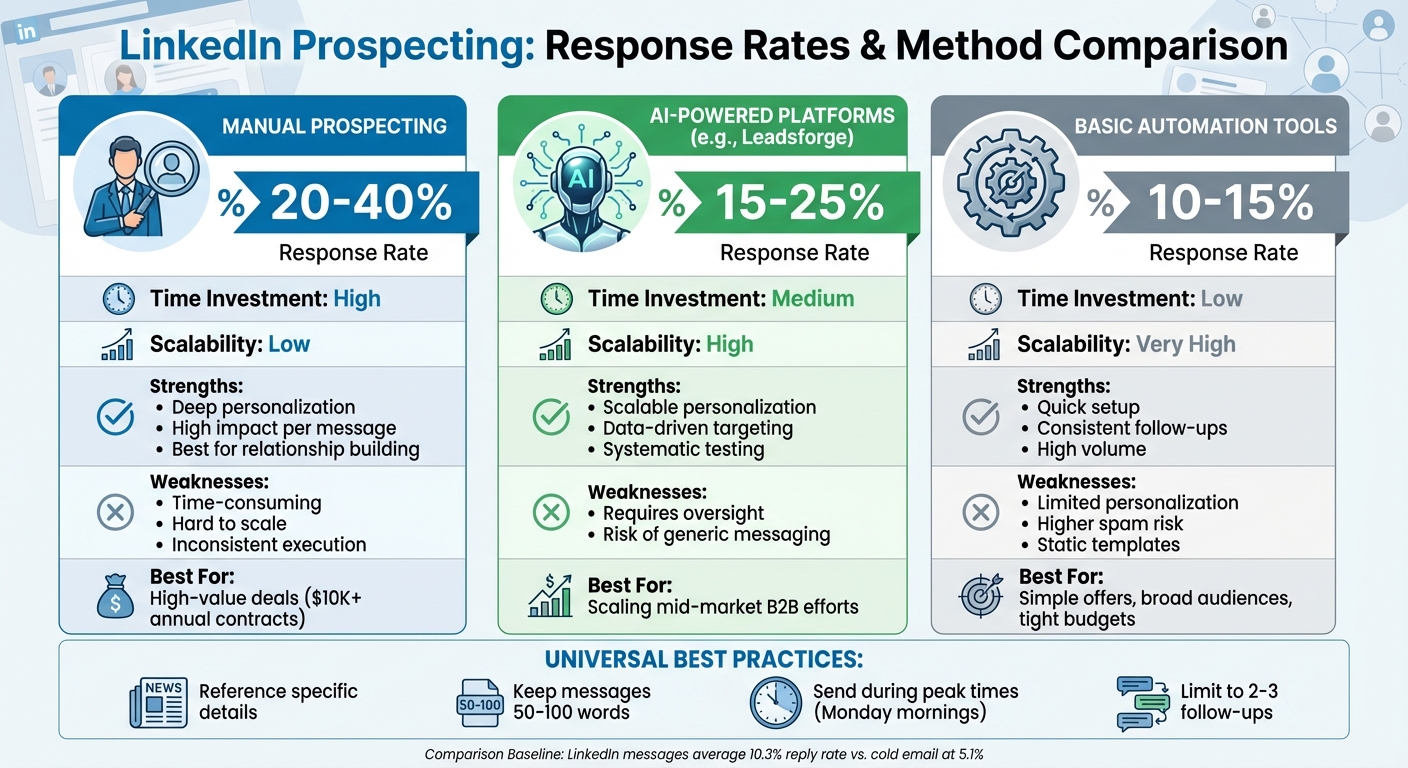
LinkedIn Prospecting Methods: Response Rates and Performance Comparison
Manual LinkedIn prospecting involves sales reps using LinkedIn's search tools and filters to identify prospects and send tailored messages. This method prioritizes precision and relevance over sheer volume, allowing reps to craft messages that align closely with each prospect's unique circumstances.
This approach relies on LinkedIn's native search and Sales Navigator filters to narrow down potential leads. Filters like job title, company size, industry, location, and keywords help pinpoint the right prospects. Reps then manually review profiles to ensure a good fit before reaching out. This hands-on review process also allows them to spot buying signals - such as recent promotions, company expansions, or funding announcements - that automated tools might overlook. For high-value deals in the U.S., especially those worth $10,000 or more annually, this extra level of scrutiny is often worth the effort. Focusing on 2nd-degree connections is also a smart strategy, as research shows that 20–55% of prospects accept personalized connection requests that highlight mutual contacts.
One of the standout benefits of manual prospecting is the ability to deeply personalize outreach. Sales reps can reference a prospect's recent LinkedIn activity, podcast appearances, or company updates in a way that feels authentic and not overly scripted. Personalization pays off: messages tailored to the recipient's context can increase response rates by around 30%. A good rule of thumb is the 90/10 approach - spend 90% of your message focusing on the prospect's situation and only 10% on your solution. Keep the initial message concise - 50–100 words - and include a simple, low-pressure call-to-action like, "Would you be open to a quick chat next week?". This attention to detail can significantly boost results, as one GTM agency reported reply rates of 48% compared to just 6% in similar campaigns.
Timing plays a critical role in manual LinkedIn prospecting. According to Salesbread, prospects are most likely to respond at 10:00 a.m. local time, and connection requests sent on Mondays have the highest acceptance rates. The best days for outreach are Monday and Thursday mornings, which tend to yield stronger engagement. Follow-ups also matter - a second follow-up can increase responses by about 4%, although additional follow-ups typically offer diminishing returns. A well-structured cadence might look like this: send a personalized connection request, follow up with a short message once accepted, add a value-driven follow-up 3–5 days later, and finish with a polite check-in 5–7 days after that. Beyond this, it’s best to stop and avoid over-messaging.
Manual LinkedIn prospecting consistently delivers higher response rates compared to cold emails. While cold email averages a 5.1% response rate, manual LinkedIn outreach achieves around 10.3%. With well-executed campaigns, the results can be even better. For example, Salesbread reported a 45% connection acceptance rate and a 48.14% positive reply ratio by focusing on personalized outreach to decision-makers. Similarly, SalesSo's manual-style LinkedIn campaigns often achieve 15–25% response rates. Alsona benchmarks suggest that 10–15% is solid, 20%+ is great, and 30–40% is exceptional. However, the downside to manual prospecting is the time and effort required. It demands careful research and custom messaging for each prospect, which makes it difficult to scale and can lead to inconsistent follow-ups without disciplined tracking.
Next, we’ll dive into AI-powered platforms, like Leadsforge, which offer scalable ways to achieve personalization.
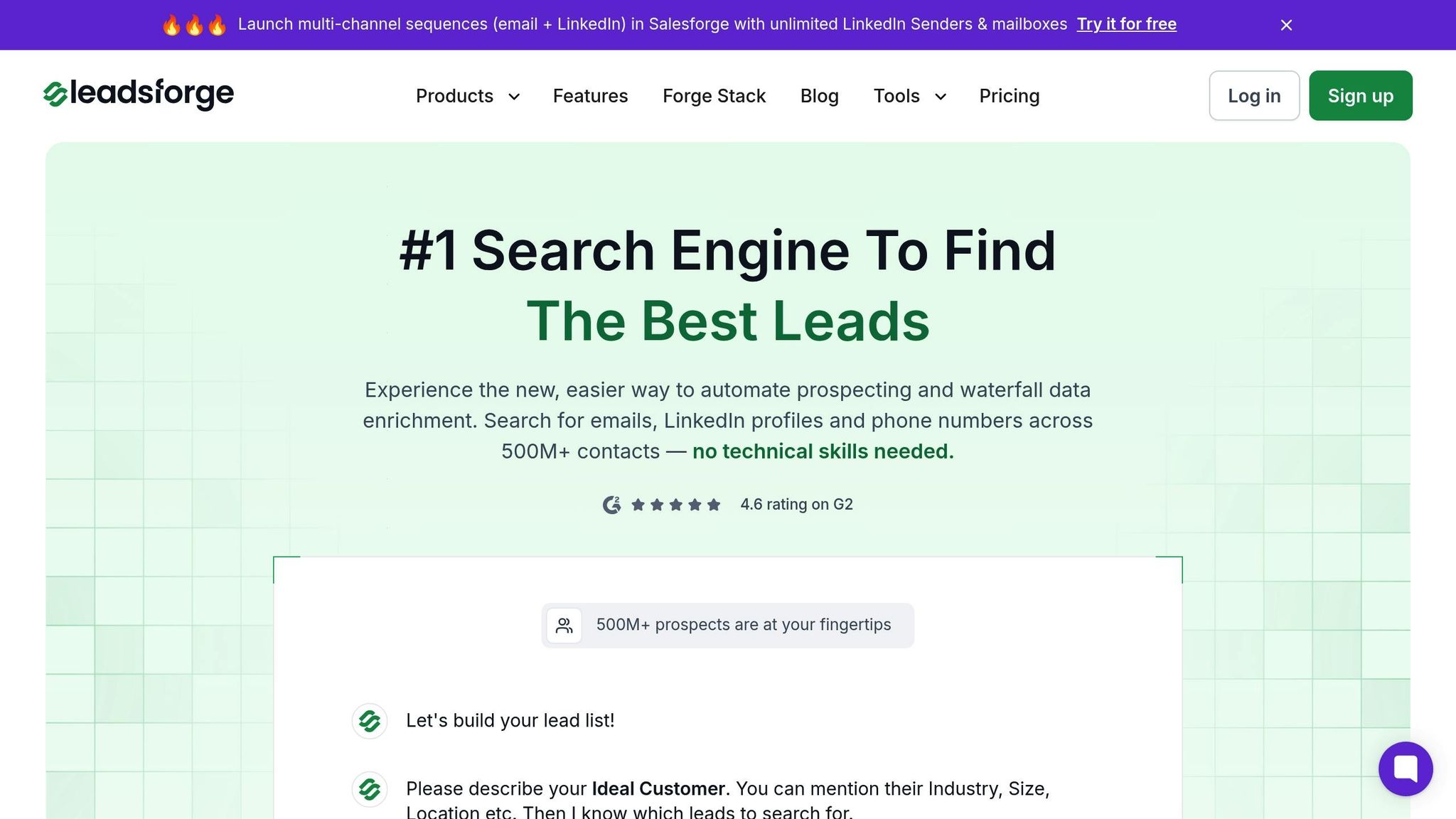
AI-powered platforms have revolutionized the way businesses approach prospecting, making it faster and more efficient to target and communicate with potential leads. Instead of spending hours manually scouring LinkedIn or crafting outreach messages, tools like Leadsforge use machine learning to handle these tasks automatically. For example, you can describe your ideal customer profile in plain language - something like, "Marketing managers at tech companies that are publicly funded and based in the USA" - and the platform will generate a verified lead list. This list includes LinkedIn profiles, emails, and phone numbers, saving sales teams significant time and effort while maintaining relevance on a larger scale.
AI platforms take targeting to the next level by combining LinkedIn data with external insights, such as a company’s tech stack, hiring trends, funding history, and even content engagement patterns. Unlike manual research, these tools instantly enrich and qualify leads. Leadsforge, for example, offers features like Company Lookalikes, where you can input the domain of an existing customer and instantly find similar businesses, or Company Page Followers, which turns a competitor's LinkedIn followers into a prospect list ready for enrichment.
Leadsforge connects to multiple verified B2B data providers, covering more than 500 million contacts worldwide. It uses a waterfall enrichment process, meaning if one data source doesn’t yield verified results, it queries additional sources. This approach ensures cleaner, more accurate lead lists with higher match rates compared to tools relying on a single data source, making it easier to scale your prospecting efforts without sacrificing quality.
Personalization is key to effective outreach, and AI platforms excel at this by automatically inserting relevant details like a prospect’s name, role, company, and recent activity into messages. Leadsforge takes it a step further by using intent signals and custom prompts to tailor messages even more. For instance, it can create different message versions for a VP of Sales at a mid-sized SaaS company versus a founder at a smaller agency, even within the same campaign.
This level of personalization has a measurable impact: research shows that AI-assisted personalization can increase connection acceptance rates by 40% and response rates by up to 67% compared to generic outreach. By combining AI’s efficiency with human oversight, sales teams can ensure their messages are concise, relevant, and conversational - leading to stronger engagement.
Timing matters in prospecting, and AI platforms analyze campaign data to identify the best times to send messages, the ideal delays between follow-ups, and the optimal length for outreach sequences. For example, data might show that decision-makers in U.S.-based SaaS companies are most responsive to LinkedIn messages sent mid-morning on Tuesdays through Thursdays, with outreach sequences of 3–5 touches over 10–14 days yielding the best results.
Some platforms also use activity triggers - like a prospect visiting your profile or engaging with your content - to prioritize outreach when interest is highest. Leadsforge integrates seamlessly with Salesforge, allowing teams to push enriched lead lists into adaptive multi-channel sequences that combine email and LinkedIn outreach. These adaptive sequences outperform rigid schedules, improving response rates and accelerating the journey from lead to pipeline.
When implemented effectively, AI-powered prospecting consistently outperforms manual outreach and basic automation in terms of response rates. In competitive U.S. B2B markets, well-executed AI-driven campaigns can achieve response rates of 15–25% or more. This success is largely due to the combination of hyper-targeted lead lists and context-aware messaging, which generate far more replies than generic templates.
The key to achieving these results lies in balancing AI’s speed and precision with thoughtful human input. While AI handles the heavy lifting of data analysis and message generation, human oversight ensures that every interaction feels genuine and meaningful. This blend of technology and human touch not only boosts engagement but also sets a strong foundation for evaluating how basic automation tools stack up in comparison.
Basic automation tools handle predefined workflows for outreach but lack the flexibility of AI-driven tools or manual prospecting. These tools are great for automating repetitive tasks like sending connection requests, follow-ups, or logging activity. However, their effectiveness heavily depends on the quality of your initial research and message preparation before the automation kicks in.
When it comes to targeting, basic automation tools rely entirely on the filters you set - like job titles, industries, or locations. They can't dig deeper into a prospect's buying stage or specific needs, which means they’re limited to surface-level data. For example, Expandi's 2025 benchmarks reveal that 71% of users send 50 or fewer connection requests per week. This suggests that those who succeed with these tools prioritize small, highly focused lists over mass outreach. The takeaway? The more precise and qualified your list is upfront, the better your response rates will be. Automation can only amplify the groundwork you’ve already laid.
Most basic tools offer simple personalization features, like inserting a prospect’s name, company, or job title into a message template. While this helps boost reply rates, these tools can't analyze deeper context - such as a prospect’s recent activity or interests - to create messages that feel truly tailored. To get the best results, focus on crafting templates that sound conversational and centered on the prospect, not your pitch. Keep messages short and engaging, with about 90% of the content addressing the prospect’s world. When done right, basic automation can deliver reply rates in the 10-15% range, but it requires thoughtful preparation before hitting send.
Basic automation tools operate on fixed schedules rather than adapting to a prospect’s behavior. This means they miss opportunities to respond to real-time triggers, like a prospect changing jobs or publishing a new post. Expandi's 2025 data reveals that adding a second follow-up increases responses by about 4%, but additional follow-ups offer diminishing returns. Shorter sequences tend to perform better than lengthy drip campaigns. Timing also plays a crucial role: Salesbread's analysis found that Thursdays see the highest reply rates (20.32%), while Saturdays are the least effective (2.65%). While basic tools can schedule messages during optimal business hours, they lack the ability to capitalize on timely, high-engagement moments.
When used thoughtfully, basic automation tools can achieve 10-15% reply rates, which Alsona's 2025 benchmarks consider solid performance. This is a big step up from cold email, where Expandi’s data shows an average 5.1% reply rate, compared to 10.3% for LinkedIn messages. To hit these numbers, you’ll need to keep daily volumes low (under 50-70 connection requests per week), avoid generic templates, and limit follow-ups to one or two messages. These practices highlight the limitations of basic automation compared to more advanced methods, but they also show that with proper planning, these tools can still deliver effective results.
When it comes to prospecting, each method has its own advantages and challenges, especially when considering response rates. Let’s break them down.
Manual outreach is the gold standard for personalization. It delivers impressive per-message response rates - ranging from 28% to 48% - thanks to its tailored, human touch. However, the downside is scalability. Realistically, it’s tough to go beyond a few dozen quality contacts each day, which limits the total number of replies you can generate. So, while it’s highly effective on a per-message basis, the overall reach is inherently restricted by time and effort.
On the other hand, AI-powered platforms like Leadsforge strike a balance between quality and scale. These tools leverage precise ICP (Ideal Customer Profile) targeting and context-driven personalization to reach hundreds or even thousands of prospects. They maintain consistent response rates while significantly expanding your pipeline. Features like waterfall data enrichment and intent signals ensure you’re connecting with the right people at the right time, which is vital - especially since LinkedIn messages already outperform cold emails by a factor of two (10.3% vs. 5.1% average reply rates). However, if these platforms prioritize sheer volume over thoughtful strategy, or if the messages feel overly polished, response rates can take a hit.
Lastly, basic automation tools focus on volume and efficiency. When used strategically, they can achieve reply rates of 10-15%, thanks to their ability to enforce consistent follow-up sequences - something manual outreach often struggles with. However, these tools lack the contextual nuance that drives higher engagement. They rely heavily on the quality of your initial research and templates, and excessive volume paired with generic messaging can make your outreach feel spammy, damaging your reputation in the long run.
Here’s a quick comparison of how these methods perform across key factors:
| Method | Key Strengths for Response Rates | Main Weaknesses / Risks | Best Use Cases for High Response Rates |
|---|---|---|---|
| Manual LinkedIn prospecting | Highly personalized; contextual outreach; effective for building relationships | Limited scalability; inconsistent execution; hard to test and optimize; risk of burnout | Ideal for high-value accounts, complex deals, and relationship-driven sales |
| AI-powered platforms (e.g., Leadsforge) | Scalable personalization; precise targeting; data enrichment; systematic testing | Needs strategic oversight; risks “robotic” messaging; misuse can appear spammy | Best for scaling mid-market B2B offers and mature teams seeking predictable pipelines |
| Basic automation tools | Quick to set up; high activity volume; consistent follow-ups; low operational costs | Lacks contextual depth; higher spam risk; limited to static templates | Suitable for simple offers, broad audiences, and short-term pipeline boosts on tight budgets |
Ultimately, your choice of prospecting method should align with your goals, deal size, and available resources. For high-ticket contracts targeting a small set of strategic accounts, manual prospecting - enhanced by AI research - delivers the best results. If you’re scaling mid-market B2B efforts, AI-powered platforms provide a strong mix of personalization and volume. Meanwhile, basic automation tools are a good fit for broad, simple offers when you need quick results, but they come with a higher risk of lower engagement and reputation issues if not handled carefully.
As highlighted in the comparisons above, your prospecting strategy should align with your business goals and resources. For consultants, small agencies, or founders closing high-value deals (like $10,000+ annual contracts), manual prospecting is often the most effective route. By focusing on detailed research and personalized outreach, you can achieve reply rates of 20–40%. On the other hand, growing SMB SaaS teams or agencies needing a steady pipeline without overextending resources might find AI-powered platforms like Leadsforge to be the ideal solution. These tools combine precise Ideal Customer Profile (ICP) targeting, data enrichment, and scalable personalization, delivering reply rates of 10–20% while reaching hundreds of prospects each week. For larger SDR teams, a hybrid approach works well: AI handles tasks like list building, data enrichment, and initial outreach, while human reps focus on personalizing tier-1 accounts and managing follow-ups after positive responses. These strategies echo the earlier analysis on balancing scalability with engagement.
Start by crafting a clear and detailed ICP. Consider factors like industry, company size, geography, role, and specific triggers - elements that matter far more than sheer volume. Personalization is key here. Move beyond generic merge fields and incorporate role-specific challenges, recent company news, or shared connections into your outreach. This level of detail significantly boosts reply rates. Timing and cadence are equally crucial. For example, sending connection requests on Mondays and follow-up messages on Thursday mornings around 10:00 AM - when U.S. professionals are most active - can improve engagement. Keep follow-ups to a maximum of three, spaced strategically, to avoid diminishing returns.
Consistently track and refine your benchmarks. Aiming for a reply rate of at least 10–15% is a good starting point; lower rates may signal issues with targeting or messaging. Monitor metrics like connection acceptance rates (ideally 35–60% for a well-defined ICP), reply rates, and meeting-booked rates to identify what’s working. When using AI tools, leverage intent signals and lookalike searches to pinpoint prospects and experiment with message variations to improve results. These efforts underscore the importance of a thoughtful, data-driven approach.
The prospecting game is evolving, shifting from purely manual efforts to AI-assisted workflows that balance scale with a personal touch. Whether you're a solo consultant targeting 20 highly specific prospects a day or part of an enterprise SDR team managing thousands of contacts, the fundamentals remain the same: precise targeting, meaningful personalization, and smart follow-ups drive responses - not just the tools you choose. Select the approach that fits your current needs and double down on the practices that make prospects want to engage.
Manual LinkedIn prospecting often yields better response rates because it focuses on genuine, personalized interactions. By creating tailored messages and connecting with prospects on a more human level, you can establish trust and build stronger relationships - key ingredients for meaningful engagement.
On the other hand, while AI-driven platforms can make outreach more efficient, they sometimes miss the mark when it comes to deep, context-driven personalization, which can make messages feel less relatable. Tools like Leadsforge address this challenge by blending automation with precise targeting, making outreach smarter and more relevant without losing the personal touch.
AI tools such as Leadsforge offer game-changing benefits for LinkedIn prospecting. By automating tasks like data collection and enrichment, they cut down on the time and effort traditionally spent on these processes. These platforms can create precise, verified lead lists using straightforward, natural language inputs, helping you zero in on the most relevant prospects.
Features like intent signals and lead qualification take things a step further by identifying leads with a higher likelihood of engagement, boosting your response rates. Plus, with smooth integration into multi-channel outreach tools, AI-powered solutions make prospecting not only faster but also more accurate and efficient.
To strike the right balance between personalization and scalability in LinkedIn outreach, it's essential to craft messages that resonate with your audience while using tools to maximize efficiency. Start by defining your ideal customer profile (ICP) - this helps you focus your efforts on the right people. Platforms like Leadsforge can simplify this process by providing highly targeted and verified lead lists, ensuring your messages are both relevant and engaging.
To scale without sacrificing that personal touch, automation tools can be a game-changer. For instance, pairing Leadsforge with multi-channel outreach tools like Salesforge lets you expand your campaigns while keeping them tailored. By combining enriched lead data with intent signals and qualification criteria, you can send a high volume of outreach that still feels personal. This approach not only boosts response rates but also saves valuable time.