Intent signals are behavioral clues that reveal when a prospect is actively considering a product or service. Actions like visiting pricing pages, downloading solution guides, or signing up for demos can indicate readiness to buy. By focusing on these signals, businesses can prioritize high-interest leads, improving qualification accuracy and conversion rates.
Here’s why intent signals matter:
For example, a B2B software company using intent signals saw a 25% increase in qualified leads and a 15% boost in conversions in just three months. Tools like Leadsforge automate this process, analyzing behaviors across multiple channels and generating high-intent lead lists.
Key Intent Signal Types:
Intent signals are like breadcrumbs on a trail - they reveal where your prospects are in their buying journey. By combining different types of signals, you can create a clear and actionable picture of their intent. This layered approach not only helps with lead qualification but also informs how you score their behavior and plan your outreach.
First-party signals come straight from your own digital channels, making them some of the most reliable indicators of interest. These are actions taken by prospects already familiar with your brand, providing clean and direct data for your sales team to act on.
Website behavior is one of the strongest first-party signals:
Email engagement patterns also tell a compelling story. High open rates, frequent clicks, and responses to your marketing emails show a prospect is highly engaged. If they’re consistently interacting with product-specific content, it’s time to prioritize them.
Content consumption behavior reveals how prospects move through your resources. Downloading educational content and then progressing to solution-specific guides is a strong sign they’re considering a purchase.
Third-party signals are all about what your prospects are doing outside your ecosystem. These behaviors often highlight buying intent before they even land on your radar. Spotting these early gives you a competitive edge, letting you engage them before they finalize their shortlist.
Topic-based research activity happens when prospects search for industry-specific terms, solution categories, or problem-solving keywords on external platforms. For instance, a company looking up "best CRM software for manufacturing" on review sites is likely in the early stages of their buying process.
Competitor research behavior is another tell. Whether they’re comparing competitors, reading reviews, or consuming competitor content, it’s clear they’re actively evaluating options and moving closer to a decision.
Industry publication engagement shows prospects are in research mode. If decision-makers are consuming content about trends, best practices, or solution comparisons on trade publications, they’re likely gearing up for a purchase.
Social and company-based signals add valuable context to your lead qualification process. They help you understand not just individual interest but also organizational readiness and timing.
LinkedIn activity can be a goldmine of insights. If someone follows your company page, it’s a direct signal of interest. Engaging with your posts or connecting with your employees further underscores their market curiosity.
Company growth indicators - like rapid hiring, funding announcements, or office expansions - often hint at new budgets and evolving needs. For example, a company posting multiple IT job openings might be gearing up for a major technology upgrade.
Organizational changes also provide clues. New leadership often brings a fresh perspective on technology investments, while department expansions suggest growing operational demands. Recent funding announcements? That’s a strong signal they’re ready to spend.
Platforms like Leadsforge simplify the process of gathering and analyzing these signals. For instance, the platform can identify LinkedIn followers of your company page, convert them into high-intent prospect lists, and enrich those leads with verified contact details. From there, it integrates them into multi-channel outreach campaigns.
| Signal Type | Data Source | Key Indicators |
|---|---|---|
| First-Party | Your own platforms | Website visits, email engagement, demo requests |
| Third-Party | External platforms | Topic searches, competitor research |
| Social/Company | Social media, company news | LinkedIn activity, hiring trends, funding signals |
This guide explains how to turn behavioral data into actionable steps for lead qualification. By integrating intent signals into your process, you can create a system that consistently captures, scores, and acts on valuable behavioral insights throughout your sales funnel.
Setting up a behavioral lead scoring system starts with pinpointing specific actions that reflect purchase intent. Actions like requesting a demo or repeatedly visiting pricing pages should hold more weight than less targeted behaviors, such as reading blog posts or signing up for newsletters.
Here’s a straightforward approach:
Set clear thresholds for action: leads with mid-range scores might require nurturing, while high scores should trigger direct outreach. This strategy keeps your focus on the 10% of your market that's actively ready to buy at any given time.
To keep your scoring system accurate, validate it regularly. Monitor how well scored leads convert, and adjust point values as needed. For instance, if visits to your integration pages are driving more conversions than expected, increase their weight in your scoring system. Continuous tweaking ensures your scoring stays aligned with real-world buyer behavior.
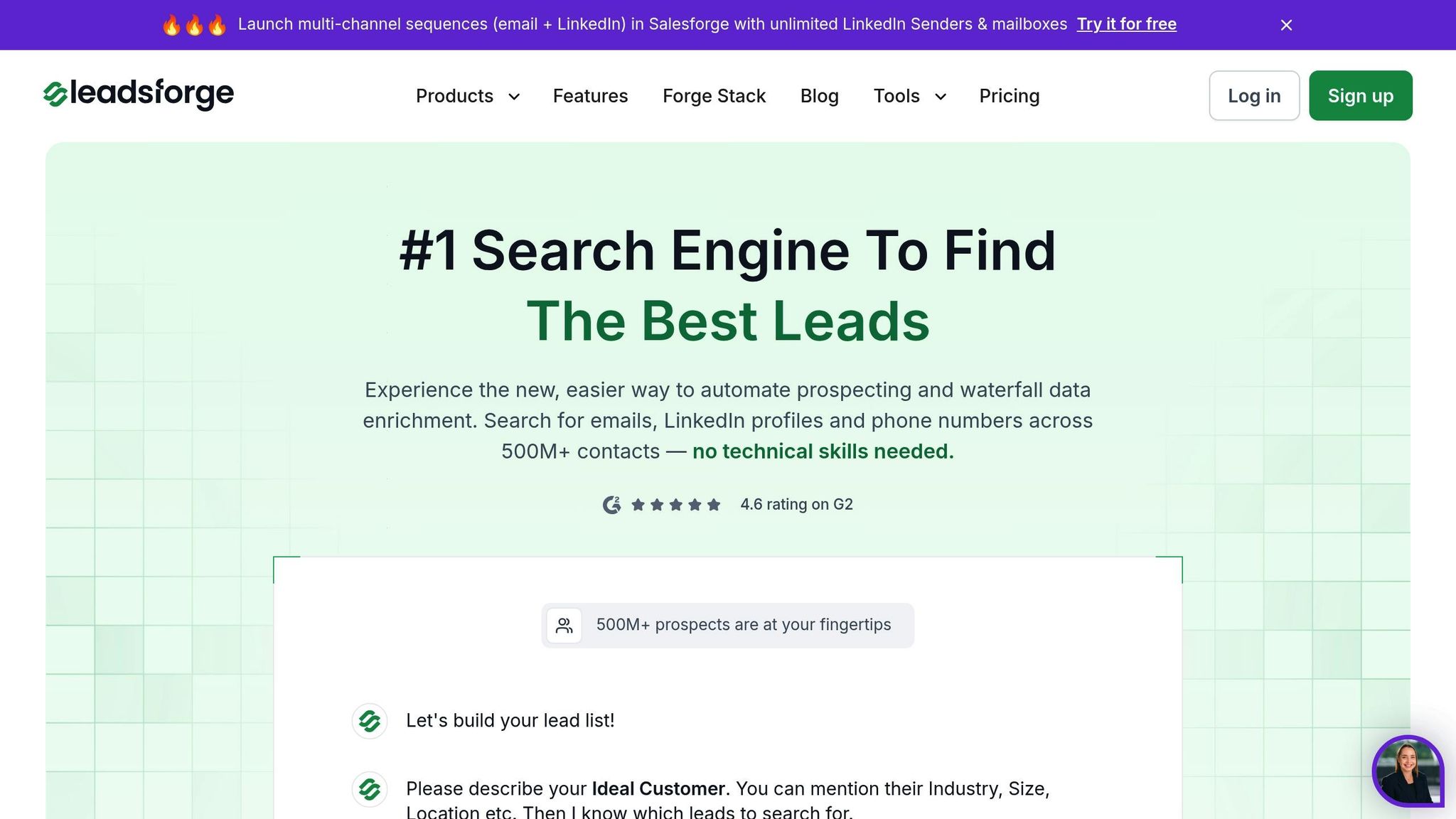
Leadsforge simplifies intent signal analysis with automation. Its AI-powered engine tracks behavioral data across various channels, assigns scores to leads based on their actions, and updates their qualification status in real time.
The platform’s chat-like interface makes it easy to define your ideal customer profile and intent signals. For example, you can describe your target audience as “SaaS companies with 50-200 employees interested in CRM solutions,” and Leadsforge will identify prospects matching these patterns.
Waterfall data enrichment further enhances lead profiles by pulling information from verified B2B sources. With access to over 500 million contacts globally, Leadsforge provides detailed profiles, including LinkedIn accounts, email addresses, and phone numbers for high-intent leads.
A standout feature is the company followers search, which turns your company page followers into qualified leads. Since following your page already signals interest, these leads often score higher in intent-based systems. Leadsforge enriches these followers' profiles with contact information and behavioral data, making them ready for outreach.
The system continuously updates lead scores as new data comes in, ensuring that each prospect’s score reflects their most recent actions.
To fully leverage intent signals, integrate this data directly into your CRM. Seamless connections between your intent signal platform and sales tools ensure behavioral insights flow smoothly into your system, eliminating manual work and reducing errors.
Here’s how to integrate effectively:
If you’re using Leadsforge, the platform enables instant multi-channel outreach. Qualified leads can seamlessly transition from intent analysis into personalized email or LinkedIn campaigns, cutting down on time-to-pipeline and boosting response rates.
Regular data synchronization ensures lead statuses remain up-to-date across all systems. As prospects engage with your campaigns, their behavioral data updates their intent scores, potentially triggering new actions or moving them to different nurturing paths.
| Integration Component | Purpose | Key Benefit |
|---|---|---|
| API/Native Connection | Automated data transfer | Reduces manual entry errors |
| Field Mapping | Behavioral data visibility | Gives sales teams a full prospect view |
| Automated Triggers | Immediate lead routing | Ensures quick attention to high-intent leads |
| Feedback Loops | Continuous improvement | Enhances scoring accuracy over time |
AI-powered tools are reshaping how businesses approach lead qualification by focusing on real-time buyer intent rather than traditional demographic scoring. These tools continuously update lead scores based on actual engagement patterns, helping sales teams zero in on the 10% of prospects who are ready to buy at any given moment. This real-time adaptability ensures that efforts are concentrated on prospects with genuine purchase intent, setting the stage for tools like Leadsforge to shine.
Leadsforge has carved out a strong presence in the AI-driven lead generation space, thanks to its thorough approach to intent signal analysis. Its AI-powered engine tracks behavioral data across multiple channels - web, social media, CRM systems, and LinkedIn - providing real-time insights into how prospects are engaging.
The platform makes it easy to define your ideal customer profile. Using natural language descriptions, you can generate tailored prospect lists complete with verified contact details.
One standout feature is its waterfall data enrichment, which pulls data from multiple verified B2B sources. This ensures that every high-intent lead comes with a complete profile, including LinkedIn accounts, email addresses, and phone numbers.
Another unique capability is the company followers search, which turns your existing page followers into actionable leads. Since following your page already indicates a level of interest, these individuals often rank higher in intent-based scoring systems. Leadsforge enriches these profiles with additional contact and behavioral data, making them ready for immediate outreach.
Leadsforge offers a credit-based pricing model that starts at $49 per month for 2,000 credits or $588 annually for 28,000 credits. This flexible system allows businesses to pay only for the data they actually use, ensuring predictable costs with no hidden fees or long-term commitments.
The platform integrates seamlessly within The Forge Stack, creating a smooth workflow from lead generation to multi-channel outreach. Qualified leads can move directly from intent analysis into personalized email or LinkedIn campaigns via Salesforge, speeding up the sales process and improving response rates.
Here’s how Leadsforge stacks up against other AI-powered intent signal platforms, with a focus on data sources, automation, integrations, and pricing:
| Platform | Intent Signal Sources | Automation Features | Integrations | Pricing Model |
|---|---|---|---|---|
| Leadsforge | Multi-channel intent signals | AI lead generation, real-time analysis, data enrichment | CRM, The Forge Stack, LinkedIn | Credit-based ($49/month) |
| Demandbase | Web, third-party, CRM | Account-based targeting, predictive analytics | CRM, marketing automation | Subscription/tiered |
| ZoomInfo | Web, firmographic, third-party | Automated enrichment, intent scoring | CRM, sales tools | Subscription/tiered |
| DealMayker | Web, CRM, email | Automated lead routing, scoring | CRM, email platforms | Subscription/tiered |
What sets Leadsforge apart? Its flexible credit-based pricing, broad intent signal coverage, and user-friendly design make it accessible even for smaller teams. While competitors like Demandbase and ZoomInfo bring strong features to the table, they often require long-term subscriptions and can overwhelm users with complex interfaces. For instance, ZoomInfo excels at firmographic data but doesn’t emphasize real-time behavioral signals, and Demandbase caters to enterprise-level account-based marketing but comes with higher costs and added complexity. DealMayker, while strong in automation, lacks the multi-channel intent signal depth that Leadsforge offers.
For U.S. businesses looking to control costs and simplify workflows, Leadsforge’s credit-based model aligns well with the preference for measurable, pay-as-you-go solutions. Its seamless integration capabilities also cater to the common desire for unified tech stacks over fragmented tools. While enterprise-level organizations might lean toward Demandbase for advanced account-based marketing, growing businesses often find Leadsforge’s flexible pricing and comprehensive features a better fit for their budgets and operational needs.
Let’s dive into some effective strategies for turning intent signals into actionable, qualified leads. By integrating these practices into your behavioral lead scoring system, you can better target prospects who are ready to engage.
High-priority leads are those whose actions clearly indicate a strong buying intent. For example, behaviors like frequent visits to pricing pages, downloading product specs or case studies, using ROI calculators, or requesting demos are key indicators. But here’s the catch: it’s not just about individual actions - it’s about the combination and timing of these behaviors.
Take this scenario: a prospect downloads a case study and visits your pricing page within 48 hours. That’s a much stronger buying signal than someone who only performs one of those actions. That’s why a tiered approach works so well:
To make this work, assign point values to different actions. For instance, a demo request might be worth 25 points, while downloading a case study could be 15 points. Once a prospect hits a certain score, they’re ready for direct outreach.
Timing also plays a critical role. A prospect who visited your pricing page yesterday should be prioritized over someone who did the same thing three months ago. Companies that track both the frequency and recency of intent signals are far more successful at converting leads into customers.
Generic outreach often falls flat because it doesn’t address what the prospect is really interested in. To make your outreach resonate, focus on the specific intent signals prospects have already shown.
For example, if someone repeatedly checks your ROI calculator and pricing pages, your follow-up should emphasize cost savings and financial benefits. On the other hand, if they’re comparing competitors, your messaging should highlight your unique advantages. And if they download a case study about enterprise solutions, you know they’re thinking about scalability - so reference that case study and offer resources that address enterprise-level challenges.
The key here is to align your messaging with where the prospect is in their buyer’s journey. Whether they’re still comparing options or ready to schedule a demo, tailor your communication to position your solution as the answer to their specific need. And as always, keep data privacy and transparency in mind while crafting personalized outreach.
When using intent signals for lead qualification, it’s critical to stay compliant with regulations like GDPR, CCPA, CAN-SPAM, and TCPA. Here’s how to do it right:
Lastly, train your sales and marketing teams on the ethical use of intent data. Just because you can track every action doesn’t mean you should act on every signal. Overly aggressive follow-ups can harm your reputation and may even breach compliance standards. Tools like Leadsforge can help streamline lead qualification while ensuring data is used responsibly.
Intent signals are changing the game for lead qualification by zeroing in on actual buyer behavior. Instead of relying on static demographic data, businesses now use real-time insights to uncover genuine buying intent. The results? Higher conversion rates, shorter sales cycles, and smarter use of resources.
The key advantage here is precision and timing. Traditional methods often cast too wide a net, leaving sales teams chasing leads who aren’t ready to buy. Intent signals, on the other hand, pinpoint prospects actively searching for solutions. This means sales teams can focus their energy where it matters most, leading to better results.
By targeting engaged leads, intent signals save valuable time. Sales reps no longer need to sift through cold prospects, as they can prioritize those already showing strong buying signals. This streamlined approach eliminates wasted effort and speeds up the entire sales process.
Platforms that leverage intent signals make this even easier. Tools like Leadsforge bring sophisticated intent analysis to small and mid-sized businesses without requiring complex setups. With a simple chat-like interface, users can describe their ideal customer profile, and the platform generates verified lead lists enriched with intent data from a massive pool of over 500 million contacts. Features like real-time email, LinkedIn, and phone verification ensure these lists are accurate and ready to use.
Aligning sales strategies with buyer intent isn’t just efficient - it drives revenue. By identifying high-priority leads at the right moment, companies can close deals faster and boost ROI. Integration with CRM systems and automated workflows ensures no promising lead slips through the cracks, while personalized outreach based on behavioral signals keeps engagement relevant.
This shift to intent-driven qualification isn’t just an upgrade - it’s a fundamental change in how businesses approach sales. As buyers increasingly research solutions on their own before reaching out, capturing and acting on these digital breadcrumbs is now essential. Companies that adapt to this data-driven approach will stay ahead, ensuring long-term growth and competitiveness in today’s market.
Intent signals are all about tracking a prospect's real-time actions - things like downloading a whitepaper, searching for specific topics, or interacting with your website. These behaviors give you a clear picture of their current interests and how ready they might be to make a purchase. Unlike static demographic data (like age or job title), intent signals are dynamic and actionable.
Demographic data tells you who your audience is, but intent signals show you what they’re interested in right now. When you combine the two, you get a much sharper view of which leads deserve your attention. Tools like Leadsforge simplify this process by automating lead qualification and enriching your prospect data, so your sales team can zero in on the most promising opportunities.
First-party intent signals reflect the direct actions of your audience - things like visiting your website, downloading content, or engaging with your emails. On the other hand, third-party intent signals come from outside sources, such as search behavior, social media activity, or interactions on external platforms.
When building a lead scoring system, it's smart to assign higher scores to behaviors that strongly suggest buying intent. For example, downloading a pricing guide or frequently visiting a product page are clear indicators of interest. By combining first-party and third-party data, you can create a more precise and adaptable scoring model. This ensures your sales team focuses on leads that are most likely to convert. Tools like Leadsforge simplify this process by integrating intent signals into automated workflows, helping you quickly identify and prioritize top prospects.
Leadsforge uses intent signals - like content downloads, search activity, and engagement trends - to pinpoint high-quality leads with greater precision. By diving into these signals, the platform sharpens lead qualification, helping your sales team zero in on prospects who are most likely to convert.
Powered by AI, Leadsforge streamlines data enrichment and prospecting, delivering highly targeted and verified lead lists. This approach not only cuts down on time spent searching but also ensures your team is working with the most actionable intent data, giving you an edge in sealing deals.