Geo-based prospecting is transforming B2B sales strategies. By focusing on specific locations, businesses can reduce costs, improve ROI, and connect with prospects more effectively. Instead of broad, generic outreach, this approach uses location data (like city or ZIP codes) to target high-potential regions, enabling personalized campaigns and better engagement.
Key takeaways:
This shift to localized strategies is becoming essential as businesses aim to optimize resources and close more deals in less time.
Geographic-based prospecting reshapes how B2B teams find and connect with prospects by focusing on specific regions where the chances of success are highest. Instead of using nationwide lists based only on industry or company size, this method combines location data - like city, state, or ZIP code - with firmographic details to create more accurate customer profiles.
The results speak for themselves. Companies using geographic segmentation often see 2–3x higher ROI compared to broader campaigns. Why? Because they can customize their messaging to reflect local events, regulations, and market dynamics. For instance, a B2B company might reference a state-specific compliance rule in its outreach, making the conversation more relevant. Research has shown that geoframing - targeting prospects based on their physical location - can increase B2B lead conversion rates by 30%, thanks to tailored follow-up content that aligns with the prospect's context.
AI tools like Leadsforge make this level of precision easy to achieve. With a simple prompt like "CEOs from Atlanta" or "Marketing managers in tech companies based in the USA", users can instantly generate verified lead lists from a database of over 500 million contacts. The platform integrates real-time data checks - verifying emails, confirming LinkedIn profiles, and validating phone numbers - eliminating the guesswork of outdated databases.
This approach lays the groundwork for highly targeted outreach that drives better conversion rates.
Outreach tailored to specific locations consistently outperforms generic campaigns because it delivers content that feels personal and relevant. Imagine receiving an email that highlights a nearby industry event, a local success story, or even a seasonal challenge unique to your area - it immediately grabs attention and builds trust faster.
Businesses that focus on prospects within a 50-mile radius often report 30–40% lower customer acquisition costs and higher close rates. Why? Because proximity makes face-to-face meetings more feasible, speeding up trust-building and shortening sales cycles. In-person consultations and on-site demonstrations - practical when prospects are nearby - tend to convert more effectively than remote outreach. Regional sales managers with defined territories also see better results due to their ability to schedule local appointments.
Take Monalee, a solar company, as an example. By using Google Maps geoframing to analyze rooftop data, they generate over 300 proposals daily with 30% greater targeting accuracy than before, leading to improved conversion rates.
These engagement benefits highlight how geographic focus can directly improve sales outcomes. The next step is examining how this strategy boosts efficiency and ROI.
Geographic-based prospecting minimizes waste by zeroing in on high-value areas. By concentrating efforts on these regions, companies save on travel costs and avoid spending time on low-priority prospects. Sales reps can optimize their schedules, often fitting multiple meetings into a single day.
This efficiency has a direct impact on the bottom line. Conversion rates for location-based marketing reach 3.8%, compared to a baseline of 1.5% - a 152% improvement, according to industry data for 2025.
| Benefit | Key Metric | B2B Application |
|---|---|---|
| Conversion Rate | 152% increase (3.8% vs. 1.5%) | Focused regional targeting |
| Customer Acquisition Cost | 40% reduction | Efficiency from in-person outreach |
| ROI | 2–3x better ROI | Concentrated resource allocation |
AI removes the manual roadblocks that once limited geographic prospecting to small-scale efforts. Platforms like Leadsforge automate the process of enriching data from multiple sources to verify contacts and identify high-intent leads. With a simple prompt, such as "CEOs from Atlanta", users can generate over 10,000 profiles in seconds.
This scalability allows B2B teams to dominate local markets efficiently. For example, a company can saturate a market with personalized outreach, quickly achieve the "Rule of 7" touches through targeted ads and event sponsorships, and then replicate this strategy in other regions. AI-powered tools also prioritize leads based on intent signals, ensuring sales teams focus on prospects who are already exploring solutions. This leads to more informed and productive sales conversations.
Additionally, integration with multi-channel outreach platforms speeds up the time it takes to move leads into the sales pipeline. Leadsforge, for instance, pushes verified, geo-targeted lists directly into automated sequences that adapt to prospect behavior. Follow-ups reference local details, and in-person meetings are scheduled when engagement levels indicate interest. By combining tools like Salesforge for outreach and Warmforge for deliverability, the process becomes seamless, showing how geographic precision can outperform traditional prospecting strategies.
Traditional prospecting often operates like casting a wide net - covering the entire country without much thought about where prospects are actually located. Sales teams typically rely on broad demographic data and outdated static databases. For instance, a software company might target all manufacturing firms across the U.S., treating vastly different markets the same without adjusting for local nuances.
This approach lacks focus. Without incorporating location data, outreach becomes a numbers game - sending thousands of emails and hoping for a small response rate. Companies using this method often experience 30% lower targeting accuracy compared to geo-targeted campaigns that focus on prospects within a 50-mile radius. The result? A lot of wasted effort. Sales teams end up chasing leads scattered across the country while potentially ignoring high-value opportunities closer to home. This broad, untargeted strategy not only reduces precision but also makes meaningful engagement harder to achieve.
One of the biggest challenges with traditional prospecting is its lack of personalization. Generic messaging doesn’t resonate because it fails to address specific regional events, local challenges, or unique pain points. As a result, traditional cold email campaigns and nationwide LinkedIn outreach often see response rates below 5–10%. Compare that with geo-targeted efforts, which can double or even triple engagement by incorporating regional references and localized context.
When it comes to building trust, traditional methods fall short. Without proximity, face-to-face meetings become expensive and time-consuming to arrange, further delaying the sales cycle. In contrast, focusing on local prospects can speed things up, as the ability to meet in person strengthens relationships and boosts conversion rates.
Traditional prospecting can be a major drain on budgets. Nationwide campaigns often lead to wasted outreach and inflated travel expenses. For example, companies running broad campaigns can see customer acquisition costs that are 30–40% higher than geo-targeted strategies. The inefficiency doesn’t stop there - up to 70–80% of outreach is often wasted on out-of-area leads.
Instead of concentrating resources in high-value regions, traditional methods spread efforts too thin, leaving promising territories underdeveloped while saturating less profitable ones. This scattershot approach not only reduces ROI but also leaves gaps in areas where opportunities might be ripe for the taking.
Traditional prospecting also struggles to take full advantage of AI. Why? Because it relies on outdated, non-geo-enriched contact lists that don’t provide the location signals modern AI tools need to optimize targeting. While AI excels at processing large datasets, feeding it broad, imprecise inputs results in lots of leads but few valuable ones.
On top of that, manual territory segmentation slows everything down. Sales teams often have to divide national lists by hand, assign territories, and coordinate outreach without the precision that location-based intent data could provide. This lack of automation makes scaling difficult. Adding more prospects only creates more noise, and even AI tools can struggle to identify which leads are worth pursuing versus those unlikely to convert.
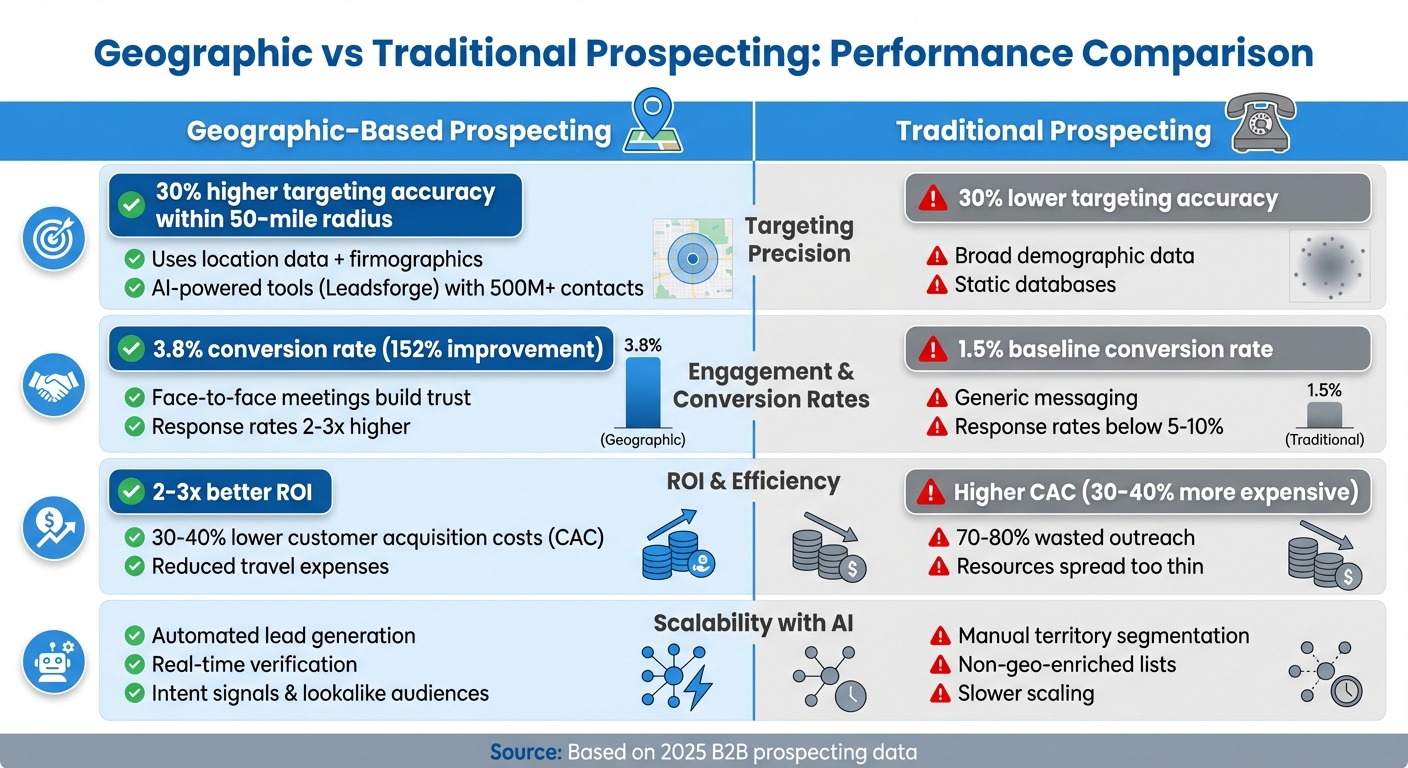
Geographic vs Traditional B2B Prospecting: Performance Comparison
Here's a breakdown of how geographic-based prospecting stacks up against traditional prospecting in key areas:
| Criterion | Geographic-Based Prospecting | Traditional Prospecting |
|---|---|---|
| Targeting Precision | Leverages location data alongside firmographics to pinpoint high-intent clusters and customize outreach based on local context. Geo-segmentation boosts targeting accuracy by 30% within a 50-mile radius. Tools like Leadsforge make it easy to create precise lead lists by letting users describe their ideal customer profile in natural language (e.g., "CEOs from Atlanta") and search across over 500 million contacts with real-time verification. | Takes a broader approach, using national demographic data and static databases. This results in 30% lower targeting accuracy and a higher proportion of unqualified leads. |
| Engagement & Conversion Rates | Localized strategies, including face-to-face interactions, build trust more effectively. Geo-marketing achieves a 3.8% conversion rate compared to 1.5% for non-location campaigns - a 152% improvement. Regional managers focusing on prospects within a 50-mile radius also report better results compared to remote outreach. | Generic messaging that overlooks local nuances often leads to lower response rates, typically under 5–10%. This can prolong sales cycles and weaken trust with prospects. |
| ROI & Efficiency | Focusing on specific regions delivers 2–3× better ROI. B2B companies targeting within a 50-mile radius report 30–40% lower customer acquisition costs, cutting down on wasted impressions and travel expenses. | Nationwide campaigns often spread resources too thin, leading to higher travel costs and underdeveloped high-potential areas. This inefficiency drives up customer acquisition costs. |
| Scalability with AI | Platforms like Leadsforge combine geo-targeting with automated lead generation and multi-channel outreach. Features like lookalike audience searches, intent signals, and an intuitive chat-like interface simplify regional expansion and make scaling more efficient. | Relies on static, non-geo-enriched contact lists that lack the precision modern AI tools provide. Manual territory segmentation slows down scaling efforts, and the broader prospect pool adds noise that makes it harder to identify high-potential leads. |
When comparing geographic prospecting to traditional methods, the benefits of a local, targeted approach stand out. The data is clear: geographic-based prospecting delivers stronger results for B2B businesses. By focusing on specific regions, companies can lower acquisition costs, increase ROI, and build trust through face-to-face meetings and local credibility. These factors not only shorten sales cycles but also significantly boost conversion rates - advantages that traditional prospecting methods often struggle to achieve.
Platforms like Leadsforge simplify the process of implementing location-based strategies. For instance, you can describe your ideal customer - such as "CEOs in Atlanta" - and instantly generate verified lead lists from a database of over 500 million contacts. As highlighted earlier, localized strategies drive higher engagement by enabling meaningful, face-to-face interactions. The platform's advanced data enrichment ensures you receive accurate LinkedIn profiles, email addresses, and phone numbers. Plus, seamless integration with multi-channel outreach tools allows you to act on those leads without delay.
Geo-based prospecting is reshaping B2B lead generation. Small and medium businesses are rapidly adopting geomarketing, with a projected annual growth rate of 27.5% through 2030. This trend enables smaller players to compete more effectively with larger companies by focusing on hyper-local markets. Additionally, 67% of marketers identify targeting as the top benefit of location-based services, underscoring its competitive edge.
Geo-based prospecting boosts B2B lead conversion rates by narrowing your focus to specific geographic areas. This strategy allows you to create more relevant and personalized outreach, aligning your messaging with the unique needs of local markets. The result? Better engagement and stronger connections with potential customers.
It’s also an effective way to pinpoint high-intent prospects in targeted regions. By concentrating on these areas, you can generate better-qualified leads, which naturally leads to higher conversion rates. Using tools to automate this process can streamline your efforts, making your approach even more efficient and effective.
AI is revolutionizing geographic-based prospecting by taking over time-consuming tasks like gathering data and verifying contacts. This ensures that lead information is always accurate and current. By examining intent signals, AI pinpoints prospects with the highest potential, enabling businesses to zero in on leads most likely to turn into customers.
Take tools like Leadsforge, for instance. Users can describe their ideal customer profile in a simple, conversational way, and the platform generates highly targeted, verified lead lists. This not only simplifies the prospecting process but also makes outreach efforts more efficient. For B2B companies, this means saving valuable time while achieving more precise lead generation.
Focusing on potential customers within a 50-mile radius can help businesses save money and work more efficiently. By concentrating on nearby leads who are more likely to be interested, companies can cut down on travel and outreach costs while boosting their chances of making meaningful connections and closing deals faster.
Targeting a local audience also comes with added perks: businesses often have a better understanding of the local market, can engage more personally, and build trust more easily. These advantages not only improve the return on investment but also help avoid wasting valuable resources.