Dynamic prospect scoring uses AI to prioritize leads based on real-time data like website visits, email engagement, and content downloads. Unlike older methods that rely on fixed rules and manual updates, this approach updates scores instantly, helping sales teams focus on high-intent prospects. Here's why it works:

Manual vs AI Dynamic Prospect Scoring Comparison
Dynamic prospect scoring is a method that uses AI and machine learning to constantly evaluate leads and predict their likelihood of converting. Unlike traditional scoring systems, which rely on fixed rules and require manual updates - usually done on a weekly or monthly basis - dynamic scoring updates in real-time as new data comes in. This means the AI recalculates scores instantly based on a prospect’s latest actions, capturing their current intent. This real-time adaptability sets dynamic scoring apart from older, static approaches.
Traditional scoring methods assign points based on fixed criteria, like a prospect’s job title or company size, and then rely on manual updates to refine the scoring model. In contrast, dynamic scoring evolves continuously, learning from behavioral data, intent signals, and historical trends.
| Feature | Manual/Static Scoring | AI/Dynamic Scoring |
|---|---|---|
| Data Basis | Basic demographics and fixed rules | Behavioral, intent, and real-time signals |
| Adaptability | Requires frequent manual updates | Continuously learns and adapts to data |
| Speed | Batch processing with delays | Instant, real-time updates |
| Accuracy | Subjective and prone to human bias | Objective and data-driven |
| Efficiency | Time-intensive (hours per lead) | Automated (seconds per lead) |
This comparison highlights how AI leverages a wide range of data points to make smarter, faster decisions in real time.
Dynamic scoring powered by AI takes lead evaluation to the next level. Instead of relying on static rules, AI uses machine learning algorithms to analyze massive datasets and uncover patterns that human analysts might overlook. These algorithms process a wealth of data - everything from email open rates and website activity to social media interactions and firmographic details - and assign weights to each factor based on its historical impact on conversions.
The system is constantly learning. For instance, if data reveals that prospects attending webinars are more likely to convert, the AI will automatically adjust the scoring model to give webinar participation greater importance in future evaluations. Tools like Leadsforge use this technology to analyze intent signals and behavioral trends, enabling instant lead qualification without requiring any manual input.
Real-time scoring ensures your team engages with high-intent leads at the perfect moment. Instead of waiting hours or even days to act, you can reach out when prospects are most engaged, greatly increasing the chances of conversion. This immediacy not only boosts efficiency but also directly impacts revenue - perfectly aligning with the fast-paced decision-making required in today’s sales environment.
The results speak for themselves. For example, U.S. Bank implemented Salesforce Einstein to analyze website activity and email engagement. The result? A 260% increase in lead conversion rates and a 300% rise in marketing-qualified leads. Similarly, HubSpot achieved a 50% increase in lead volume, a 30% boost in conversion rates, and 40% revenue growth by combining explicit data (like company size) with implicit data (like demo requests). Even Wistia saw success by using AI-driven negative scoring to identify low-interest leads, leading to a 15% growth in free trial conversions and a 10% reduction in churn.
Real-time scoring removes the guesswork from lead prioritization. Sales teams know exactly which prospects to focus on immediately and which ones to nurture over time, helping them close deals faster and more efficiently.
(function(d,u,ac){var s=d.createElement('script');s.type='text/javascript';s.src='https://a.omappapi.com/app/js/api.min.js';s.async=true;s.dataset.user=u;s.dataset.campaign=ac;d.getElementsByTagName('head')[0].appendChild(s);})(document,372145,'tlb9tturzitublbka5ay');
AI-driven lead scoring relies on three main types of data: firmographic data, behavioral and intent signals, and historical performance data. These elements work together to create a system that constantly adjusts and refines lead rankings in real time. Let’s break down how each type of data plays a role in this process.
Firmographic data is the backbone of B2B lead scoring. It includes details like company size, industry, annual revenue, location, and job titles. AI uses this information to determine whether a prospect aligns with your ideal customer profile. For example, if your product is tailored to mid-sized SaaS companies with 50 to 500 employees, the AI will prioritize leads that meet these criteria while lowering the scores of those outside your target range. Platforms like Leadsforge and other top B2B data providers can identify matching companies early in the prospecting stage, giving you a head start. While firmographic data provides a solid foundation, combining it with real-time behavioral insights makes the scoring process even more precise.
Behavioral and intent signals help gauge how interested a prospect is right now. AI examines engagement metrics such as email opens, website visits, content downloads, social media interactions, and demo requests to measure buying intent. One key feature is "recency weighting," which places greater emphasis on recent interactions. For instance, if a prospect repeatedly visits your pricing page in a single day, the AI interprets this as a strong buying signal and adjusts their score accordingly. These real-time behaviors, paired with ongoing dialogue cues, offer a clearer picture of a lead’s intent. Together, these signals provide a dynamic layer of insight that complements historical data.
AI doesn’t just look at what’s happening now - it also learns from the past. By analyzing CRM records, previous sales data, and customer success metrics, the system identifies patterns that have historically led to conversions. This allows the scoring model to evolve over time. For instance, tools like Oracle Sales automatically retrain their algorithms monthly using data from the last three years, ensuring the scoring logic stays relevant to changing market trends. Historical data also supports negative scoring, where leads showing behaviors tied to churn or low interest - like unsubscribing from emails or browsing competitor websites - are downgraded. The richer the dataset, the more accurate the predictions become.
AI scoring models are created through a systematic process that blends data collection, machine learning algorithms, and ongoing adjustments. Understanding this process sheds light on why these models often outperform traditional methods and how businesses can leverage them effectively.
The first step in building AI scoring models is gathering data from various sources like CRM systems, email platforms, web analytics, social media, and third-party providers. The AI identifies patterns that indicate high-value prospects and likely conversions. For example, Oracle’s AI model requires at least 1,000 closed leads and 100 converted leads to begin meaningful training. The more diverse and comprehensive the data, the better the model performs. Tools like Leadsforge enhance this process by automatically enriching datasets, ensuring the AI has a solid foundation for training. This robust dataset is critical for the model’s ongoing improvement, as discussed in the next section.
Once the initial model is up and running, it doesn’t stop there - AI scoring models continuously evolve. Real-time feedback loops allow the system to adjust scores as new data flows in. For instance, Oracle Sales updates lead scores every 12 hours based on input from sales teams and retrains monthly using the past three years of data to align with broader trends. Some platforms implement a 5% change threshold to strike a balance between responsiveness and stability.
AI scoring dramatically improves on the limitations of manual methods. Traditional scoring relies on static firmographic data and fixed point systems set by sales teams. These approaches can quickly become outdated, resulting in inefficiencies. AI scoring, on the other hand, uses real-time behavioral data and continuous updates, achieving accuracy rates of 85–95%, compared to 60–75% for manual methods. This dynamic system eliminates the need for constant manual rule adjustments, making it possible to manage thousands of leads with minimal human intervention.
In September 2025, UniteSync showcased the power of AI-driven scoring by using the Forge Stack (Salesforge, Mailforge, and Warmforge) for its outreach efforts. Through real-time deliverability tracking and automated lead generation, the company achieved an impressive 85.26% positive reply rate and brought its Customer Acquisition Cost (CAC) down to $2.86. This case highlights how AI scoring models not only provide more precise lead assessments but also deliver measurable business results.
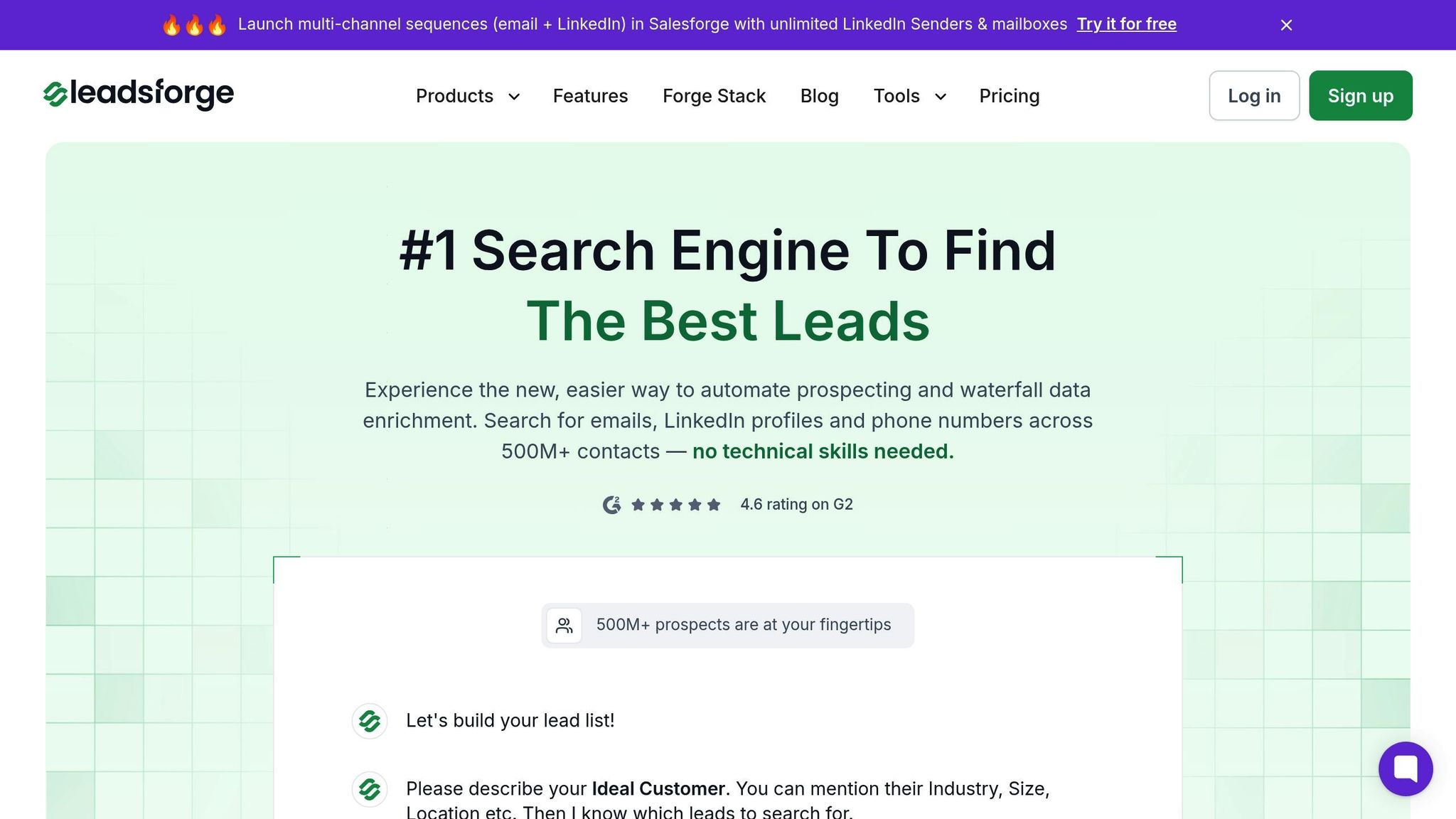
Leadsforge offers a chat-style interface designed to create targeted lead lists by scoring prospects based on firmographic, behavioral, and intent data.
The platform evaluates a variety of factors - like job titles, company size, website activity, and content downloads - to instantly assign scores to leads. For example, if a prospect visits your pricing page repeatedly or downloads key resources like case studies, their score is updated in real time, marking them as a high-priority lead. Research shows that contacting leads within five minutes can increase conversion rates by up to 9× compared to waiting an hour. Additionally, intent signals help gauge buying readiness across multiple channels, while the lookalike search feature uses machine learning to identify prospects similar to your top-performing customers by analyzing historical data. To further enhance scoring accuracy, the system enriches profiles automatically with verified LinkedIn, email, and phone details through its waterfall data enrichment process. This AI-driven approach identifies around 20–30% of leads with genuine buying intent, allowing your sales team to focus on the most promising opportunities.
The scoring data integrates seamlessly with CRM systems for streamlined workflows.
Leadsforge feeds real-time scores and enriched data directly into your CRM, ensuring that prioritized lead lists are always up to date. High-scoring leads can trigger engagement sequences automatically, eliminating the need for manual updates. The system also recalibrates scores based on sales outcomes and changes in prospect behavior.
When paired with Salesforge, the integration becomes even more powerful. With just one click, scored leads are pushed into multi-channel outreach campaigns. AI SDRs then personalize emails and LinkedIn messages based on these dynamic scores. This setup creates a feedback loop where prospect responses refine the scoring model further. The Forge Stack extends the workflow by incorporating tools like Mailforge for managing email infrastructure and Warmforge for optimizing deliverability, consolidating all replies and actions into a single command center.
Leadsforge starts at $49 per month (2,000 monthly credits) or $588 annually (28,000 credits upfront). Credits are flexible - they never expire and roll over, making this pricing structure ideal for small and mid-sized businesses without requiring hefty upfront investments. For reference, one email uses 1 credit, a phone number lookup requires 10 credits, and company follower or lookalike searches cost 1 credit each.
New users receive 100 free credits to get started, and you can add 6,000 extra credits for $40 per month as your lead generation efforts grow. This pricing model brings AI-powered dynamic scoring within reach for teams that previously couldn't afford enterprise tools. Plus, the intuitive, chat-like interface ensures that even beginners can use the platform effectively without a steep learning curve.
To get the most out of dynamic scoring, it's essential to follow these key practices.
Define specific thresholds that signal when it's time for sales to step in. For example, a score of 80 or higher could automatically flag a lead as high-priority. These thresholds should be based on your historical conversion data, helping your team focus on the prospects most likely to convert. This starts with knowing how to build a sales prospecting list efficiently using AI.
Bring together data from every interaction a prospect has with your brand. Pull insights from your CRM, website analytics, email campaigns, and social media platforms like LinkedIn. This approach eliminates blind spots. For instance, imagine a prospect who downloads a case study, visits your pricing page several times, and interacts with a LinkedIn post. By cross-referencing these touchpoints through tools like waterfall enrichment, you can create a detailed profile, leading to more accurate scoring.
Keep an eye on metrics like lead-to-opportunity conversion rates and pipeline velocity to evaluate your scoring model's effectiveness. Regularly compare the AI's predicted conversion rates with actual results, and tweak the model parameters monthly to stay in sync with market changes. Research shows that teams using AI-scored leads build their sales pipelines about 30% faster by zeroing in on high-quality prospects. By continuously refining your scoring model based on past performance, you can ensure it remains effective and aligned with your business goals.
AI-powered dynamic prospect scoring is reshaping how businesses identify and prioritize leads. Unlike older methods that rely on fixed criteria or gut feelings, AI adjusts in real time using live data like website activity, email engagement, and content interactions. This ensures your sales team focuses on prospects with genuine buying intent, rather than wasting time on unresponsive leads.
With an accuracy rate of 85–95%, compared to the 60–75% typically achieved with traditional methods, AI scoring delivers a much sharper edge in lead discovery and engagement.
Leadsforge goes beyond just scoring leads - it also discovers them. Features like lookalike searches and company follower tools enrich profiles with verified LinkedIn, email, and phone details. Starting at just $49 per month for 2,000 credits, it’s designed to be accessible for businesses of all sizes.
Leadsforge works seamlessly with the Forge Stack. Once you've identified and scored your top prospects, you can transition effortlessly to multi-channel outreach using tools like Salesforge, which even includes autonomous AI SDRs like Agent Frank. This integrated system ensures your highest-priority leads flow directly into targeted campaigns, removing the need for manual processes.
Think of dynamic scoring as a continuous journey. By regularly analyzing conversion rates and fine-tuning your models based on real-world performance, you stay ahead in today’s fast-paced B2B environment. This ongoing refinement not only keeps you competitive but also bridges the gap between identifying prospects and converting them into customers.
AI-powered dynamic prospect scoring takes lead evaluation to the next level by analyzing real-time behaviors like website visits, email interactions, content downloads, and changes in firmographics - think funding announcements or recent hires. Unlike traditional static scoring systems that rely on periodic updates, this approach updates instantly whenever a prospect takes action. The result? Sales teams always have up-to-the-minute insights into a lead’s buying intent.
With this real-time scoring, businesses can zero in on the most promising leads, automate timely follow-ups, and customize outreach based on where prospects are in their buying journey. Companies leveraging dynamic scoring often report a 30–50% boost in conversion rates, faster sales cycles, and reduced acquisition costs. Platforms like Leadsforge take it a step further by integrating dynamic scoring with tools for lead generation, data enrichment, and multi-channel outreach. This combination makes it easier to identify and engage high-value prospects, all in one smooth workflow.
AI systems assess and score leads instantly by examining a mix of critical data points. These include behavioral cues such as email opens, link clicks, website visits, and content downloads. They also factor in firmographic and demographic information like company size, industry, and job title. On top of that, intent data - things like recent funding news, new hires, or other major business developments - adds another layer of precision to the scoring process.
This dynamic method, used by tools like Leadsforge, helps you zero in on the leads most likely to convert, saving time and boosting your chances of success.
Leadsforge works effortlessly with top CRM systems like Salesforce, HubSpot, and Microsoft Dynamics using built-in, ready-to-use connectors. When a lead is captured, the platform enriches it with verified information, including email, phone number, company details, and intent signals. It then sends the fully detailed profile - complete with an AI-powered lead score - straight to the CRM in real time.
Any updates, such as changes in engagement, lead scores, or refreshed data, are automatically synced with the CRM. This allows sales teams to streamline workflows, like creating tasks or updating lead stages, without lifting a finger. Leadsforge is part of the Forge Stack, a unified system that brings together lead generation, scoring, enrichment, and outreach to simplify and optimize lead management.