AI-powered lead scoring helps businesses prioritize leads by analyzing real-time data to identify prospects most likely to buy. Unlike static, rule-based methods, AI uses behavioral, engagement, and demographic data to update lead scores instantly, ensuring sales teams can act at the right moment. Here's how it works:
AI systems continuously learn and adjust scores based on new interactions, improving accuracy (85–95%) compared to manual methods (60–75%). This reduces qualification costs by up to 80% and boosts sales productivity. Platforms like Leadsforge simplify implementation with tools for defining customer profiles, integrating data sources, and refining strategies.
Key Benefits:
AI-driven scoring transforms lead management, helping businesses focus on prospects ready to convert while cutting costs and increasing revenue.
AI lead scoring systems rely on three primary types of real-time data to determine which prospects are worth prioritizing. Each type offers unique insights into a lead's potential readiness to buy, and when combined, they provide a well-rounded view of purchase intent.
Behavioral data focuses on what prospects are doing on your digital platforms. AI systems analyze website activity, such as how often someone visits and which pages they explore. For example, a prospect who visits your pricing page multiple times within a week sends a much stronger buying signal than someone casually browsing a blog post. Actions like downloading whitepapers, registering for webinars, or attending online events also carry weight. However, not all actions are equal - downloading a product comparison guide typically signals higher intent than reading a general industry article.
This data is gathered in real time through tools like website tracking scripts, email tracking pixels (to monitor opens and clicks), and third-party intent platforms like G2 and Bombora, which track browsing behavior beyond your site. Together, these behavioral signals provide a rich layer of insight into a prospect's immediate interests and intent.
Engagement metrics reveal how prospects respond to your outreach efforts. Metrics like email opens and click-through rates offer immediate clues about interest levels. For instance, repeated email opens or multiple clicks on links can indicate strong engagement. Social media activity is another key factor, especially on LinkedIn, where AI can track profile views, connection requests, and interactions with your company’s posts.
Conversational AI takes this a step further by analyzing live chat interactions. It evaluates response times, types of questions asked, and even sentiment during conversations. What sets AI apart is its ability to update scores in real time. Unlike traditional systems that rely on batch updates, AI reacts instantly - allowing sales teams to engage with prospects while they’re actively researching, rather than days later when their interest might have waned.
Demographic and firmographic data answers the question: Does this prospect align with our ideal customer profile? AI systems constantly verify details like job titles, company size, industry, revenue, and even the technology stack in use. Unlike static databases, which can become outdated quickly (with decay rates as high as 70% per year), AI ensures accuracy through continuous updates.
Platforms like Leadsforge automate this process, generating verified lead lists based on your ideal customer profile and enriching them with up-to-date LinkedIn, email, and phone number information. AI also keeps track of changes, like job promotions or company growth. For example, a newly promoted VP of Sales at a fast-growing tech firm could suddenly become a top-priority lead. By combining this data with behavioral and engagement insights, AI can distinguish between casual browsers and decision-makers who are ready to take action. These enriched profiles feed directly into the AI’s dynamic scoring algorithms, ensuring sales teams focus on the right leads at the right time.

Traditional vs AI-Powered Lead Scoring: Key Differences and Performance Metrics
AI takes raw data and transforms it into actionable lead scores through three key stages. Each step builds on the last, helping create a detailed and dynamic profile for every prospect.
The process begins with gathering data from various interactions prospects have with your brand. This includes information from CRM tools like Salesforce or HubSpot, website analytics platforms such as Google Analytics, email marketing systems, and enrichment services like Leadsforge. By combining behavioral signals (like website visits and email clicks), engagement data (social media interactions, chat conversations), and firmographic details (e.g., company size, industry, and tech stack), AI builds a comprehensive profile for each lead.
These systems work through automated pipelines, regularly importing and transforming data. For example, some enterprise platforms refresh scores every 12 hours to reflect the latest interactions. Tools like Leadsforge streamline this by automatically enriching lead profiles with verified LinkedIn, email, and phone number details. Once the data is unified, machine learning steps in to uncover patterns and insights.
After data is collected, AI algorithms analyze both past and current behaviors to identify patterns that signal conversion potential. Models like Logistic Regression, Random Forest, and XGBoost are commonly used to handle different types of data and complexities. Supervised learning studies previous deals - both successful and unsuccessful - while unsupervised learning techniques, like clustering, reveal hidden similarities among prospects.
Automated feature engineering pinpoints critical behaviors. For instance, visiting a pricing page three times within 48 hours might increase conversion likelihood by 65%. Ensemble methods enhance prediction accuracy, and Natural Language Processing (NLP) helps interpret sentiment and intent from email exchanges and chat logs. Businesses using AI-powered lead scoring often report a 60–80% reduction in lead qualification costs. This stage ensures that lead scoring remains precise and evolves with customer behavior.
The final stage showcases AI's edge over traditional methods: real-time updates to lead scores. Unlike manual recalculations, AI instantly adjusts scores as new behaviors occur, allowing sales teams to engage with prospects at the peak of their interest rather than days later when enthusiasm fades.
AI models also retrain themselves regularly to counteract "model drift", which happens when predictions lose accuracy due to changing market conditions. This self-learning capability allows the system to adapt to new products, shifting buyer preferences, and seasonal trends - all without manual intervention. Organizations using AI for lead scoring often experience 10–20% revenue growth within the first year, while sales teams spend 30–40% less time on initial qualification. This adaptability ensures sales teams are always acting on the most relevant and up-to-date information.
| Feature | Traditional Lead Scoring | AI-Powered Lead Scoring |
|---|---|---|
| Data Basis | Static attributes (e.g., job title, company size) | Dynamic behavior + firmographics + intent |
| Logic | Manual, rule-based (prone to bias) | Machine learning (pattern recognition) |
| Update Frequency | Periodic/Manual | Real-time/Instant |
| Adaptability | Requires manual rule updates | Continuous learning from new outcomes |
Real-time AI lead scoring offers tangible benefits in three key areas: sales team productivity, response speed, and prediction accuracy. These improvements lead to shorter sales cycles and increased revenue.
AI-powered lead scoring takes the guesswork out of the sales process. Instead of spending hours researching prospects or chasing leads with low potential, sales teams can zero in on high-scoring opportunities. For example, Closely reported that its AI-driven lead qualification process saved each team member an average of 10 hours per week on manual prospecting tasks. That extra time can be redirected toward meaningful conversations with potential clients rather than routine administrative work.
Traditional lead scoring methods typically achieve an accuracy rate of 60–75%, while AI systems reach 85–95% consistently. This higher accuracy reduces wasted outreach efforts and improves deal closure rates. Marketing teams also benefit, as AI-guided nurturing strategies can boost conversions by as much as 20%. These combined efficiencies ensure prospects are engaged more effectively and at the right time.
In B2B sales, actions like visiting a pricing page or downloading a product guide are clear indicators of interest. Real-time scoring identifies these signals immediately, allowing sales teams to act while the lead's interest is at its peak - before competitors can step in.
Apollo.io emphasizes this shift, stating, "AI lead scoring isn't the future; it's the new standard for high-performing sales teams". Businesses using real-time scoring report shorter sales cycles because they connect with prospects at exactly the right moment, improving their chances of closing deals.
Human-led scoring often suffers from bias and inconsistency. AI, on the other hand, removes subjectivity by analyzing thousands of behavioral signals simultaneously, uncovering patterns that manual methods might overlook. It continuously learns from every interaction - whether a win or a loss - automatically refining its predictions.
Unlike static models that quickly become outdated as markets evolve, AI systems adapt in real time. They retrain themselves to account for shifting buyer behaviors, seasonal trends, and changes in product offerings. This adaptability can make a significant impact; for instance, businesses have seen customer churn rates drop by up to 31% when AI scoring is used to flag at-risk accounts early. Over time, the system becomes even more effective without requiring constant manual updates.
| Metric | Traditional Scoring | Real-Time AI Scoring |
|---|---|---|
| Accuracy Rate | 60–75% | 85–95% |
| Update Speed | Manual/Periodic | Instant/Continuous |
| Bias Level | High (subjective judgment) | Low (data-driven) |
| Marketing Conversion Lift | Baseline | Up to +20% |
| Churn Reduction | Baseline | Up to -31% |
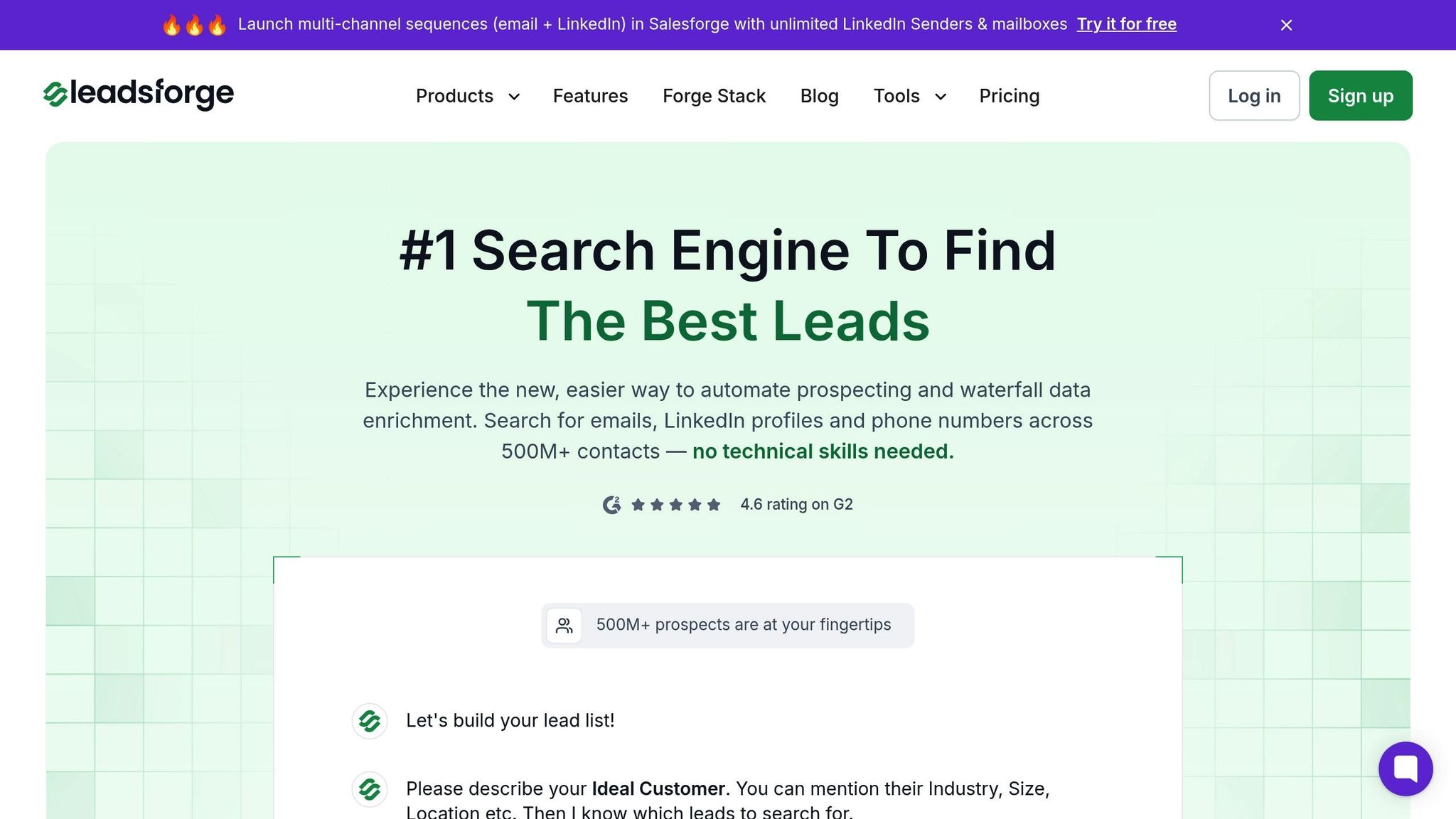
Leadsforge makes it easy to harness AI for real-time lead scoring, even if you’re not a data scientist. Its chat-like interface allows you to describe your ideal customer using simple inputs, while the platform handles the technical complexities. The process boils down to three key steps: defining your ideal customer profile, connecting the right data sources, and fine-tuning your approach based on results.
Start by analyzing your best customers to create a detailed profile of your ideal lead. Look at firmographic data like company size, industry, and revenue, as well as behavioral signals such as engagement with your content. Leadsforge’s lookalike search feature can then identify similar prospects automatically, saving you hours of manual work.
For example, if your top customers are SaaS companies with 50–200 employees that have recently secured Series A funding, input these specifics into the platform. You can also refine the profile further by including job titles, tech stacks, or growth signals. Once you’ve nailed down these details, integrate real-time data sources to enrich your insights.
Leadsforge pulls from a variety of data sources to build comprehensive profiles. First-party data - like CRM records and website activity - captures direct engagement with your brand. Third-party signals, such as funding news or job postings, provide insights into a prospect’s budget and organizational changes. Leadsforge keeps this data fresh and accurate by automatically verifying and updating contact details.
Take UniteSync as an example. By integrating the Forge stack, they achieved an impressive 85.26% positive reply rate and a customer acquisition cost of just $2.86. Their success came from connecting real-time data sources to pinpoint decision-makers at the perfect moment. Similarly, VAI Consulting used Leadsforge’s AI-powered SDR tool to test new market strategies, secure qualified calls, and maintain strong brand positioning.
Here’s how different data sources contribute to lead scoring:
| Data Source Type | Examples | Impact on Scoring |
|---|---|---|
| First-Party | CRM records, Website visits, Email clicks | Indicates high intent and direct engagement |
| Third-Party | Funding news, Tech stack, Job postings | Shows contextual intent, such as budget availability |
| Social | LinkedIn updates, Professional milestones | Highlights the best timing to reach out |
| Firmographic | Company size, Revenue, Industry | Ensures the lead aligns with your ideal customer profile |
Once your system is up and running, it’s essential to monitor and refine it regularly. AI-powered lead scoring isn’t a “set it and forget it” tool - it requires ongoing adjustments to stay effective. Review your model quarterly to identify and address false positives and negatives. Companies that treat lead scoring as a dynamic process often see conversion rates improve by around 25%.
"Lead scoring is not just a marketing metric; it is a pact between sales and marketing. When both teams co-author the rules, they share ownership of the outcome." – Ami Heitner, Author
Track how leads progress through your funnel and implement score decay for inactive leads. For example, automatically lower the scores of leads that haven’t shown activity in 30–60 days. This keeps your pipeline focused on prospects who are actively engaged. Document all changes to your scoring system along with their business rationale. Adobe, for instance, improved its sales acceptance rates by 30% by aligning lead definitions across teams and maintaining consistent handoff processes.
AI-powered real-time lead scoring is revolutionizing how businesses prioritize leads. By reducing wasted efforts on low-priority leads, teams can focus on prospects that are more likely to convert, leading to higher deal closure rates. What sets this approach apart is its ability to continuously learn and adapt from every interaction, instantly adjusting scoring models. Unlike static rules that quickly become outdated, AI-driven systems evolve in tandem with your business needs.
Another major advantage is real-time data processing, which helps identify prospects when their interest is at its peak. This means your sales team can act quickly, improving response times and boosting conversion rates. The shift from traditional lead scoring to AI-powered systems isn’t just about better metrics - it’s about creating a smarter, more responsive strategy that adapts with every interaction. This dynamic system ensures your team can take action right when it matters most.
Leadsforge takes the complexity out of implementing AI-powered lead scoring. New users can sign up and receive 100 free credits to test the platform’s search and verification tools. Simply describe your ideal customer in the chat interface, and the AI will handle the rest, from prospect scoring to prioritization.
For ongoing use, the Essential Plan starts at $49 per month, offering 2,000 export credits. Alternatively, opt for the annual plan at $588 per year, which includes 28,000 credits. Monthly rolling credits ensure you get the most out of your subscription. By connecting your CRM, you can sync leads and use intent signals to prioritize outreach effectively. Start by analyzing your best-performing customers, use the lookalike search feature to find similar prospects, and refine your strategy based on real-world results.
AI transforms lead scoring by employing machine learning to evaluate real-time data, such as website interactions, email engagement, firmographics, and intent signals. Unlike older methods that depend on fixed rules and occasional updates, AI constantly adjusts to shifts in a prospect's behavior, offering fresh insights into their purchasing intent.
This adaptive system removes guesswork and reduces bias, enabling businesses to prioritize high-value leads with greater accuracy. Companies using AI for lead scoring often experience tangible benefits like improved sales efficiency, better conversion rates, and reduced customer acquisition costs. Tools like Leadsforge take this even further, automating the entire process and delivering highly focused, sales-ready leads. This lets sales teams concentrate on what truly drives results - closing deals.
AI uses a mix of real-time data sources to calculate lead scores with precision. This includes internal data - like CRM records and purchase history - alongside behavioral data such as website visits, email engagement, content downloads, and LinkedIn activity. It also factors in firmographic and technology details, like company size or the tools a business uses. On top of that, intent signals - such as announcements about funding or recent hiring trends - help pinpoint prospects that are worth prioritizing.
Platforms such as Leadsforge leverage these insights to guide sales teams toward the most promising leads, simplifying workflows and improving overall productivity.
Leadsforge leverages AI and real-time data to evaluate leads, assigning scores based on their potential to convert. This allows businesses to zero in on the most promising prospects. By tracking real-time actions like website visits and email interactions, along with firmographic details like company size and industry, Leadsforge creates dynamic scores that adjust instantly as new information becomes available.
To get started with AI-powered lead scoring, businesses can use Leadsforge to enhance raw contact lists with enriched data. The platform’s AI model then calculates lead scores, making it easy to categorize leads into different priority levels. High-priority leads can be immediately engaged through multi-channel outreach, while lower-priority leads are nurtured over time. This streamlined approach removes the guesswork from lead management and helps businesses achieve better sales results, offering a practical, data-driven tool for companies across the U.S.