AI retargeting transforms how B2B businesses engage potential customers. By leveraging machine learning and real-time data, it tailors ads based on user behavior, job roles, and intent, ensuring prospects see relevant messaging at the right time. Here's why it matters and how it works:
To succeed, focus on intent-based segmentation, fresh creative updates, and unified messaging across channels. Avoid common pitfalls like over-targeting or using outdated data. Tools like Leadsforge streamline this process by providing verified, high-quality leads and actionable insights. AI retargeting ensures your efforts are efficient, data-driven, and impactful.
AI takes the guesswork out of lead prioritization by analyzing data points like job titles, company size, behavior, and past purchases. It assigns a numerical value to each lead, predicting their likelihood to convert. This approach allows your team to channel retargeting budgets toward high-value accounts instead of wasting resources on leads that are unlikely to engage.
Did you know that 54% of businesses already use predictive AI for lead generation? By identifying prospects who show genuine buying signals, you can increase ad spend for those accounts while scaling back on low-probability leads.
Platforms such as Leadsforge streamline this process by combining predictive scoring with real-time data updates. Unlike tools that rely on outdated, static databases, Leadsforge continuously refreshes scores based on how prospects interact with your content. This ensures your retargeting dollars are spent on the right audience at the right time. Beyond scoring, AI taps into real-time user behavior to fine-tune personalization even further.
Building on predictive scoring, AI tracks every move a prospect makes - whether they’re downloading a whitepaper, watching a product demo, or repeatedly visiting your pricing page. These actions reveal their needs and how close they are to making a purchase. AI uses this behavioral data to craft retargeting campaigns that feel highly personalized.
For instance, you can set up custom feeds to monitor visits to high-intent pages like pricing or "buy now" sections. This allows you to trigger immediate outreach or track engagement with specific content using unique URLs.
Unlike traditional methods, which rely on broad role-based targeting and basic personalization (like adding a first name), AI-driven behavioral retargeting digs deeper. It leverages real-time actions and intent signals to deliver messages that address specific pain points. Plus, AI ensures data accuracy with live verification and enrichment, eliminating the need for manual updates.
Intent signals are like breadcrumbs leading you to where prospects are in their buying journey. For example, a CFO downloading an ROI calculator signals a different level of interest than someone casually reading an industry blog. AI identifies these signals - whether it’s a product search, competitor comparison, or pricing page visit - and tailors retargeting messages accordingly.
Personalized campaigns based on intent signals can deliver 40–50% higher click-through rates and conversion boosts compared to generic messaging. In one LinkedIn video retargeting test, high-intent viewers drove a 20% increase in trial signups.
To make the most of intent signals, segment your audience by their level of interest:
The key is matching your content to the prospect's intent. Use educational materials for those at the top of the funnel, case studies for the middle, and social proof or demos for those closer to conversion.
As third-party cookies are phased out, B2B marketers are leaning more on first-party data - like website activity, video engagement, and CRM-based account lists - to inform retargeting strategies. This shift makes intent signal detection even more essential for success.
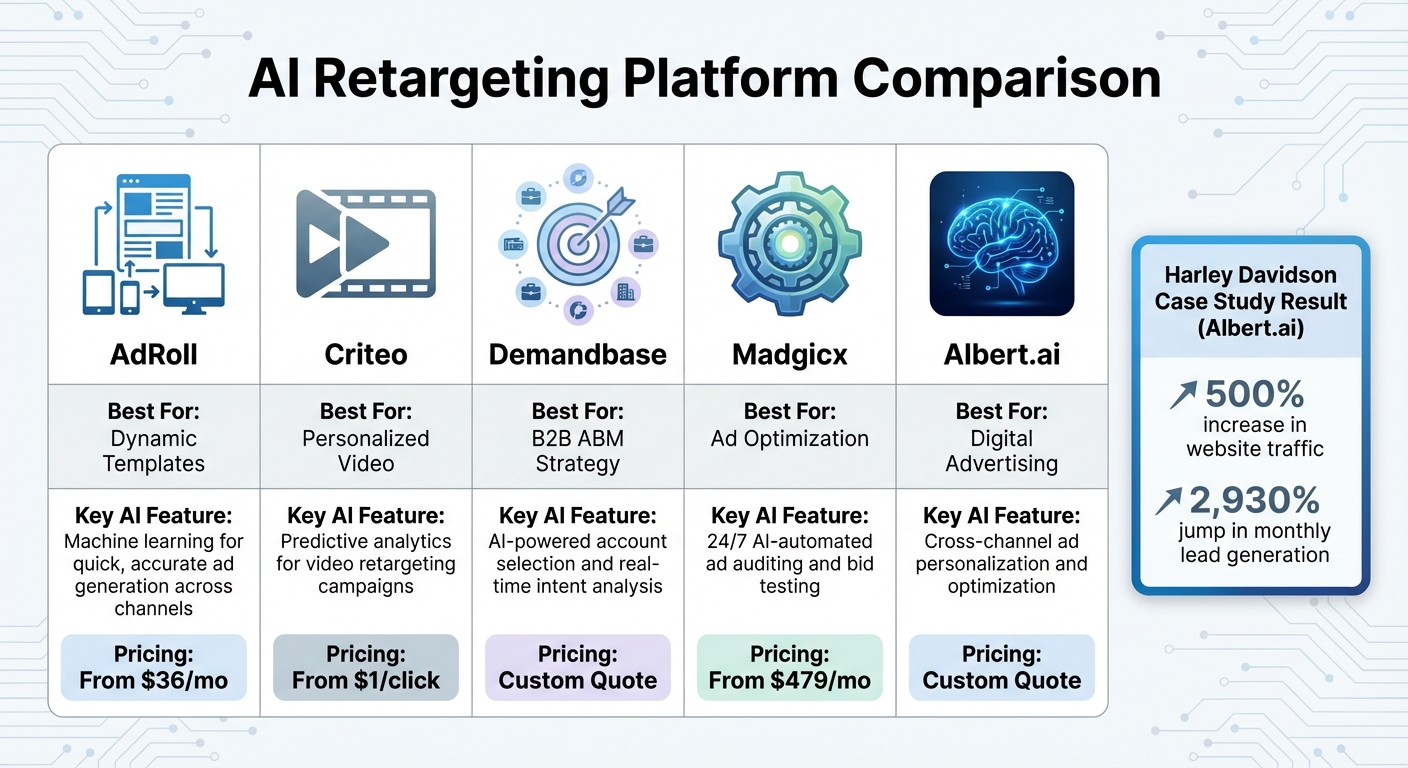
AI Retargeting Platform Comparison for B2B Lead Generation
Selecting the right AI retargeting platform is a game-changer for B2B campaigns. AdRoll leads the pack with its dynamic retargeting templates and a cross-channel performance dashboard. This tool lets you manage ads across Google, social media, and over 500 other platforms seamlessly. Meanwhile, Criteo takes a different route, using its AI engine to track visitor behavior and predict engagement. Its personalized video retargeting and automated display ads make it a strong contender.
For teams invested in account-based marketing, Demandbase provides a comprehensive ABM platform. It uses AI predictive scoring to rank accounts by their likelihood to convert, combined with real-time intent signals. On the other hand, Albert.ai focuses on scaling personalized and optimized ad content across platforms like Facebook, YouTube, and Google Ads. Harley Davidson, for instance, saw a 500% increase in website traffic and a staggering 2,930% jump in monthly lead generation after adopting Albert.ai.
Rounding out the list is Madgicx, known for its multi-functional approach. It offers 24/7 AI-driven ad auditing and autonomous budget management, making it a powerful tool for ad optimization. Each platform has its unique strengths, so the right choice depends on your specific goals and budget.
Here’s a quick look at how these platforms stack up:
| Platform | Best For | Key AI Feature | Pricing |
|---|---|---|---|
| AdRoll | Dynamic Templates | Machine learning for quick, accurate ad generation across channels | From $36/mo |
| Criteo | Personalized Video | Predictive analytics for video retargeting campaigns | From $1/click |
| Demandbase | B2B ABM Strategy | AI-powered account selection and real-time intent analysis | Custom Quote |
| Madgicx | Ad Optimization | 24/7 AI-automated ad auditing and bid testing | From $479/mo |
| Albert.ai | Digital Advertising | Cross-channel ad personalization and optimization | Custom Quote |
When choosing a platform, it’s essential to implement strategies like frequency caps to avoid ad fatigue and use creative rotation to keep ads engaging. Integration capabilities are also worth considering. For instance, HubSpot Marketing (starting at $800/month) offers robust CRM integration, though its workflow automation can be challenging to navigate.
For a more streamlined approach, Leadsforge offers a unique solution to AI retargeting.

Leadsforge takes a distinct approach to AI retargeting, prioritizing simplicity and precision. Unlike platforms that rely on manual filtering, Leadsforge uses a conversational AI interface. You simply describe your ideal customer in plain language, and the platform generates highly targeted, verified lead lists, enriched with real-time data.
| Feature | Leadsforge | ZoomInfo | Apollo.io | Lusha |
|---|---|---|---|---|
| Interface | AI Conversational (Chat) | Complex Filters | Traditional Search | Simple Extension |
| Automation | Full End-to-End | Partial/Manual | Partial | Manual |
| Verification | Real-time Waterfall | Static/Inconsistent | Inconsistent | Inconsistent |
| Best For | Fast, verified leads | Enterprise-level data | All-in-one outreach | Individual SDRs |
What sets Leadsforge apart is its real-time data enrichment. The platform continuously verifies LinkedIn profiles, email addresses, and phone numbers, ensuring accuracy. It also detects intent signals, helping you segment high-intent prospects (like pricing page visitors) from low-intent ones (such as blog readers).
At just $49/month for the Essential Plan (or $588/year), Leadsforge provides 2,000 monthly credits, making it a budget-friendly alternative to enterprise platforms. It also integrates seamlessly with Salesforge for multi-channel outreach, creating a smooth workflow from lead discovery to conversion. Plus, new users get 100 free credits to try out how AI-powered retargeting can elevate their B2B campaigns, combining behavioral insights with predictive strategies for success.
To get the most out of AI-driven retargeting campaigns, start by installing tracking pixels like the LinkedIn Insight Tag, Meta Pixel, or Google Ads Tag. These tools lay the foundation for accurate tracking, which is essential for effective retargeting.
When segmenting your audience, consider intent-based tiers. For example, high-intent prospects are those who visit pricing or demo pages, while mid-funnel users might engage with case studies or webinars. On the other hand, low-intent visitors typically interact with blog content only. Add an extra layer of segmentation by grouping users based on recency, such as 0–30 days, 31–90 days, and 91–180 days. This allows you to focus more of your budget on recent visitors who are more likely to convert.
Keep your ad creative fresh by updating it every 14–21 days. Split your budget evenly between educational content and direct offers. While it's tempting to push hard sales, avoid turning every ad into a pitch. A balanced approach - offering value while encouraging conversions - keeps your audience engaged.
Integrate your retargeting data with your CRM. This enables your sales team to act on digital signals quickly. For instance, if a prospect repeatedly visits your pricing page or watches over 50% of a product video, initiate a retargeting sequence and follow up with sales outreach within 24–48 hours. By aligning marketing and sales efforts, you can turn digital activity into meaningful conversations. Also, prioritize mobile retargeting - mobile campaigns often yield 60% higher engagement and 30% lower CPC than desktop. To capitalize on this, optimize your landing pages for speed and adopt vertical creative formats.
By following these practices, you can set your campaign up for success and avoid common mistakes that could derail your efforts.
Even with a strong strategy, there are common missteps to watch out for. One major mistake is treating every visitor like they're ready to book a demo. Keep in mind that only about 2% of website visitors convert on their first visit. Applying aggressive offers across the board not only wastes your budget but also frustrates potential customers who aren't ready to commit. Instead, use intent-based tiers and set frequency caps - 3–5 impressions per week on LinkedIn and 7–10 on Google Display - to prevent ad fatigue.
Another common issue is running retargeting campaigns in isolation. Disconnected messaging between ads, sales emails, and your website can confuse prospects and erode trust. Ensure that all touchpoints - ads, emails, and calls - deliver a unified message. It's equally important to exclude irrelevant audiences like existing customers, competitors, partners, and disqualified leads. Without these exclusions, you're wasting resources on people unlikely to convert.
"AI is only as good as the data it's trained on." – Ben Crouch, Author, Gripped
Over-relying on automation can also backfire. While AI tools are powerful, they can't compensate for a weak value proposition or a poorly defined product. Before diving into AI, take the time to establish clear buyer personas and craft strong messaging. Privacy concerns are another potential hazard. Ads that reference specific user behaviors too directly can come across as invasive. Instead, focus on addressing user needs and solving problems without making your audience feel like they're being watched. Always ensure compliance with regulations like GDPR, working with legal teams to set up consent-based data collection and transparent opt-out options.
Lastly, don’t overlook the importance of data quality. Outdated or inconsistent data can lead to inaccurate targeting and wasted ad spend. Regularly clean and update your database to maintain accuracy. Tools like Leadsforge can help by verifying LinkedIn profiles, email addresses, and phone numbers in real time, ensuring your campaigns are built on reliable information. Solid data is the backbone of any successful retargeting effort.
When it comes to retargeting campaigns, the right metrics make all the difference between wasted spend and meaningful results. Instead of focusing on vanity metrics, prioritize downstream pipeline metrics like Cost per Sales-Qualified Lead (SQL), Cost per Meeting Booked, and pipeline-influenced revenue. These numbers reveal whether your retargeting efforts are actually moving prospects closer to becoming customers.
It’s also essential to break metrics down by intent tiers. For instance, high-intent prospects - like those visiting pricing or demo pages - should convert at much higher rates than casual blog readers. If that’s not happening, it could signal an issue with your offer or messaging. Another key metric is the percentage of leads that align with your Ideal Customer Profile (ICP). AI-driven retargeting should improve the quality of leads, not just the quantity. For example, LinkedIn Lead Gen Forms typically achieve a 13% conversion rate for retargeted audiences, offering a useful benchmark to measure against.
Engagement metrics, like Click-Through Rate (CTR), still play an important role. Retargeting ads generally see CTRs around 0.7%, which is significantly higher than standard display campaigns. If your CTR is falling short, it may be time to experiment with fresh creative ideas or refine your audience segmentation. Don’t overlook mobile retargeting either - it tends to deliver 60% higher engagement and 30% lower cost-per-click compared to desktop, making it a smart choice for reaching busy professionals.
Once you’ve established your metrics, the next step is to continuously optimize your strategy.
Optimization isn’t a one-and-done process - it’s an ongoing cycle of testing, learning, and improving. One effective tactic is creative rotation. Businesses that update their ad creatives every 14–21 days have seen a 28% drop in cost-per-qualified-lead and a 1.7x increase in opportunity-to-close rates. Testing different messaging angles - like pain-point-driven, outcome-focused, or social proof - can also help you find what resonates most with your audience.
A/B testing is another essential tool. Use it to fine-tune elements like calls-to-action for high-intent visitors or downloadable resources for mid-funnel prospects. Adjusting retargeting windows can also make a big impact - try 7–30 days for high-intent leads and 30–90 days for nurturing less engaged prospects.
Make sure to feed engagement data directly into your CRM. This allows your sales team to act quickly when prospects repeatedly engage with high-intent content, signaling they’re ready for outreach. In this way, retargeting shifts from being a passive strategy to an active driver of pipeline growth. To avoid overwhelming your audience, stick to frequency caps: 3–5 weekly impressions on LinkedIn and 7–10 on Google Display.
This iterative approach is more than theory - it’s proven in practice.
Leadsforge offers a great example of how integrating accurate data and ongoing optimization can elevate retargeting performance. The platform ensures data reliability by verifying LinkedIn profiles, email addresses, and phone numbers in real time. When paired with Salesforge's Agent Frank, Leadsforge automates personalized outreach based on retargeting engagement, creating a seamless transition from digital ads to direct sales conversations.
Additionally, Leadsforge’s intent signal tracking allows you to segment audiences based on firmographic data, behavioral patterns, and ICP alignment. This level of precision ensures your retargeting efforts focus on the accounts most likely to convert. The result? Higher-quality leads at a lower acquisition cost - exactly what every B2B retargeting campaign should aim to achieve.
AI has reshaped how B2B companies handle retargeting, transforming it from a manual, generic process into one driven by hyper-personalized outreach at scale. AI tools now create tailored messages across channels like email, LinkedIn, and even voice, achieving levels of personalization that manual efforts simply can't match. The results speak for themselves: retargeting can improve conversion rates by 278%, and B2B retargeting consistently outperforms B2C by 147%. On top of that, businesses using AI for lead generation have cut costs by 60%, making it a smart choice for both effectiveness and efficiency.
The secret lies in unified data systems. Modern AI platforms bring together first-party engagement data and third-party insights, eliminating the fragmented data silos that often hinder traditional approaches. This means your campaigns don’t just reach more people - they reach the right people at the right time. A great example is Guild Mortgage, which used AI tools in Q1 2025 to prioritize high-value leads and automate follow-ups. The result? Faster lead response times and quicker deal closures.
"Keeping up with demand in this increasingly competitive landscape wouldn't be possible without technology." – Gemma Currier, Senior Vice President of Retail Sales Operations at Guild Mortgage.
By combining behavioral personalization with predictive lead scoring, AI-powered retargeting ensures your campaigns target high-quality leads efficiently. These results highlight why adopting AI tools now is a strategic move for any business.
Ready to take advantage of AI-powered retargeting? Here’s how to get started:
Platforms like Leadsforge make this process easier. You can define your ideal lead - say, "CTOs at Series B SaaS companies" - in plain language, and the tool generates verified lists instantly. Pair this with Salesforge’s Agent Frank to automate personalized outreach based on retargeting engagement. With real-time verification of LinkedIn profiles, email addresses, and phone numbers, these tools ensure your efforts focus on accurate, high-quality leads.
AI transforms B2B retargeting by analyzing visitor behavior in real time to pinpoint the ideal audience, craft tailored messages, and determine the perfect timing. Using machine learning, it segments leads based on actions like visiting specific pages or downloading resources. It also adjusts ad content on the fly and ensures budgets are allocated toward high-value prospects rather than wasting resources on low-priority traffic.
Platforms such as Leadsforge take this to the next level. They combine AI-powered retargeting with enriched lead data, intent signals, and lookalike audience profiles. With Leadsforge, you can describe your ideal customer, and the platform generates highly targeted lead lists while automating ad campaigns and outreach efforts. Unlike generic tools, Leadsforge integrates smoothly with complementary platforms like Salesforge and Mailforge, creating an efficient workflow. This approach not only boosts ROI but also keeps your brand actively engaged throughout the often-complex B2B buying journey.
To segment B2B audiences effectively using intent signals, start by pinpointing clear intent indicators. These can include direct actions like demo requests or visits to pricing pages, as well as subtler behaviors such as engagement on social media or changes in their tech stack. Combine your first-party data with insights from third-party sources to build a well-rounded picture of a lead's interest.
Leverage AI-powered tools to score and categorize leads into high-, medium-, and low-intent groups based on their real-time actions. Enhance these segments further with firmographic details like company size, industry, and revenue. For instance, you might focus on mid-sized SaaS companies that are actively exploring specific features or researching competitors.
Keep in mind that intent signals can shift quickly, so it’s critical to update your segments regularly. Automated workflows can simplify this process, allowing you to re-score and reassign leads in real time. Align your outreach with where leads are in the buyer’s journey - high-intent leads should receive decision-focused content like case studies, while low-intent leads might benefit more from educational materials like webinars. By taking these steps, you can create dynamic, targeted segments that enhance retargeting efforts and boost conversions.
AI-powered retargeting is reshaping how B2B companies generate leads. By analyzing user behavior and predicting buying intent, it allows businesses to deliver personalized and timely outreach. Tasks like audience segmentation and ad optimization are automated, ensuring your brand remains visible throughout the often lengthy B2B buying process - all while cutting down on unnecessary spending.
Here are some standout platforms for AI-driven retargeting:
For businesses in the U.S., Leadsforge stands out as an all-in-one solution. By combining lead generation, data enrichment, and multi-channel outreach, it offers a streamlined and cost-effective strategy for B2B retargeting success. When paired with Salesforge, it becomes an even more powerful tool for driving conversions.